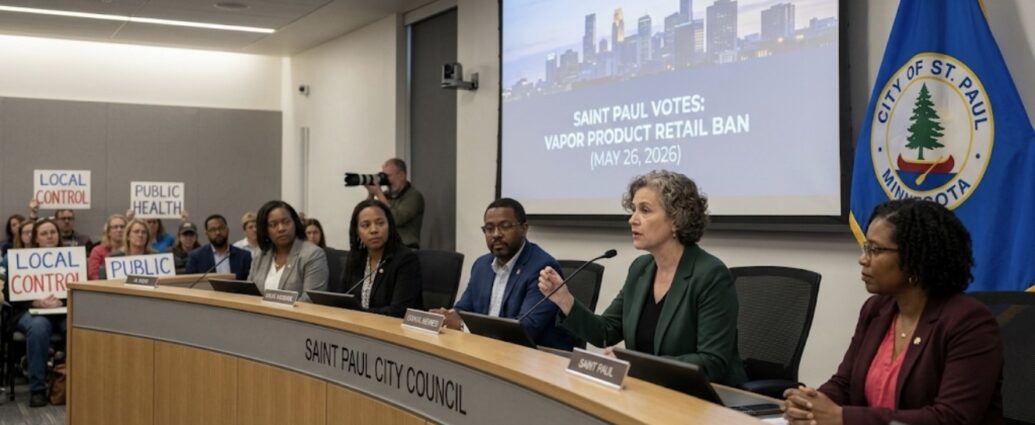
St. Paul — Local municipal assemblies across Minnesota began enacting comprehensive emergency bans on non-tobacco vapor products on May 26, 2026, directly challenging the U.S. Food and Drug Administration’s recent regulatory pivot that authorized sweet flavors. Association of Minnesota Cities Executive Director Luke Fischer confirmed that local city councils are executing a coordinated regional intervention following a highly controversial federal policy overhaul. The escalating bureaucratic standoff signals a severe constitutional clash over commercial preemption, as state-level health authorities aggressively move to block physical retail distribution channels after the White House systematically relaxed restrictions to clear multi-national alternative nicotine lines.
The localized regulatory counter-offensive is a direct reaction to an unprecedented federal policy shift finalized earlier this month. The FDA granted historic marketing orders to Los Angeles-based manufacturer Glas Inc., officially authorizing the sale of its Gold (mango) and Sapphire (blueberry) liquid pods at a high-potency 50mg/ml concentration. In subsequent directives drafted days before the sudden resignation of former FDA Commissioner Marty Makary, the agency published broad “enforcement discretion” guidelines. These measures effectively shield non-vetted electronic cigarettes and nicotine pouches from federal asset seizures provided the products remain under active “scientific review.” Senior agency officials confirmed to the press that executive leadership largely bypassed traditional internal vetting protocols, a maneuver that public health agencies argue has directly flooded regional retail markets with unregulated, child-appealing fruit profiles.
For consumer goods distributors and institutional tobacco investors, the localized legislative resistance introduces a significant layer of operational volatility. Shares of major domestic alternative nicotine manufacturers, including Juul Labs and Vuse parent company Reynolds American, retreated from their mid-week highs as equity analysts at Cowen & Co. downgraded near-term retail growth projections for the Upper Midwest. Financial models indicate that if municipal blockades successfully isolate major metropolitan markets like Minneapolis and Duluth, the projected revenue gains from tech-enabled age-gating infrastructure could be entirely neutralized by localized enforcement fines. While the FDA defended its national authorization by citing Glas Inc.’s Bluetooth-enabled smartphone authentication protocols as a sufficient barrier to underage acquisition, state lawmakers are rejecting the digital safeguards as an unproven corporate defense mechanism.
Public health tracking metrics compiled by the Truth Initiative and the Campaign for Tobacco-Free Kids have added significant momentum to the local banning movement. Regional enforcement data shows that sweet and fruit profiles comprise roughly 63% of all youth nicotine initiation vectors, with adolescent consumer demand heavily indexing toward unauthorized disposable brands like Geekbar. Municipal leaders in Minnesota argue that the federal government’s newly established enforcement loopholes make it impossible for local police departments to effectively monitor retail store compliance, leaving city-level zoning laws as the only viable mechanism to suppress adolescent consumption patterns.
The legal architecture governing the tobacco trade is subsequently bracing for a high-stakes corporate challenge. Attorneys representing regional convenience store coalitions and specialized vape distributors have already signaled intentions to file for immediate injunctions against the municipal bans, arguing that state-level prohibitions directly violate the Supremacy Clause of the U.S. Constitution given the FDA’s explicit federal marketing orders. However, localized legal teams intend to rely on historical judicial precedents that preserve the statutory right of individual municipalities to enforce stricter public safety ordinances than those mandated by Washington.
As the administrative gridlock deepens, the broader commercial landscape for alternative consumer products is facing systemic fragmentation. Multi-national tobacco conglomerates are watching the midwestern test cases closely to determine whether to invest capital into compliance engineering for state-by-state supply chains or completely suspend localized shipments until federal courts rule on the limits of city-level preemption. With the FDA currently operating under an interim, unconfirmed leadership structure following Makary’s departure, the lack of a centralized federal regulatory enforcement strategy ensures that the legal and commercial warfare between state assemblies and the alternative nicotine sector will intensify throughout the upcoming fiscal quarter.
JBizNews Desk | Midwest
© JBizNews.com. All rights reserved. This article is original reporting by JBizNews Desk. Unauthorized reproduction or redistribution is strictly prohibited.