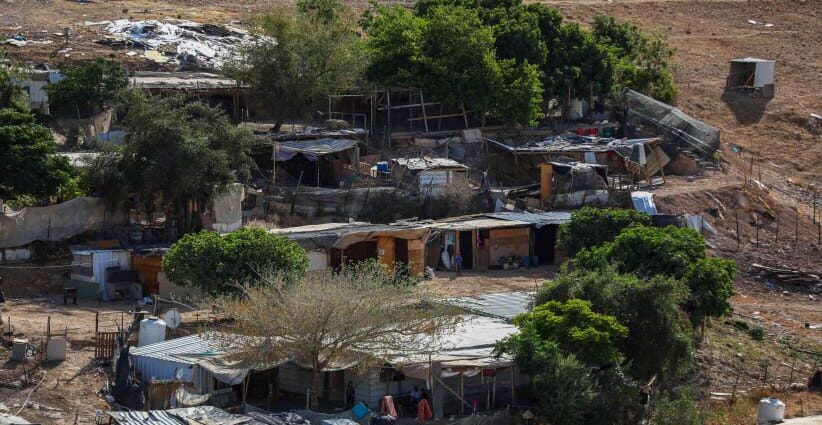
The state told the High Court of Justice on Wednesday that Bedouin Palestinian residents of Ras Ein al-Auja may return to the Jordan Valley community in coordination with the army, but said there is currently no basis to close the area to Israelis, station a permanent security force there, or allow residents to hire a private security company.
The update, filed by the State Attorney’s Office on behalf of the IDF’s West Bank commander, the Civil Administration, and Israel Police, follows a February High Court decision ordering authorities to assist the residents’ return to a defined area of Ras Ein al-Auja and report back on enforcement measures taken to ensure security there.
The case concerns Ras Ein al-Auja, a Bedouin Palestinian herding community north of Jericho whose residents say they were effectively pushed out after months of sustained settler harassment, grazing takeovers, blocked access routes, damage to infrastructure, intimidation, and livestock theft.
The state has rejected the characterization of the events as forcible displacement, arguing in earlier proceedings that no formal eviction took place, that residents were not barred from returning, and that security forces operate in the area to prevent friction and respond to complaints.
In its latest filing, the state said it had sent the petitioners’ attorney, Shlomo Lecker, a response on Tuesday to letters he had sent in February and March. According to the state, the handling of those letters was delayed after the Iran operation began on February 28, and relevant military officials were required to address the security situation in the area.
The state said the residents may coordinate their return at least seven days in advance, so that military officials can accompany them for the first several hours after they arrive. If exceptional incidents occur in real time, the state said, residents can contact the police emergency hotline.
The state rejected a request to station a permanent police force in the area
The military commander’s position, the state stressed, is that there is no legal obstacle preventing the petitioners or other residents of the Ras Ein al-Auja cluster from coming to the site. It added that no private civilian actor has the authority to order them to leave or to act independently to force them out.
At the same time, the state rejected several of the practical protections sought by the petitioners.
Lecker had asked that the area of the residential cluster be declared a closed military zone for Israelis only.
The state said that, after a renewed review by officials in the Jordan Valley and the local brigade, no current justification was found for such a step. However, it added that if circumstances change, the matter may be reconsidered.
The state further said that if friction develops after the residents return, the relevant military officials intend to issue such a closure order, subject to their operational judgment at the time.
The state also rejected the request to station a permanent military or police force in the area.
It said military officials found no justification for such a step, citing available resources, the operational tasks before them, the expected benefit of a permanent presence, and the possibility of achieving that benefit through other means, including forces arriving after reports from the field.
The state further rejected the petitioners’ alternative request to allow them to hire a private civilian security company. It said operational forces deployed in the sector provide a response to incidents in the area, including violent incidents.
The filing did not specify what legal or operational approval would be required for such a company, or why that specific option was unavailable beyond the state’s position that it was unnecessary.
On illegal construction, the state said the Civil Administration had already issued a stop-work and demolition order in November 2025 regarding construction in the compound and the opening of a road, which it said were located on government property.
The state added that nothing in its letter determines the legality of any particular structure or authorizes construction contrary to the law in the area. It noted that, from the outset, the structures built in the cluster were illegal construction.
The High Court’s February decision did not make factual findings on who was responsible for the residents’ departure, nor did it adopt the petitioners’ full legal framing.
It also did not order the dismantling of outposts, declare the area closed to Israelis, or issue a permanent injunction. Instead, it took the narrower step of requiring assistance with return, subject to advance coordination, and a follow-up update on enforcement.
Israeli and international reports have also documented the broader circumstances around Ras Ein al-Auja.
HaMakom reported in February that the community’s situation had deteriorated significantly after the establishment of a nearby grazing outpost, while the Associated Press reported in January that more than two dozen families had fled amid escalating harassment and violence by settlers from unauthorized outposts.
For now, the state’s position leaves the next move with the petitioners: whether to coordinate a return under the framework offered, or return to the court and argue that the proposed measures do not meaningfully implement the February ruling.