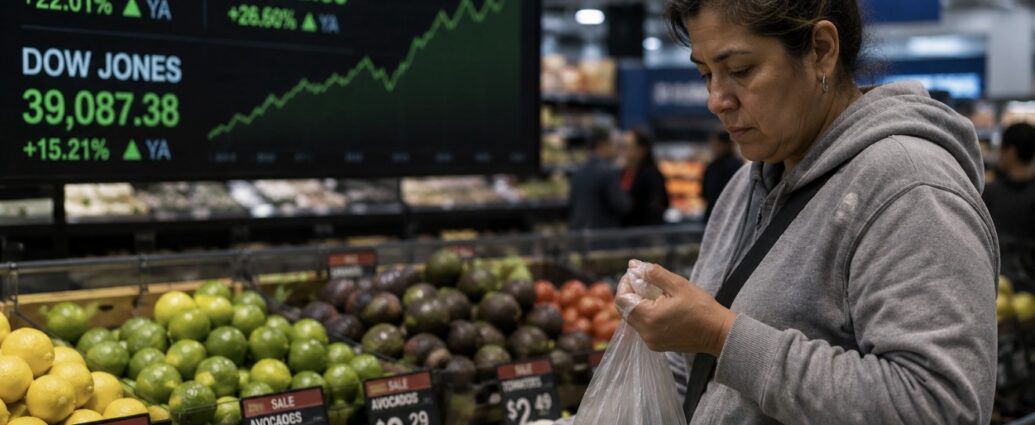
The U.S. economy is increasingly moving along two different paths, with economists saying the stock market’s powerful rally is benefiting wealthy households far more than the average American. As of Monday, June 29, 2026, a small share of higher-income households is driving much of the nation’s discretionary spending while many middle- and lower-income families continue facing tighter budgets.
The numbers behind the divide are striking.
The S&P 500 has gained approximately 22% over the past year, 76% since 2023, and more than 327% over the past decade. Those gains have significantly increased household wealth for investors who own stocks, encouraging greater spending on travel, dining, luxury goods, and other discretionary purchases.
Michael Pearce, chief U.S. economist at Oxford Economics, said rising stock prices have become a major driver of spending among older and wealthier households, which account for more than half of discretionary consumer spending.
Because stock ownership is heavily concentrated among higher-income Americans, the spending generated by those gains is concentrated as well.
Joe Brusuelas, chief economist at RSM US, estimates that roughly 75% of the consumer spending fueled by the recent market rally comes from the nation’s top 20% of earners. He estimates the wealth effect created by higher stock prices generated approximately $53 billion in additional consumer spending over the past year.
According to the Federal Reserve Bank of Dallas, the highest-earning 20% of households now account for roughly 57% of all consumer spending in the United States.
Much of that financial strength extends beyond the stock market.
Higher-income households are also more likely to own homes and to have locked in mortgage rates below 3% during the pandemic, allowing them to benefit from rising home values while avoiding today’s higher borrowing costs.
Economists say the concentration of spending creates both opportunity and risk.
Consumer spending remains the largest driver of U.S. economic growth. If a relatively small group of wealthy households accounts for an outsized share of that spending, any significant decline in financial markets could have a broader economic impact.
Heather Long, chief economist at Navy Federal Credit Union, has described today’s economy as increasingly “K-shaped,” with wealthier Americans continuing to prosper while many others struggle with higher living costs.
Despite widespread pessimism, spending has remained surprisingly resilient.
The Bank of America Institute reports that consumer spending continues to outpace last year across many income levels even though surveys show consumer confidence remains historically weak. Economists say affluent households are spending because their investment portfolios continue reaching new highs, while many lower-income households are relying more heavily on tighter budgets and increased borrowing.
Another concern is the concentration within the stock market itself.
Technology companies now account for roughly one-third of the S&P 500’s total value, while semiconductor companies tied to artificial intelligence represent an increasingly large share of overall market gains. That means much of the recent wealth creation depends on the continued performance of a relatively small group of technology companies.
Most analysts do not believe the current rally resembles the dot-com bubble of the late 1990s, noting that today’s technology leaders are generating substantial earnings and cash flow. Still, economists caution that a meaningful market correction could reduce the wealth effect supporting consumer spending among higher-income households.
For businesses, understanding where consumer demand originates has become increasingly important. Retailers, restaurants, luxury brands, travel companies, and other discretionary businesses are benefiting disproportionately from spending by affluent consumers whose investment portfolios continue to grow.
The stock market is not the economy. But with household wealth more concentrated than ever, Wall Street’s performance is playing an increasingly important role in shaping spending patterns across Main Street.
JBizNews Markets Desk
© JBizNews.com All Rights Reserved. Reproduction or distribution without written permission is prohibited.