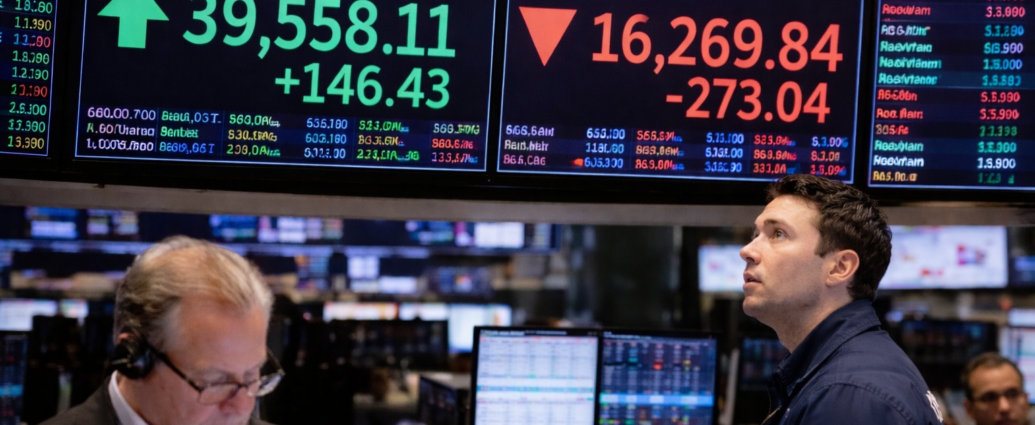
U.S. markets closed mixed Monday as investors weighed the outlook for Federal Reserve policy, ongoing geopolitical tensions, and volatility in energy markets, with modest divergence across major indices.
The Dow Jones Industrial Average rose 120 points, or 0.3%, to close at 38,240, supported by gains in industrial and financial stocks. The S&P 500 edged up 0.05% to 5,145, while the Nasdaq Composite declined 0.4% to 16,020, pressured by weakness in large-cap technology names.
In broader markets, U.S. oil (WTI crude) settled around $82.26 per barrel, reflecting continued geopolitical risk premiums tied to global supply uncertainty. Gold climbed to approximately $2,335 per ounce, as investors maintained a cautious hedge amid macro uncertainty. The VIX volatility index hovered near 13.4, signaling relatively contained market fear, while the 10-year Treasury yield held around 4.61%, reflecting ongoing uncertainty around interest rate policy.
Investors remain focused on the Federal Reserve’s next move. Federal Reserve Chair Jerome Powell has reiterated that policymakers are “data-dependent,” reinforcing that the central bank is not rushing to cut rates despite signs of moderating inflation. Treasury markets continue to reflect this cautious stance, with yields stabilizing after recent volatility.
Energy markets played a central role in shaping sentiment. Analysts at Goldman Sachs, led by Daan Struyven, noted that “geopolitical risk premiums remain embedded in oil markets,” underscoring how global tensions continue to influence pricing and inflation expectations.
Within equities, sector rotation continued. Financial and industrial stocks supported the Dow, benefiting from stable rates and economic resilience, while technology stocks saw mild pullbacks as investors reassessed valuations in a higher-for-longer rate environment.
Economic data continues to point toward a gradual rebalancing. Recent labor market signals, including a modest rise in jobless claims, suggest cooling without significant deterioration. Michael Gapen, Chief U.S. Economist at Bank of America, said the labor market “remains resilient, even as it softens at the margins,” reinforcing expectations of a soft landing.
At the same time, macro risks remain in focus. Jamie Dimon, CEO of JPMorgan Chase, recently warned that “geopolitics may become one of the most significant drivers of economic outcomes,” highlighting the growing influence of global tensions on markets.
Despite the mixed close, underlying fundamentals remain stable. Consumer spending continues to support growth, and corporate balance sheets remain strong. However, markets are showing signs of consolidation as investors await clearer signals on inflation, interest rates, and global developments.
Looking ahead, investors will closely monitor upcoming inflation data, Federal Reserve commentary, and energy market movements. These factors are expected to play a decisive role in shaping near-term market direction.
For now, the session reflects a market in pause mode—balancing improving conditions with lingering uncertainty as investors position for the next move.
JBizNews Desk