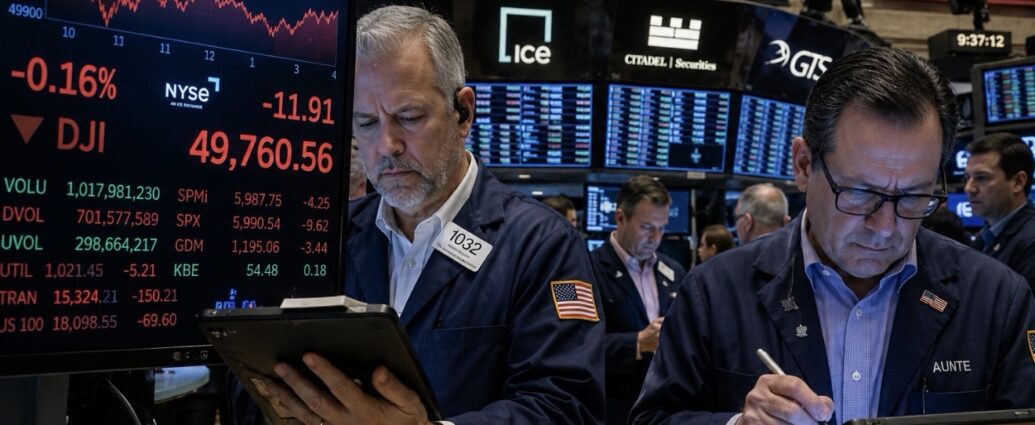
U.S. equities closed mixed Tuesday after a session marked by sharp profit-taking in technology and semiconductor stocks, with the S&P 500 and Nasdaq Composite retreating from Monday’s record-closing highs as a hotter-than-expected April Consumer Price Index print and rising oil prices put pressure on growth-sensitive equities, while the Dow Jones Industrial Average managed a narrow gain on defensive leadership from consumer staples, health care, and financials.
The S&P 500 ended the session at 7,400.96, down 0.16%. The Nasdaq Composite fell 0.71% to close at 26,088.20, its first decline after consecutive record closes. The Dow Jones Industrial Average advanced 56.09 points, or 0.11%, to 49,760.56 — its third consecutive positive session. The Russell 2000 small-cap index, which had traded down as much as 2.34% intraday, recovered to close down roughly 0.5%. The CBOE Volatility Index (VIX) rose to 18.38, up 6.9% from Monday’s close and reflecting elevated short-term hedging demand.
The session’s most consequential macro catalyst was Tuesday morning’s Bureau of Labor Statistics Consumer Price Index release for April. The headline index rose 0.6% on the month, putting annual inflation at 3.8% — the highest reading since May 2023 and above the Dow Jones consensus of 3.7%. Core CPI, excluding food and energy, rose 0.4% on the month and 2.8% year over year, also exceeding the 0.3% monthly consensus. The shelter component, the largest single line in the index, climbed 0.6%, double the March pace.
“Inflation is moving higher again as the war in Iran — and the associated closing of the Strait of Hormuz — is impacting both the headline number as expected, but also the core, which was even higher than the +0.3% expected,” Chris Zaccarelli, Chief Investment Officer at Northlight Asset Management, said in a note. “Given that inflation is heading in the wrong direction and the labor market is holding up, it’s very unlikely that the Fed will be able to lower interest rates any time soon, and it’s possible we may start pricing in rate hikes for next year.”
CME FedWatch repriced sharply on the print. Markets are now pricing in a 98% probability the Federal Reserve holds rates steady at the June 16-17 FOMC meeting and through most of 2026, with a roughly 30% probability of a rate hike at the December meeting — a remarkable shift from positioning held just two weeks ago that had a December cut as the base case.
The semiconductor and AI complex bore the brunt of the selling pressure as investors took profits after a parabolic run. Qualcomm fell 12% in its worst single day since 2020. Intel, up roughly 430% over the past year, declined 9%. Micron Technology, which had led the S&P 500 and Nasdaq to Monday’s records with a 6.5% gain on top of a 37% rally last week, reversed 3.6%. Advanced Micro Devices fell 2%, Broadcom declined 2%, and the iShares Semiconductor ETF (SOXX) dropped 5%.
The semiconductor index nonetheless remains up 4% over the past five sessions, 29% over the past month, and 60% year to date — placing Tuesday’s pullback in the context of one of the strongest single-sector runs of 2026. South Korea’s reported consideration of a universal dividend on AI infrastructure stocks added additional supply-side pressure on the names with heavy Korean exposure.
The mega-cap technology block also rolled over. Tesla, Nvidia, Amazon.com, and Alphabet each fell more than 1%. The Roundhill Magnificent Seven ETF (MAGS) declined 0.76% to $68.92. West Pharmaceutical Services dropped 5% and Dell Technologies fell 4.9%. Hims & Hers Health plunged 15% after the telehealth platform reported a surprise first-quarter loss tied to its pivot toward name-brand GLP-1 weight-loss drugs and away from cheaper copycat versions. AST SpaceMobile, GitLab, PACS Group, and ZoomInfo all saw double-digit declines on company-specific earnings or guidance disappointments.
Defensive names provided the counterweight. Walmart rose 2.15%, UnitedHealth Group added 2.06%, and JPMorgan Chase climbed 1.68%. Merck gained 1.48% and Johnson & Johnson added 1.15%, both supporting the Dow‘s narrow advance. Caterpillar fell 2.56%, Goldman Sachs dropped 1.88%, and Boeing declined 1.83% — leading the Dow’s losers but not enough to overwhelm the defensive gains.
A handful of names bucked the broader weakness. Zebra Technologies jumped 15% in early trading on earnings. Arista Networks gained 2.8%, Amphenol rose 2.7%, Plug Power popped 11% after reporting strong revenue growth and progress toward Q4 2026 profitability, and Quantum Computing Inc. surged 27% after reporting Q1 revenue of $3.69 million against $39,000 a year earlier. Vestis, the uniform and apparel maker, surged more than 30% on a fiscal Q2 beat.
The energy complex was the dominant macro driver. WTI crude futures settled up 4.19% at $102.18 a barrel after President Trump called the U.S.-Iran ceasefire “unbelievably weak” and “on massive life support” Monday, rejecting Iran’s counterproposal seeking war reparations, full sovereignty over the Strait of Hormuz, the release of frozen Iranian assets, and the lifting of economic sanctions. Brent crude settled at $107.77, up 3.42%. Reports that Trump is more seriously considering a resumption of combat operations against Iran kept oil firmly bid through the session. Gasoline averaged $4.50 per gallon nationally according to AAA.
Bond markets reflected the inflation surprise. The 10-year Treasury yield rose 4.6 basis points to 4.41% during the session, while shorter-dated yields moved less as traders adjusted Fed-path expectations. Gold fell nearly 1% to $4,693.70 per ounce as the dollar strengthened. Silver declined 1.84% to $84.40. Bitcoin traded near $80,950, down roughly $780 on the day. Copper, after Monday’s record close, was little changed.
Corporate news added several cross-currents. eBay rejected GameStop’s $56 billion takeover proposal, calling the unsolicited bid “neither credible nor attractive.” Apple CEO Tim Cook, Tesla CEO Elon Musk, BlackRock CEO Larry Fink, Boeing CEO Kelly Ortberg, and Goldman Sachs CEO David Solomon were named among executives joining President Trump on his state visit to Beijing departing Tuesday evening. Cerebras Systems, returning from its 2024 IPO derailed by a national-security review, will price Wednesday for a Thursday listing — the largest U.S. IPO of 2026 to date, with Amazon and OpenAI named among its new partners. Greenlight Capital’s David Einhorn told CNBC at the Sohn Conference that he missed the recent rebound but remains concerned about lofty valuations, calling stocks “very, very pricey” on a historical basis. Jim Chanos confirmed on CNBC’s “Closing Bell” that he remains short Tesla.
The next macro test arrives Thursday with the Census Bureau’s April Retail Sales release, followed by Walmart’s Q1 earnings Friday morning and the start of major department-store earnings the week of May 18 with Target, Lowe’s, Macy’s, and Home Depot. With the Fed repriced toward an extended hold, oil above $102, the Iran war ceasefire on the brink, and President Trump in Beijing by Wednesday, the path of equities through the rest of May now depends as much on geopolitics as on the Q1 earnings cycle.
JBizNews Desk
© JBizNews.com. All rights reserved. This article is original reporting by JBizNews Desk. Unauthorized reproduction or redistribution is strictly prohibited.