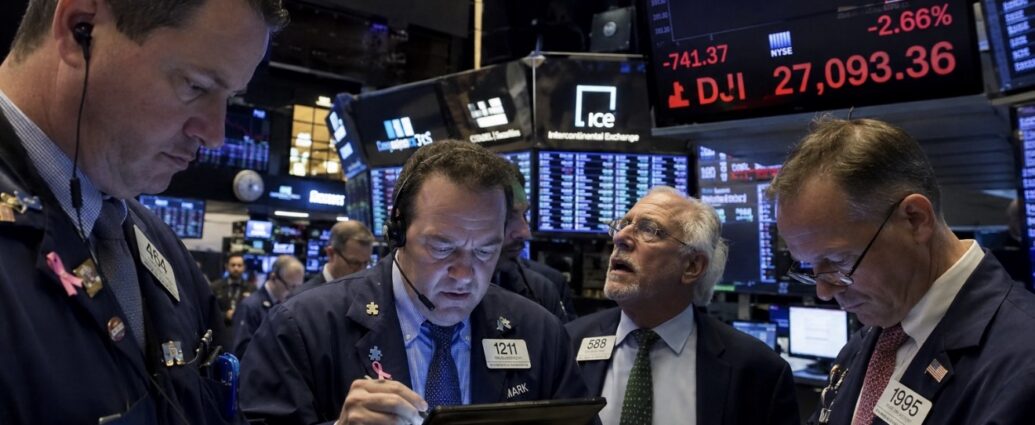
Global financial markets turned sharply lower Friday after President Donald Trump’s closely watched summit with Chinese President Xi Jinping concluded in Beijing without the sweeping trade breakthroughs investors had anticipated, while another jump in oil prices intensified fears that the prolonged closure of the Strait of Hormuz could trigger a broader global inflation shock.
U.S. stock futures fell aggressively before the opening bell as investors digested what many on Wall Street viewed as a summit heavy on symbolism but light on substance. According to official White House and Chinese government readouts, Trump and Xi agreed the Strait of Hormuz “must remain open” and reaffirmed their desire to stabilize economic ties between the world’s two largest economies. But the talks produced no formal tariff rollback framework, no major new market-access agreement, and no concrete diplomatic breakthrough on the Iran war that has disrupted global energy flows for nearly three months.
The disappointment immediately rippled across global markets.
Dow Jones Industrial Average futures dropped 242 points, or roughly 0.5%, in early trading Friday. S&P 500 futures declined 0.9%, while Nasdaq-100 futures slid 1.3% as investors moved aggressively out of high-valuation technology shares that had powered the market’s spring rally.
The reversal came just one day after the Dow reclaimed the psychologically important 50,000 level for the first time since February and the S&P 500 closed above 7,500 for the first time in history, underscoring how sensitive the market has become to geopolitical headlines and interest-rate expectations.
The selling pressure was even more severe overseas.
South Korea’s Kospi index plunged more than 6% to close at 7,493.18 after touching record highs earlier in the trading session, with semiconductor and artificial-intelligence-related shares leading the decline. Japan’s Nikkei 225 fell 2% to 61,409.29, Hong Kong’s Hang Seng dropped 1.6%, and mainland China’s CSI 300 index lost 1.12% to finish at 4,859.59.
Commodity markets also swung sharply. Spot gold declined 1.43% to $4,583.02 an ounce, while silver tumbled more than 5% to $79.07 as traders rotated away from recent momentum trades amid broad portfolio deleveraging.
Analysts said the market reaction reflected frustration over the absence of meaningful deliverables from the summit rather than any explicitly negative announcement.
Paul Donovan, chief economist at UBS, told clients Friday morning that “much increasingly scarce jet fuel has been burned to produce nothing of real substance,” adding that Beijing’s pledge to stabilize trade ties carried limited credibility given the volatility of U.S.-China economic policy over the past year.
At Deutsche Bank, strategist Jim Reid wrote that markets had quietly hoped China might emerge from the summit playing a more active role in helping de-escalate the Iran conflict and reopen the Strait of Hormuz. Those expectations weakened substantially after Trump told reporters following the summit that the United States does not need the strait open “at all,” comments that unsettled energy traders already grappling with tight global supply conditions.
ING strategist Francesco Pesole said the meeting “yielded too little so far” to materially improve global risk sentiment.
Oil prices surged again on the geopolitical uncertainty.
West Texas Intermediate crude rose 2% to roughly $104 a barrel, while Brent crude climbed to approximately $108 a barrel, extending one of the strongest energy rallies since Russia’s invasion of Ukraine in 2022. Energy markets remain under extreme pressure because roughly one-fifth of global oil shipments typically transit through the Strait of Hormuz, which has effectively remained blocked since the outbreak of the U.S.-Iran conflict in late February.
The prolonged disruption has tightened supplies of jet fuel, diesel and gasoline globally, fueling concerns that another wave of energy inflation could spill into consumer prices just as central banks were hoping inflation pressures were stabilizing.
Trump told Fox News host Sean Hannity after the summit that Xi had offered to help broker a diplomatic arrangement with Tehran. But expectations of any imminent breakthrough were quickly tempered after Secretary of State Marco Rubio told NBC News that the administration “didn’t ask them for anything,” suggesting Washington may not yet be pursuing an active Chinese mediation role.
One of the largest disappointments for U.S. industry centered on Boeing.
Shares of the aerospace giant extended Thursday’s nearly 5% decline in pre-market trading after Trump confirmed that China had agreed to purchase 200 aircraft from Boeing — only modestly above prior expectations and far below the blockbuster order some investors had anticipated ahead of the summit.
Technology stocks, meanwhile, came under particularly intense pressure as investors locked in profits following one of the sector’s strongest multi-week rallies in years.
Intel fell roughly 4%, Marvell Technology dropped 4%, and Advanced Micro Devices lost about 3%. Nvidia and Micron Technology each declined around 2%, while ASML and Arm Holdings fell more than 3.5%.
Even newly public AI-chipmaker Cerebras Systems, which surged 68% during its Nasdaq debut Thursday to reach a market capitalization near $95 billion, fell 3% in early Friday trading.
“The group has witnessed an extremely unsustainable move in recent weeks and remains vulnerable to profit taking regardless of the headlines,” wrote Adam Crisafulli of Vital Knowledge in a note distributed to institutional clients Friday morning.
There were limited pockets of strength.
Gemini Space Station, the cryptocurrency exchange founded by Tyler Winklevoss and Cameron Winklevoss, surged 22% in pre-market trading after announcing a $100 million strategic investment from Winklevoss Capital Fund alongside stronger-than-expected quarterly earnings.
“We believe the market has significantly undervalued Gemini, and that this investment will allow us to set up the company for its next phase of growth,” Tyler Winklevoss said in a statement, describing the investment as part of the company’s evolution “from a crypto company into a markets company.”
European markets also traded broadly lower. The pan-European Stoxx 600 index fell 1.3% during morning trading, with London, Frankfurt, Paris and Milan all posting sizable declines as investors reassessed inflation risks tied to higher energy prices.
Despite Friday’s global selloff, major U.S. indexes remain on track for strong weekly gains. The S&P 500 and Nasdaq Composite are still positioned for a seventh consecutive winning week, while the Dow remains on pace for its sixth winning week in seven weeks — a streak that has left equity valuations elevated and investor positioning increasingly fragile.
With the Beijing summit now concluded, investors are turning their focus toward whether the White House can help engineer a reopening of the Strait of Hormuz before higher oil prices begin feeding more aggressively into transportation, manufacturing and consumer costs. Markets are also closely watching the Senate confirmation process for Federal Reserve chair nominee Kevin Warsh, whose hearings are advancing as outgoing Chair Jerome Powell prepares to relinquish the chairmanship while remaining on the Federal Reserve Board.
JBizNews Desk
© JBizNews.com. All rights reserved. This article is original reporting by JBizNews Desk. Unauthorized reproduction or redistribution is strictly prohibited.