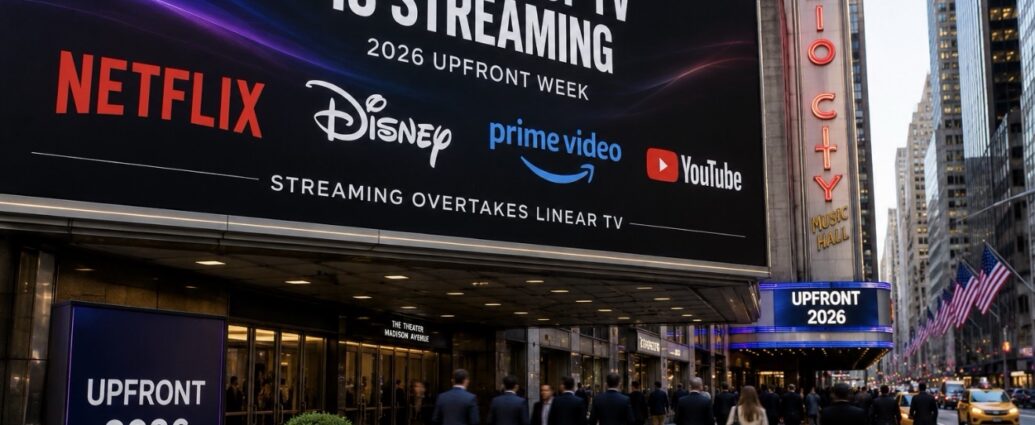
Streaming platforms are officially overtaking traditional television in the most important advertising market in American media, marking a historic turning point for Madison Avenue and accelerating the transformation of how entertainment companies, advertisers, and consumers interact.
For the first time ever, U.S. connected-TV upfront advertising spending is projected to exceed traditional primetime broadcast and cable upfront commitments in 2026, according to new forecasts released by research firm EMARKETER.
The firm projects advertisers will commit approximately $17.73 billion to connected television (CTV) upfront deals this year, surpassing the estimated $16.98 billion expected for traditional linear primetime television.
The crossover represents one of the clearest financial confirmations yet that streaming has fundamentally displaced the decades-old broadcast television model that dominated American advertising for generations.
The shift is unfolding this week in Manhattan, where the television industry’s annual upfront presentations — historically centered around major broadcast networks — have increasingly become showcases for streaming giants including Netflix, Disney, Amazon, and YouTube.
The data behind the transition are striking.
According to Nielsen’s 2026 Upfront Planning Guide, streaming platforms now account for roughly 66.7% of all ad-supported television viewing among Americans aged 18 to 49, the most valuable demographic for advertisers.
Streaming also surpassed combined broadcast and cable television viewing for the first time last year and has continued widening that lead ever since.
Meanwhile, EMARKETER projects total U.S. connected-TV advertising spending will reach approximately $38 billion this year and climb to nearly $47 billion by 2028 — eventually surpassing all traditional television advertising combined.
The growth is being driven by a dramatic shift in consumer behavior.
Younger audiences increasingly consume entertainment through ad-supported streaming tiers, free streaming television channels, mobile video platforms, and smart-TV ecosystems rather than traditional cable subscriptions.
That migration is now fundamentally reshaping the economics of the media industry.
Among the biggest winners has been Netflix, which spent years resisting advertising entirely before aggressively embracing the business.
The company told investors during its recent earnings call that it expects advertising revenue to approach $3 billion in 2026 as its ad-supported subscription tier continues expanding rapidly.
Netflix said more than 70 million monthly active users globally now use its ad-supported plan, with a majority of new subscribers in supported markets choosing the lower-cost advertising tier.
The company’s broader business remains strong as well.
Netflix reported first-quarter revenue of $12.25 billion, up more than 16% year-over-year, while maintaining full-year revenue guidance between $50.7 billion and $51.7 billion.
Executives have increasingly positioned Netflix not just as a streaming service, but as a next-generation advertising platform.
Amy Reinhard, President of Advertising at Netflix, has highlighted the company’s growing suite of targeting, measurement, and programmatic advertising tools designed to compete directly with traditional television ad buying.
Disney is also emerging as one of the largest beneficiaries of the streaming advertising shift.
The company’s streaming advertising business generated approximately $5.3 billion in revenue during the quarter ending December 2025, while profitability across Disney’s streaming segment rose sharply.
Executives have increasingly emphasized the power of combining streaming inventory across Disney+, Hulu, ESPN, ABC, and FX into unified advertising campaigns spanning both traditional and digital audiences.
At the same time, Amazon has arguably moved most aggressively to position itself as the infrastructure layer connecting the entire streaming ecosystem.
Its advertising platform, powered through Amazon DSP, now combines inventory from Prime Video, Fire TV, and third-party streaming platforms into one integrated marketplace for advertisers.
Amazon executives say the company’s advertising graph now reaches roughly 90% of U.S. households, giving it one of the broadest audience datasets in the industry.
The broader advertising landscape is also becoming increasingly concentrated.
According to research firm MoffettNathanson, four companies — Alphabet, Meta Platforms, Amazon, and Microsoft — now control roughly 65% of all U.S. advertising spending and approximately 80% of digital advertising.
That concentration is leaving traditional television networks under mounting pressure.
EMARKETER forecasts cable television advertising spending will decline another 10% this year, while advertising rates across broadcast and cable continue weakening as audiences shrink and streaming inventory expands.
Even streaming ad prices themselves have begun softening as supply grows rapidly.
The shift has already forced difficult decisions across legacy media.
Last year, CBS, owned by Paramount Global, announced it would end production of The Late Show in 2026 after years of declining ratings and financial losses — a symbolic sign of how deeply the traditional late-night and primetime television model has eroded.
Yet despite economic concerns tied to inflation, the Iran conflict, and rising energy costs, industry executives largely remain optimistic about the broader advertising environment itself.
Advertisers continue reallocating budgets rather than pulling back entirely.
The question dominating upfront week in Manhattan is no longer whether streaming will replace traditional television advertising.
That transition has already happened.
The new battle now centers on which companies will control the platforms, audience data, and advertising infrastructure powering the next generation of global media consumption.
And increasingly, the answer appears to be shifting away from legacy television networks and toward the technology-driven streaming giants now reshaping the future of entertainment itself.
JBizNews Desk
© JBizNews.com. All rights reserved.