By JBizNews Desk
TEL AVIV — Avraham Novogrotzky, president of the Manufacturers Association of Israel, warned Monday, May 25, 2026, that the shekel’s powerful surge against the dollar is accelerating a structural shift of Israeli industrial production overseas, pointing to fresh filings from water-meter technology firm Arad as evidence that export-driven manufacturers are quietly relocating capacity to Spain, Italy, and Mexico to defend margins.
Novogrotzky said the appreciation of the shekel — which has strengthened roughly 20% against the U.S. dollar over the past year and surged a further 8.3% since the Bank of Israel’s previous rate decision — is squeezing exporters whose revenue is denominated in dollars while costs, especially wages, remain in shekels. He cited Central Bureau of Statistics data showing that Israeli production overseas climbed from $2.5 billion to $4.5 billion in a single quarter at the end of 2025, when the shekel’s rally began, and said the trend almost certainly intensified in the first quarter of 2026.
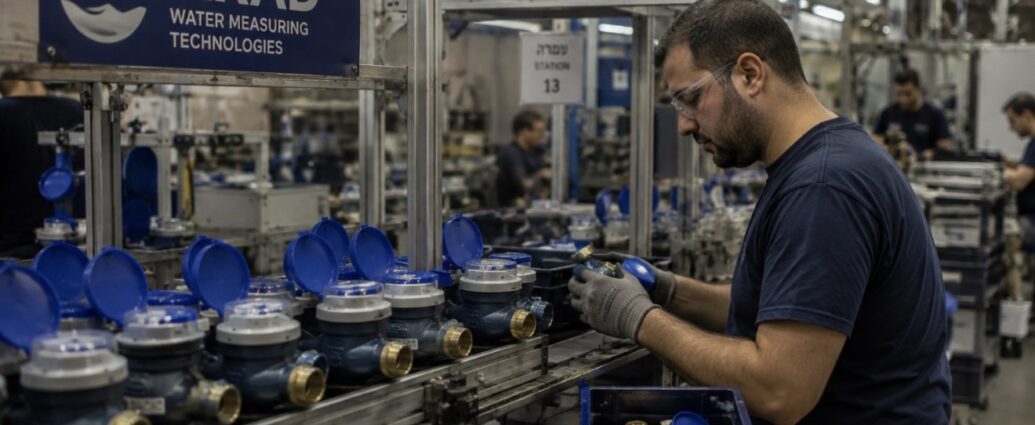
The dynamic was laid bare last week in financial disclosures from Arad, the Tel Aviv Stock Exchange-listed water-meter manufacturer controlled by Kibbutz Dalia and Kibbutz Ramot Menashe. The company, which carries a market capitalization of roughly 1.2 billion shekels, told investors it had taken deliberate steps to insulate itself from the currency’s appreciation, including shifting production for the European market from Israel to facilities in Spain and Italy, while moving production for the U.S. market to its group site in Mexico.
The moves are already paying off financially. Despite the dollar’s roughly 20% decline against the shekel over the past year, Arad reported first-quarter revenue rose 8% to $112.4 million while net profit climbed 26% to $9.2 million, driven by the offshore production strategy and continued strength in its domestic Israeli business.
Novogrotzky framed Arad’s disclosures as a warning shot, arguing that existing projects may remain in Israel but new industrial investment is increasingly being directed abroad. He said the Manufacturers Association is hearing similar concerns from member companies across Israel’s export sector, where competitiveness has steadily eroded as the shekel rallied to a 33-year high against the dollar.
The Arad case is not isolated. Polyram Plastic Industries, traded on the Tel Aviv Stock Exchange under ticker POLP, disclosed in its 2025 annual report that it had opened a new factory in Thailand and transferred select production lines out of Israel. The company told shareholders the move reflected a strategic repositioning of where its core manufacturing activity would be centered in the future.
Industry executives say Israeli manufacturers have long outsourced portions of production overseas to reduce labor costs and gain proximity to customers, particularly in Asia and North America. What has changed in 2026, according to Novogrotzky, is the pace and urgency of the shift, driven less by long-term planning and more by an immediate currency-driven profitability squeeze.
The pressure is colliding directly with the Bank of Israel’s broader policy challenge. Earlier Monday, the central bank cut its benchmark interest rate by 0.25 percentage points to 3.75%, explicitly citing the shekel’s strength as a key factor helping cool inflation. Yet the same currency appreciation celebrated by Governor Prof. Amir Yaron as a disinflationary force is simultaneously hollowing out the economics of Israel’s export manufacturing base.
Economists warn the trend could carry lasting consequences for Israel’s industrial footprint. Once factories, supplier networks, engineering operations, and management teams migrate overseas, they rarely return quickly. Production lines established in Spain, Italy, Mexico, or Thailand often become permanent components of a company’s global manufacturing chain.
That creates a growing disconnect inside the Israeli economy: macroeconomic indicators remain resilient, inflation is cooling, and the currency is strong, yet portions of the country’s traditional industrial base are steadily relocating abroad in search of lower costs and more stable margins.
For now, the Manufacturers Association of Israel is pressing policymakers to weigh the industrial consequences of the shekel’s rally alongside its inflation benefits, warning that without offsetting support measures or intervention, more Israeli production capacity will quietly leave the country in the coming quarters.
The Arad disclosures, Novogrotzky suggested, are not an isolated corporate adjustment. They may instead mark the early stages of a much broader manufacturing migration already underway.
© 2026 JBizNews. All Rights Reserved. Reproduction or distribution without written permission is prohibited.