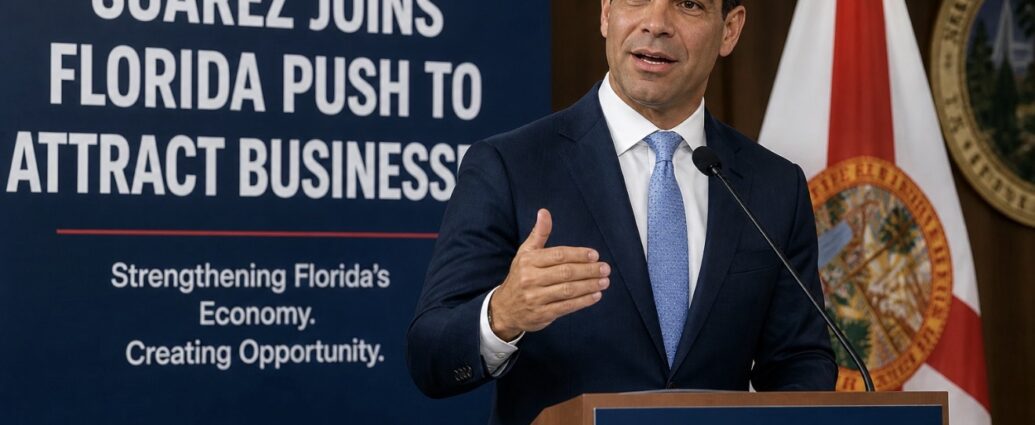
Francis Suarez, the former Miami mayor who became a national face of the city’s tech ambitions, said Tuesday he is joining Ambition Accelerated as a senior adviser, adding political star power to a Florida business-recruitment effort backed by billionaire developers and financiers. In a commentary published by Fortune, Suarez said his guiding approach remained simple: “How can I help?” That line, which he said shaped his outreach to founders and executives during Miami’s pandemic-era rise, now sits at the center of a broader campaign to market South Florida as a destination for companies, investors and skilled workers.
The initiative already carries heavyweight support from Stephen Ross of Related Companies and Ken Griffin of Citadel, and the new advisory role for Suarez signals a more coordinated pitch to corporate America. Reuters reported the appointment Tuesday, while a statement from the Florida Council of 100 framed the effort as a push to showcase Miami, Fort Lauderdale and West Palm Beach as a single business corridor. John P. McDonough, chair of the Florida Council of 100, said in the group’s release that “Ambition Accelerated will highlight the region’s talent pipeline, infrastructure and pro-business culture to the nation’s most dynamic leaders.”
The campaign arrives as Florida tries to convert years of migration momentum into a more durable corporate base. Bloomberg reported that Ambition Accelerated plans roadshows, digital outreach and town-hall-style events aimed at chief executives, venture investors and professionals considering relocation. In his Fortune essay, Suarez argued that “the single greatest competitive advantage any region can offer ambitious people is not a tax incentive or a zoning variance. It is a culture that supports them and genuinely wants them to succeed,” a statement that captures the campaign’s effort to sell responsiveness and speed alongside lower taxes.
Florida officials and business leaders have spent several years promoting that message, especially after a wave of relocations during and after the pandemic. Reuters previously reported that more than 100 startups had moved to Florida in recent years, though the pace and scale of those moves have varied by sector and funding cycle. Ron DeSantis, Florida’s governor, told Reuters that “we are the new home for American entrepreneurship,” pointing to the state’s tax structure and lighter-touch permitting environment. That claim has become a recurring theme in Florida’s economic pitch, even as rivals such as Texas and Tennessee make similar arguments to corporate decision-makers.
The involvement of Ross and Griffin gives the campaign unusual financial and reputational heft. Bloomberg reported that the two men, both closely tied to South Florida’s rise as a finance hub, backed the effort through their institutions and civic networks. In comments cited by Bloomberg, Ross said, “We are investing in the people and ideas that will drive the next wave of growth in Florida, and Ambition Accelerated is the vehicle to connect them with the resources they need.” Griffin, whose firms expanded their Florida footprint after his move from Chicago, said the commitment “is not just financial; it’s about shaping a mindset that welcomes bold, innovative ventures,” according to statements reported by Bloomberg and echoed in public materials tied to Citadel.
For Suarez, the role extends a brand he built by courting technology founders, cryptocurrency executives and venture capital firms during his time at City Hall. In the Fortune piece, he said the phrase “How can I help?” resonated because it cut through what many entrepreneurs viewed as bureaucratic delay in other cities. That image helped Miami win attention from investors during the remote-work boom, though some of the city’s early crypto enthusiasm cooled after the 2022 market collapse and broader venture funding slowed, a trend documented by CNBC, Bloomberg and market data providers tracking startup investment.
Supporters of the Florida push say the region still holds structural advantages even after the hottest phase of the relocation wave faded. Marc Andreessen told CNBC that Miami offers “the perfect blend of talent, access to Latin America and a government that wants to win,” a line that boosters frequently cite when pitching South Florida to founders and investors. Business recruiters also point to growing finance activity in West Palm Beach, office development in Miami and a broader influx of high-net-worth residents, trends covered by Reuters, Bloomberg and local economic-development groups.
Still, Florida’s sales pitch faces real tests. Housing costs in Miami have climbed sharply, insurance expenses remain a major concern for employers and residents, and infrastructure strains have become harder to ignore as population growth outpaces public investment. Economists and executives cited by Reuters and Financial Times have said those pressures could complicate the state’s claim that it offers a cheaper, easier operating environment over the long term. Even so, McDonough said in the Florida Council of 100 statement that the campaign intends to focus on “long-term competitiveness,” not just short-term relocation wins.
What comes next matters because Florida no longer needs only headlines; it needs proof that high-growth companies will build lasting operations, hire locally and stay through market cycles. The roadshows and outreach planned by Ambition Accelerated will offer an early test of whether South Florida can move from pandemic-era buzz to a more permanent role in U.S. business geography. In his Fortune commentary, Suarez said regions that succeed “genuinely want” ambitious people to thrive. The question for executives and investors now is whether Florida can turn that message into sustained corporate expansion rather than another burst of migration-driven hype.
JBizNews Desk