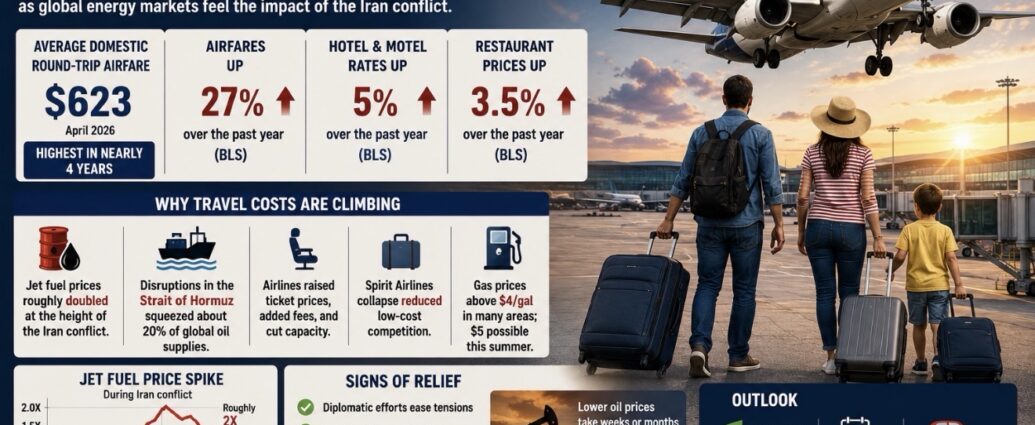
Americans heading out for summer vacations are paying significantly more to travel this year, with airfare, fuel, hotels, and other travel-related costs climbing as global energy markets continue feeling the effects of the Iran conflict.
According to data from the Airlines Reporting Corporation, average domestic round-trip airfare reached approximately $623 in April, the highest level in nearly four years.
Government inflation data tells a similar story.
The Bureau of Labor Statistics reported that airfares have risen roughly 27% over the past year, while hotel and motel rates are up about 5% and restaurant prices have increased approximately 3.5%.
At the center of the price surge is fuel.
The conflict that began on February 28 involving the United States, Israel, and Iran disrupted global energy markets and drove jet-fuel prices sharply higher. During the height of the crisis, jet-fuel costs roughly doubled compared with pre-conflict levels.
For airlines, fuel remains one of the largest operating expenses.
Hayley Berg, lead economist at travel platform Hopper, notes that jet fuel typically accounts for between 20% and 30% of an airline’s total operating costs, making fuel-price fluctuations one of the biggest drivers of airfare changes.
The situation was compounded by disruptions in the Strait of Hormuz, one of the world’s most important shipping corridors and a route through which roughly one-fifth of global oil supplies normally pass.
As fuel costs climbed, airlines moved quickly to protect profitability.
Several carriers raised ticket prices, increased baggage fees, reduced route frequencies, and adjusted capacity forecasts.
United Airlines recently lowered portions of its 2026 outlook as elevated fuel costs weighed on operating expenses.
In Europe, Lufthansa faced billions of dollars in additional fuel costs and responded by reducing flight schedules and cutting capacity across parts of its network.
Meanwhile, the collapse of budget carrier Spirit Airlines reduced low-cost competition in the domestic market, giving surviving carriers greater pricing power during the busy summer travel season.
Drivers have also felt the impact.
Gasoline prices surged above $4 per gallon in many areas this spring, well above levels seen a year earlier.
Analysts at GasBuddy warned that prices could approach $5 per gallon in some regions if disruptions to global energy supplies persisted through the summer.
For families planning road trips, higher fuel prices translated directly into increased travel budgets.
Filling a family SUV often costs substantially more than it did before the conflict began.
There are signs that some relief may be approaching.
As diplomatic efforts between Washington and Tehran progressed and shipping activity through Hormuz began normalizing, oil prices retreated significantly from their wartime highs.
The challenge for consumers is timing.
Industry analysts note that declines in crude-oil prices do not immediately translate into lower airline ticket prices or cheaper jet fuel. The process can take weeks or even months to filter through supply chains.
In many cases, fees introduced during periods of higher costs — particularly baggage charges and ancillary travel fees — tend to remain in place even after fuel prices moderate.
Travel experts continue encouraging consumers to book trips as early as possible and remain flexible when selecting destinations.
Some travelers are responding by choosing shorter trips, driving instead of flying, or selecting destinations closer to home to offset rising costs.
The travel-price surge is also contributing to broader inflation pressures across the economy.
Consumer prices remain elevated, one reason the Federal Reserve under Chair Kevin Warsh has maintained a cautious stance on interest rates rather than moving aggressively toward cuts.
For travelers, the outlook remains mixed.
While energy prices have begun easing and supply chains are stabilizing, vacation costs remain well above last year’s levels.
The good news is that the worst of the fuel shock may be over.
The bad news is that many families will still feel the impact when they book flights, reserve hotels, and fill up their gas tanks this summer.
JBizNews Desk | New York
© JBizNews.com All Rights Reserved. Reproduction or distribution without written permission is prohibited.