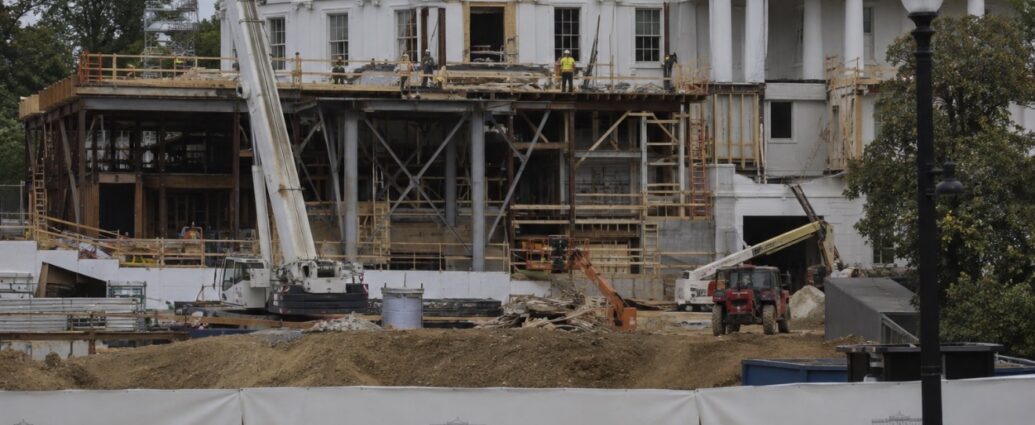
The Supreme Court handed President Donald Trump an important victory Friday, allowing construction of his $400 million White House ballroom to continue while the justices consider the administration’s emergency appeal.
Chief Justice John Roberts temporarily blocked a lower-court order that would have forced above-ground construction to stop, giving the administration the immediate result it was seeking: the project stays active while the legal fight continues.
That matters because this is no longer an early-stage proposal.
The approximately 90,000-square-foot complex is already about 65% complete, according to court filings. Roughly 250 workers are operating as much as 20 hours a day, seven days a week, and major structural work is already in place.
The project includes far more than a ceremonial ballroom.
Court filings describe an integrated White House complex with extensive underground construction, hardened structural elements, secure communications areas, medical facilities and other security-related infrastructure.
The administration says millions of pounds of reinforcing steel and thousands of cubic yards of concrete have already gone into the project, with portions extending roughly 50 feet underground.
That helps explain why the Supreme Court’s intervention is so significant.
Stopping a project at this stage is not the same as delaying construction before ground is broken. Contractors, workers, equipment, materials and engineering schedules are already committed. A prolonged shutdown could create substantial additional costs and threaten the timetable for completing the complex.
The legal battle centers on a much larger constitutional question: how much authority does a president have to make major changes to the White House without specific congressional approval?
The National Trust for Historic Preservation argues that Trump exceeded presidential authority by demolishing the East Wing and moving ahead with a project of this scale without Congress.
Lower courts agreed sufficiently to order the construction stopped.
The Trump administration argues that presidents have historically exercised broad authority over White House renovations, security improvements and executive-property management, and that courts should not interfere with decisions tied partly to presidential security.
The Supreme Court has not yet decided who is right.
Roberts’ order is temporary and does not guarantee that the administration will ultimately win the underlying case.
But for Trump, the immediate victory is substantial because construction itself is time-sensitive.
The main concrete structure is expected to be completed by November 2026, according to the project schedule submitted in court. The exterior facade is expected to be substantially completed by April 2027, with the full complex currently targeted for completion in August 2028.
That would put completion approximately five months before the end of Trump’s second term.
A lengthy shutdown now could have threatened that timetable.
Instead, workers can continue pushing toward the November structural milestone while the Supreme Court considers whether to grant longer-term relief.
The financing also raises the stakes.
Private donors have committed about $355 million toward the estimated $400 million project, with roughly $200 million already spent or committed, according to administration filings.
That means the legal dispute now involves not simply an architectural vision, but hundreds of millions of dollars in construction contracts, materials, labor and private commitments already tied to the site.
For contractors and suppliers, Friday’s ruling means schedules continue.
For workers, it means the job site remains active.
For donors, it means their money remains attached to a project that is still moving forward.
And for Trump, it prevents lower courts from stopping one of the most visible projects of his second term at the moment when construction is already roughly two-thirds complete.
The Supreme Court could still eventually rule that the administration lacked authority to proceed without Congress.
But that decision may come after significantly more of the project has been built.
That is what makes Friday’s action so consequential.
The Supreme Court has not yet ruled that Trump can ultimately keep the ballroom. It has ruled, for now, that he can keep building it — and on a $400 million project already about 65% complete, every additional day of construction matters.
JBizNews Desk | Washington
© JBizNews.com All Rights Reserved. Reproduction or distribution without written permission is prohibited.