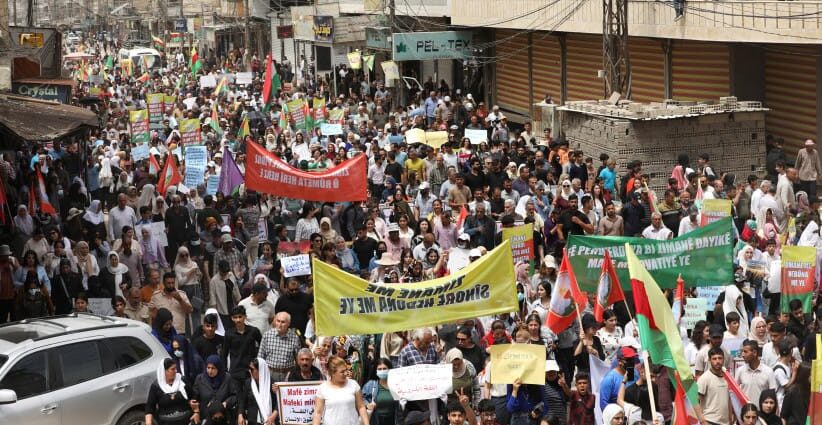
Syria’s new government is holding a type of limited election in Kurdish areas of eastern Syria.
Syria had already held types of limited elections in other areas of Syria last year. However, areas outside government control did not hold a vote. This included Suwayda and also the areas governed by the Syrian Democratic Forces and its civilian component, the Democratic Autonomous Administration of North and East Syria.
In January, clashes between the Syrian government and SDF led to the SDF withdrawing and agreeing to a deal with Damascus. This was based on a roadmap agreed in March 2025. This paved the way for Syria to move its interior ministry forces into areas such as Hasaka in eastern Syria.
Now, Syria is moving forward with a limited vote. The voting system is complex and isn’t a direct election. This has led to complaints that Damascus is using a top-down approach to create an electoral college of handpicked people who are “elected” but, in fact, do not stand for office as one would expect in the US or UK.
Syrian state media SANA said “voting began Sunday in several districts in northeastern and northern Syria to elect members of the country’s People’s Assembly, according to Syria’s Higher Committee for People’s Assembly Elections. Polling opened in the Hasakah and Qamishli districts in Hasakah province, as well as the Ain al-Arab district in Aleppo province.”
Ain al-Arab is known as Kobane. Ain al-Arab is his Arabic name; Kobane is his Kurdish one.
The report at SANA added that “the committee said 12 candidates were competing for two seats in Ain al-Arab from an electoral body of 100 members, while 13 candidates were contesting three seats in Hasakah from a pool of 150 electors. In Qamishli, seven candidates are competing for four seats in an electoral body consisting of 207 members.”
‘Isn’t really representative of the views of any community or party at all’
As can be seen, the number of actual voters is quite small. There is also a lack of clarity on parts of the process. This is leading to questions and concerns about the election process and outcomes.
Nevertheless, Syrian officials appear to see it as a success and a stepping stone to the next part of any democratic process. The previous civil authority, the DAANES, did not have elections. It essentially functioned as a one-party state linked to the far-left PYD party, a mostly Kurdish organization.
The other political actors were linked to the SDF, the military arm, as well as the YPG, a Kurdish group which has links to the Kurdistan Workers Party (PKK) in Turkey. This led Ankara to view most political institutions linked to the YPG as “terrorists” because Ankara views the PKK as terrorists. As such, all the groups linked to the AANES were seen as terrorist groups in Ankara.
When the new government of Syria took power, it was run by Hayat Tahrir al-Sham (HTS), a mostly Arab conservative rebel group. That HTS and the SDF would find an accommodation seemed complex, since one was a conservative Islamic Arab group and the other a far-left Kurdish group.
According to reports, the PYD has boycotted the recent poll in Syria. This means that those elected are from different groups. Some Kurds were elected. Several are linked to the KNC, a Kurdish centrist party that was opposed by the PYD.
“In the al-Malikiyah district, two candidates secured the allocated seats uncontested after no additional candidates registered. Voting is scheduled to continue until around midday and may be extended by one hour if minimum turnout requirements are not met. Ballot counting will begin immediately after polling closes, with preliminary results expected later Sunday,” SANA noted.
Many commentators have pointed out the drawbacks of this current election.
Meghan Bodette, Director of Research at the Kurdish Peace Institute, noted on X that “this election shows what a small group of predominantly men over age 40 who were chosen by the government think about each other. That isn’t really representative of the views of any community or party at all.”
She added that “Five Kurds and six Arabs will represent Hasakah, Kobane, Qamishlo, and Derik in the Syrian parliament.” Furthermore, she noted that three Kurds have been elected in Afrin, which would mean only eight Kurds will have been elected in the recent elections. She notes that some Kurds could still be appointed. “Syriac-Assyrian, Armenians, and Yezidis in former DAANES territory got no seats at all.”
The National Context also noted that “results from Syria’s parliamentary elections in Hasakah province and Kobani have confirmed our reporting from last week: In Hasakah, of the nine contested seats, Arabs won five and Kurds four. A tenth seat (in the Ras al-Ayn area) had already been won by an Arab candidate in elections held last year. The president will appoint the remaining five seats for the province.”
Much more will need to be done in Damascus regarding governance and elections
Aliza Marcus, author of the new book ‘Resurgence and Revolution: The PKK and the Kurdish Fight in Turkey and Syria,’ wrote on X that “this tactic of boycotting elections rarely has any positive impact for those boycotting. I’m not surprised the PYD chose this route — it allows them to unite people around the idea of the parliament’s (for them) lack of legitimacy. But at the same time, they get no say.”
Wladamir van Wilgenburg, co-author of ‘The Kurds of Northern Syria: Governance, Diversity and Conflicts (Kurdish Studies),’ noted on X that “Five Kurdish candidates won parliamentary seats today, none from the PYD, which boycotted the election. The KNC appears to have gained influence, alongside Arab tribal representatives with reported links to Damascus. Seems the Shammar tribe was also left out.”
The results of this election will be watched closely. However, it is clear that much more will need to be done in Damascus regarding governance and elections. This limited vote is only the beginning. If the voting ends here, then much will be lacking in terms of democracy.