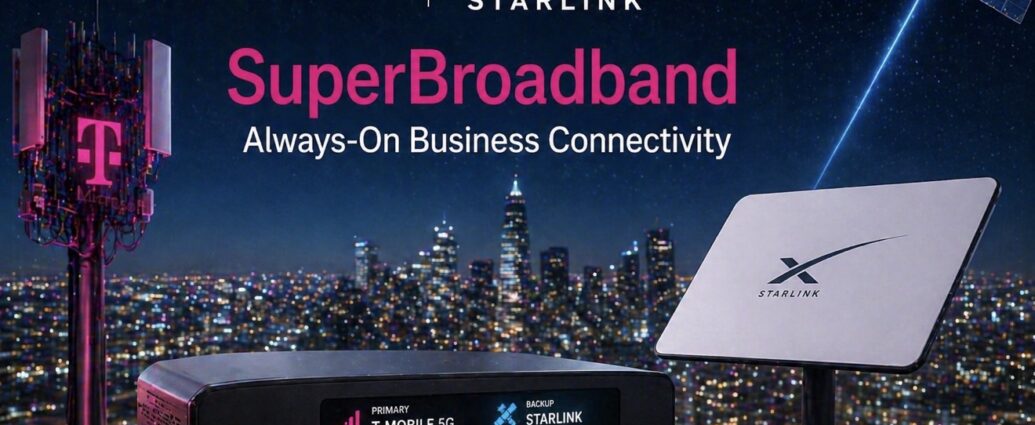
T-Mobile and SpaceX’s Starlink on Tuesday unveiled a new enterprise internet service called SuperBroadband, marking a major expansion of their partnership and a direct push into the high-stakes business connectivity market with a promise of 99.99% uptime backed by financial guarantees.
The offering combines T-Mobile’s nationwide 5G network with Starlink’s low-Earth orbit satellite constellation, creating a dual-network architecture designed to eliminate one of the most costly vulnerabilities facing businesses today: internet outages. By routing traffic simultaneously across terrestrial and satellite pathways, the system ensures that if one network fails, the other seamlessly takes over without disruption.
“This is about redefining what businesses should expect from connectivity,” said André Almeida, President of Growth and Emerging Businesses at T-Mobile, in the company’s launch announcement. “Connectivity shouldn’t stop where your business starts. With SuperBroadband, we’re delivering a solution that is resilient by design and available everywhere it counts.”
The product represents a significant escalation from the companies’ earlier collaboration, which began in 2022 and focused primarily on consumer satellite-to-cell services such as emergency texting in dead zones. With SuperBroadband, the partnership is moving squarely into the enterprise space — targeting retailers, manufacturers, healthcare systems, and hospitality operators that depend on uninterrupted connectivity to run daily operations.
At the core of the service is a fully managed infrastructure that integrates Ericsson Cradlepoint routers, NetCloud Manager software, and nationwide installation support from Acuative, with additional hardware expansion planned through Inseego. The system allows businesses to operate with a single provider, contract, and support channel — eliminating the complexity of managing multiple connectivity vendors.
The economic case is straightforward: downtime is expensive. Scott Spearin, Global Operations Manager at Columbia Sportswear, one of the first enterprise adopters, said a single checkout failure at a high-performing retail location can cost the company approximately $10,000 per hour. “When connectivity goes down, everything stops,” he said, underscoring the urgency behind redundancy solutions.
Jason Fritch, Vice President of Starlink Enterprise Sales at SpaceX, framed the service as purpose-built for high-dependency environments. “This is designed for businesses where downtime costs thousands per hour,” he said, emphasizing the role of satellite connectivity as a critical backup layer.
Early adoption is already expanding beyond retail. Aramark Destinations, a major hospitality and experience services provider, has begun deploying SuperBroadband across remote and complex locations where traditional connectivity has been inconsistent. Dimple Jethani, Chief Information Officer of Aramark Destinations, said the platform enables a “resilient, always-on foundation” that reduces operational risk and simplifies network management.
The launch comes as competition in the broadband space intensifies. AT&T is aggressively expanding its fiber footprint, targeting 40 million locations by 2026, while Verizon is scaling its business fixed wireless offerings using dedicated 5G network slices. T-Mobile’s approach — combining terrestrial and satellite infrastructure — is a strategic attempt to leapfrog both by delivering coverage and redundancy that neither fiber nor wireless alone can guarantee.
The company’s momentum in broadband has been building. T-Mobile ended 2025 with 9.4 million broadband customers, adding 2 million in a single year, signaling growing demand for alternatives to traditional cable and fiber providers.
SuperBroadband is priced starting at $250 per month under a three-year agreement, including unlimited 5G and satellite data, enterprise-grade equipment, installation, and ongoing management. Businesses can monitor performance and network status through T-Platform, T-Mobile’s centralized dashboard, which provides real-time visibility into usage, failover events, and system health.
For enterprises, the value proposition extends beyond speed or cost — it is about reliability. As businesses become increasingly dependent on digital infrastructure, the ability to maintain uninterrupted connectivity across all locations is shifting from a convenience to a necessity.
The broader implication is a redefinition of the enterprise connectivity standard. By integrating satellite and wireless networks into a unified service, T-Mobile and SpaceX are positioning themselves at the forefront of a new category: always-on, hybrid connectivity designed for resilience rather than just performance.
As adoption grows, the success of SuperBroadband will hinge on whether businesses are willing to pay a premium for reliability — and whether competitors can match the combination of reach, redundancy, and simplicity that the partnership is now bringing to market.
JBizNews Desk