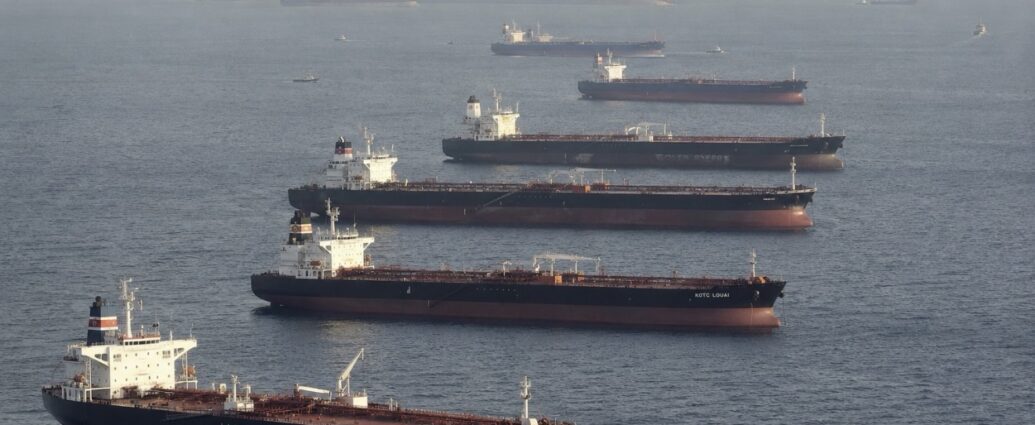
Crude carriers shifted into position near the Strait of Hormuz on Sunday, May 24, 2026, after President Donald Trump declared over the weekend that a framework deal with Iran to reopen the world’s most consequential energy corridor has been “largely negotiated” and will be unveiled imminently — even as Tehran publicly contested his version of events and tanker operators kept crews on hold pending a formal end to hostilities.
In a Saturday social-media post, Trump described the agreement as “subject to finalization between the United States of America, the Islamic Republic of Iran, and the various other Countries.” Iran’s Foreign Ministry said the two sides had locked in a memorandum of understanding as a first phase, with deeper negotiations to unfold over the following 30 to 60 days. A senior Iranian official, outlining the first-phase terms, said Tehran will return the Strait of Hormuz to pre-war operating conditions, underwrite shipping security through the waterway, give assurances that it will not pursue nuclear weapons, and resume exports of its own fuel and crude. The same official stressed that Iran has not agreed to hand over its enriched uranium stockpile, and that the nuclear question has been carved out for phase two.
Tehran’s counter-messaging muddied the picture almost instantly. Fars news agency reported that the Strait of Hormuz will stay under Iranian management and dismissed Trump’s framing as “incomplete and inconsistent with reality.” Iran’s chief negotiator Mohammad Bagher Ghalibaf struck a similar note after the latest round of talks, warning that Tehran “will not back down from the rights of our nation and country — especially when dealing with a party that has never shown sincerity.” Traders have seen this movie before: at least two prior reopening declarations during the war unraveled within days.
The Strait of Hormuz has been functionally closed to commercial transit since late February, when U.S. and Israeli strikes on Iran set off a cascade of Iranian retaliatory measures that throttled tanker movement to roughly five percent of its normal pace. The corridor moves about a fifth of the world’s daily crude shipments and a comparable slice of global LNG. General Dan Caine, Chairman of the Joint Chiefs of Staff, confirmed earlier this month that 22,500 mariners are stranded on more than 1,550 commercial ships trapped in and around the Gulf. Maersk, MSC, CMA CGM and Hapag-Lloyd halted transits in the conflict’s opening days and have yet to resume full service.
Vessel-tracking firm Kpler said crude carriers idling north of Dubai and Fujairah began nudging toward the chokepoint within hours of the weekend announcement — a near-repeat of April’s aborted reopening, when at least eight tankers advanced before the corridor refroze. Roughly 130 million barrels of crude and 46 million barrels of refined fuels are currently floating on some 200 tankers across the region, according to Kpler data, a backlog that would surge into global markets the moment flows truly restart.
Futures markets are already pricing the optionality. Brent crude has swung in a band between roughly $100 and $144 a barrel for nearly three months, settling near $105 last week, while North Sea Dated changed hands around $110 in early May. JPMorgan analysts, who had penciled in a June restart, now project oil will average $97 a barrel for the balance of 2026 if the strait reopens on track. Citigroup energy strategists Anthony Yuen and Eric Lee had earlier flagged that any closure would deliver a sharp but compressed spike, since every major economy is incentivized to restore flows. Michael Green, chief strategist at Simplify Asset Management, notes that Brent historically needs to hold near $60 a barrel before U.S. pump prices retreat to roughly $3 a gallon — a level still well south of where the market is trading.
The operational hurdle is steeper than the diplomatic one. Matt Wright, principal freight analyst at Kpler, said shipowners remain unwilling to send crews back into the corridor on a political signal alone. War-risk insurance premiums, which ran at about 0.25 percent of hull value before the conflict, have leapt to between three and eight percent — equating to $3 million to $8 million in coverage costs for a single very large crude carrier transit, according to Marsh Risk war leader Dylan Saunders-Mortimer. VLCC freight rates from the Gulf to China have spiked in recent sessions, with Kpler clocking a 24 percent single-day jump to $1.67 per barrel — the steepest move of the year. The U.S. International Development Finance Corporation has been assembling a $20 billion reinsurance facility intended to draw tanker operators back, but the program’s terms remain unsettled.
Secretary of State Marco Rubio, speaking in New Delhi on Saturday, reiterated that any final accord must reopen Hormuz toll-free, halt Iran’s nuclear weapons pursuit, and secure the transfer of enriched uranium. “This problem will be solved, as the president’s made clear, one way or the other,” Rubio said.
For corporate America, even a partial restart would ease pressure that has bled into every corner of the consumer economy. U.S. inflation has held at multi-year highs since the conflict began, gasoline prices have spiked, ocean-freight costs have lifted everything from manufacturing inputs to imported food, and supply chains have absorbed a parallel hit from the Red Sea. OPEC trimmed its 2026 global demand growth forecast to 1.17 million barrels per day in its May report, down from 1.38 million, citing the conflict’s drag on trade.
Even under the cleanest possible path — a finalized phase-one accord, Iranian compliance on safe passage, sustained U.S. and allied naval reassurance, and tanker operators willing to put crews and hulls back in harm’s way — the International Energy Agency and Wall Street energy desks expect Hormuz throughput to stay below pre-war norms well into the third quarter. Stranded barrels will hit the market first; restoring production at Saudi, Emirati, Iraqi and Kuwaiti loading facilities, and rebuilding the depleted floating-storage and onshore inventories the war has burned through, will take months, not weeks.
The next 72 hours will tell the market whether this is, at last, the real reopening — or another false start in a war that has produced several already.
JBizNews Desk
© 2026 JBizNews. All Rights Reserved. Reproduction or distribution without written permission is prohibited.