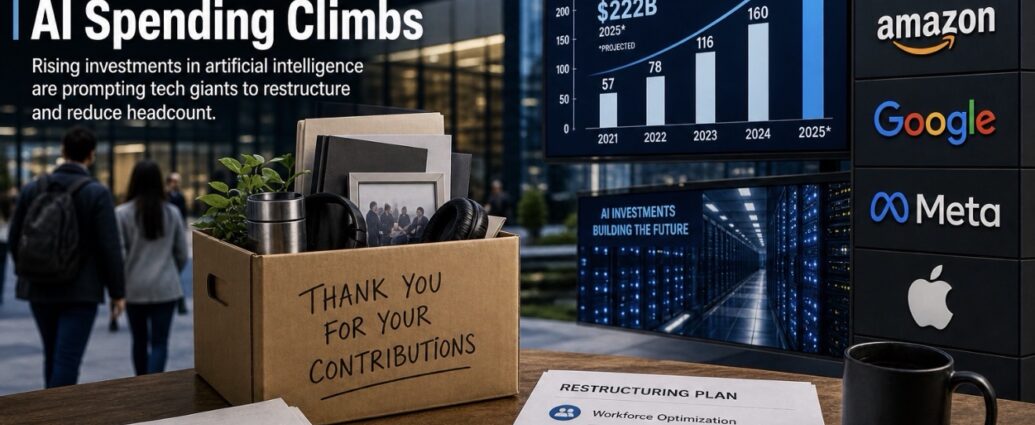
Technology companies are increasingly using voluntary buyouts, not only blunt layoffs, as they redirect cash toward artificial-intelligence infrastructure and try to keep investors comfortable with rising capital spending. Reuters reported this week that more than 92,000 tech workers have lost jobs across the sector in 2025, while analyst Dan Ives of Wedbush Securities said the cuts reflect “fiscal pressure and a strategic pivot toward AI,” a shift that now reaches some of the industry’s biggest employers.
At Microsoft, that shift has taken a more measured form. CNBC and other outlets reported that the company introduced a voluntary separation program for a portion of its U.S. workforce, offering eligible employees a chance to leave with support rather than face a direct layoff process. In an internal memo cited by CNBC, Chief People Officer Amy Coleman said, “Our hope is that this program gives those eligible the choice to take that next step on their own terms, with generous company support,” underscoring how Microsoft is trying to frame cost cuts as a managed transition rather than a punitive move.
The approach marks a notable change for a company that historically relied more heavily on conventional workforce reductions. Bloomberg has reported that Microsoft expects capital expenditures of about $145 billion in its current fiscal year, largely tied to data centers and AI capacity, a figure that highlights why labor costs have come under renewed scrutiny. Chief Executive Satya Nadella has repeatedly said, including on earnings calls carried by company transcripts, that demand for AI services and cloud infrastructure remains strong, and that investment in those areas stays central to the company’s strategy.
Meta Platforms has taken a harder line. In prior restructuring announcements and public comments, Chief Executive Mark Zuckerberg described 2023 as a “year of efficiency,” and the company has continued to emphasize leaner operations as it funds AI products, ad tools and computing infrastructure. Reuters and company statements have tied those staffing moves directly to higher AI spending, with Meta telling investors that it is reallocating resources toward core priorities and faster AI development, a message that has become standard across Silicon Valley.
At Alphabet, buyouts have also emerged as a tool in selected teams. CNBC reported that Google offered voluntary exit packages to some U.S. employees, and Senior Vice President Nick Fox told staff in a memo, “If you’re excited about your work, energized by the opportunity ahead, and performing well, I really (really!) hope you don’t take this!” He added that the program offered “a supportive exit path” for workers who no longer felt aligned with the company’s strategy, according to the report, language that reflects how large tech groups are trying to preserve morale even as they reduce headcount.
Employment lawyers say the legal and cultural logic behind buyouts helps explain the trend. Domenique Camacho Moran, a partner at Farrell Fritz, told Fortune that a voluntary exit option lets an employer signal that “it’s not about the fact that we don’t think you’re doing a good job,” but rather that the company needs to cut staff and is willing to incentivize departures. That matters because buyouts can lower litigation risk, reduce disputes over performance-based terminations and soften the reputational blow that often follows mass layoffs.
The financial backdrop remains difficult to ignore. On recent earnings calls, executives across the sector have pointed to surging AI-related spending as a long-term necessity even if it pressures margins in the near term. Alphabet Chief Financial Officer Ruth Porat said on an earnings call that the company remains focused on “durably re-engineering our cost base,” a phrase closely watched by investors because it links operating discipline to the need for continued AI investment. Bloomberg has also highlighted broader Wall Street estimates that industrywide AI capital expenditures could reach hundreds of billions of dollars by 2026, putting even more pressure on payroll budgets.
Investors, for now, appear more comfortable with voluntary programs than with abrupt cuts. CNBC has noted that markets often view buyouts as evidence management teams are acting proactively on costs without triggering the same alarm as a broad layoff announcement. That distinction matters for companies such as Microsoft and Alphabet, whose valuations depend not only on revenue growth but also on confidence that AI spending will produce returns rather than simply inflate expenses.
For employees, the calculus looks more mixed. Moran told Fortune that “a buyout is a way to support good and loyal workers and avoid the devastating blow of being laid off while ultimately cutting jobs,” but the underlying message remains that staffing levels no longer match strategic priorities. In practical terms, workers gain time and financial support to consider their next step, while employers gain a cleaner path to reducing payroll.
What comes next will matter far beyond the current round of tech job cuts. Details of Microsoft’s program are expected to circulate to eligible workers in the coming days, according to reporting on the internal memo, and investors will be watching participation rates closely as a signal of whether voluntary exits can deliver meaningful savings. If uptake proves strong, the model could spread further across the sector, especially as companies race to fund AI buildouts without sacrificing margins, a balancing act that increasingly defines the next phase of big-tech management.
JBizNews Desk