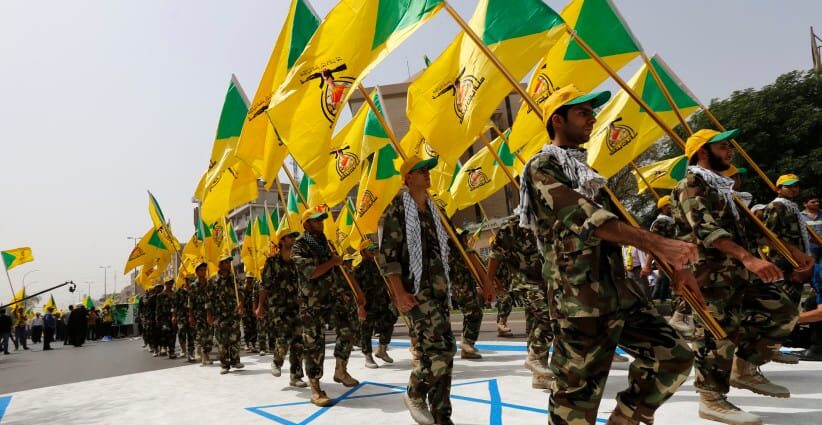
The recent announcement by the US Department of Justice regarding the arrest of Mohammed Baqer Saad Daoud al-Saadi, a senior figure in Iran’s proxy network, provides a stark illustration of the depth of Tehran’s operational penetration into both North America and Europe. Al-Saadi is not a peripheral operative.
He serves as a senior commander in Kataib Hezbollah, the spearhead of Iran’s proxy infrastructure in Iraq. He previously operated in close coordination with Qasem Soleimani, commander of the Quds Force, and with Abu Mahdi al-Muhandis, his principal counterpart in Iraq, both eliminated by the United States in 2020.
The Al-Saadi indictment: Tracking a transnational terror network
This case, however, extends beyond the familiar pattern of regionally confined counterterrorism operations. It exposes a transnational network operating across Canada, the United States, and Europe – underscoring the global scope of Iran’s proxy strategy.
The indictment filed against al-Saadi in a federal court in New York includes six serious terrorism-related charges and attributes to him direct involvement in nearly 20 attacks and attempted operations in the West.
Al-Saadi, who was arrested in Turkey and extradited to the United States, is assessed by the Federal Bureau of Investigation to have directed a sequence of 18 terrorist attacks across Europe within a span of just three months during 2026.
The evidence further reveals that on April 3, he was recorded instructing an undercover US agent to carry out a coordinated attack targeting a synagogue in New York, along with two additional Jewish institutions in Los Angeles, California, and Scottsdale, Arizona.
A new Iranian proxy in Western states
The exposure of this network directly links al-Saadi to the activation of a new and covert Iranian proxy operating under the name “Harakat Ashab al-Yamin.”
The organization appears to have been established and supported by the Iranian regime as a subversive response to the military campaign launched by the United States and Israel against Tehran.
The group’s operational record, some of which has been documented and publicized by the organization itself for purposes of psychological warfare, demonstrates a high degree of audacity.
Reported attacks include an assault on an American bank in Amsterdam (March 15), the arson of a synagogue in Skopje, North Macedonia (April 12), and a stabbing attack in London targeting two Jewish civilians, including a dual US-British national (April 29).
These incidents occurred alongside a series of explosions and arson attacks targeting Jewish sites in Golders Green in London, as well as in Belgium, Amsterdam, and Rotterdam throughout the month of March.
This reality once again underscores the direct threat posed by the Iranian regime to national security in Europe. The European Union took a significant step in mid-February by designating the Islamic Revolutionary Guard Corps as a terrorist organization. However, the picture in the British arena remains more complex.
In late March, Hamish Falconer, the United Kingdom’s Minister for the Middle East at the Foreign, Commonwealth & Development Office, formally rebuked Iran’s ambassador to London, Ali Mousavi, following the prosecution of two Iranian nationals accused of spying on Jewish centers across the country.
Despite this, official London continues to hesitate, refraining from applying a comprehensive terrorist designation to the Islamic Revolutionary Guard Corps.
Against this backdrop, a bipartisan group of US lawmakers recently urged the British government to end its hesitation. In their letter, the legislators cited the involvement of the Islamic Revolutionary Guard Corps in antisemitic attacks, intimidation campaigns, cyber operations, and assassination plots targeting regime opponents on British soil.
The pressure appears to be yielding only partial results. During a late-April visit to a London synagogue that had been targeted in an attack, UK Prime Minister Keir Starmer pledged to introduce legislation in July to outlaw the organization in order to “ensure that the Jewish community feels safe.” In an interview with The Jewish Chronicle, he also expressed deep concern over Tehran’s growing reliance on proxy actors.
Missiles over Europe and the fragility of Western alignment
The arrest of al-Saadi, together with the exposure of the “Ashab al-Yamin” networks, leaves little room for doubt: the Iranian regime constitutes a clear and present threat to global stability and to the sovereignty of Western states.
This threat is further compounded by Iran’s advancing ballistic missile program, whose operational range already covers significant portions of the European continent – placing major cities such as London, Paris, Amsterdam, Vienna, and Rome within direct reach.
This assessment is reinforced by the Iranian launch toward the joint UK-US base at Diego Garcia on March 21, which demonstrated a strike capability of approximately 3,800 kilometers. Although one missile was intercepted en route and another disintegrated roughly 600 kilometers short of its target, the test nonetheless underscores the growing range and ambition of Iran’s missile capabilities.
Yet, in the face of this escalating threat, the West appears fragmented and increasingly hesitant. While the United States is actively working to constrain Iranian aggression and, in practice, engaged in a military effort to contain it, key European states have adopted a posture of panicked appeasement, retreating from their original commitments. This trend reached a notable peak in the refusal by France, Spain, and Italy to authorize docking, refueling, or overflight access for US forces and transport aircraft en route to deliver critical military supplies to Israel.
Paradigm shift: Eradicating the head of the snake
These measures, driven by a European desire to avoid friction with Tehran and by internal political concerns, constitute a direct reward for the Islamic Republic’s state-sponsored terrorism.
Those who refuse to provide basing access and logistical support to their allies during a campaign against Iranian aggression reveal a broader reality: Iranian terrorism does not stop at the borders of the Middle East; it is already knocking at the gates of Europe, Canada, and the United States.
The West must awaken, recognize the total nature of the threat, and understand that the only way to ensure public security is not through the containment of proxies, but through eradicating the head of the snake in Tehran.
For Israel and the United States, the growing Iranian threat makes clear that the removal of the regime must serve as the central objective in any confrontation with Tehran, regardless of the outcome of the current war.
The writer is a lecturer in the “Politics of the Middle East” MA program within the School of Political Science at the University of Haifa, and a senior researcher at the Misgav Institute for National Security and Zionist Strategy.