AUSTIN, Texas — Tesla Inc. reported stronger-than-expected first-quarter earnings Wednesday, but shares gave up early gains after CEO Elon Musk and CFO Vaibhav Taneja revealed a sharp increase in capital spending plans, overshadowing an otherwise solid financial performance.
The electric vehicle maker posted revenue of $22.39 billion, up 16% from a year earlier but slightly below Wall Street expectations, while adjusted earnings per share came in at $0.41, beating analyst estimates. Operating income surged 136% year-over-year to $0.9 billion, with margins improving to 4.2%, reflecting tighter cost controls and improved pricing dynamics.
Tesla’s gross margin climbed to 21.1%, well above forecasts, driven by lower material costs and higher average selling prices, along with a one-time benefit tied to warranty and tariff adjustments. Automotive revenue rose to $16.2 billion, while the company’s energy division lagged, with revenue declining 12% to $2.41 billion following a sharp drop in energy storage deployments from late-2025 highs.
The market reaction turned sharply during the earnings call, when Taneja disclosed that Tesla now expects to spend more than $25 billion in capital expenditures in 2026, a $5 billion increase from prior guidance and nearly triple the $8.6 billion spent in 2025. The spending will fund a broad expansion across manufacturing, artificial intelligence, and robotics, including new global factories, battery production, semiconductor development, and the company’s AI infrastructure buildout.
Investors initially pushed Tesla shares higher following the earnings beat, but the stock quickly reversed course as the scale of the spending increase became clear, highlighting concerns about near-term profitability and execution risk.
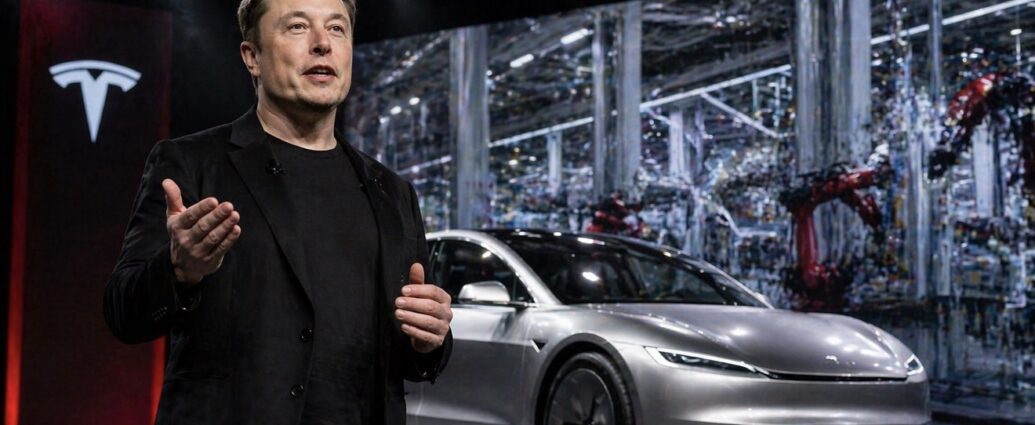
On the product front, Musk confirmed that Tesla’s Cybercab — a fully autonomous, steering wheel-free robotaxi — has begun production at its Texas facility, though he cautioned that the ramp-up would be gradual. “Initial production will be very slow, but then ramping up exponentially toward the end of the year and into next year,” Musk said, adding that Tesla Semi production is also set to begin soon in Nevada.
Tesla’s Robotaxi service, first launched in Austin in 2025, has expanded to Dallas and Houston, with Musk stating that the company aims to operate in “a dozen or so states” by the end of the year, pending regulatory approvals. He emphasized that Tesla is taking a cautious approach as it scales fully autonomous driving capabilities.
In a notable regulatory milestone, Tesla received approval for its Full Self-Driving (Supervised) system in the Netherlands, marking the company’s first entry into European autonomous driving markets.
Musk also provided updates on Tesla’s Optimus humanoid robot, saying a production-ready version is nearing demonstration, with a public unveiling expected later this summer. He acknowledged delays were partly strategic, aimed at protecting intellectual property from competitors. Tesla is converting part of its Fremont factory into a dedicated Optimus production hub.
On the technology side, Musk said Tesla has completed the design phase of its next-generation AI5 chip, which will power vehicles, AI training systems, and robotics platforms — underscoring the company’s deepening push into artificial intelligence.
In a separate disclosure, Tesla revealed it made a $2 billion equity investment in SpaceX during the quarter, contributing to a rise in total cash and investments to $44.7 billion.
Wall Street remains divided on Tesla’s trajectory. Dan Ives, Managing Director at Wedbush Securities, who maintains an outperform rating, said the company’s long-term valuation hinges on its AI and autonomy strategy. “The key focus is the Robotaxi rollout and Cybercab production — that’s the future growth engine,” Ives wrote ahead of the results.
Analysts at Cantor Fitzgerald described 2026 as a “transitional year,” noting that while Tesla’s next-generation platforms show promise, they remain in early commercialization stages amid intensifying global competition from companies such as BYD and Xiaomi.
Tesla shares are down roughly 14% year-to-date, underperforming other megacap technology firms. The company also disclosed that its Bitcoin holdings declined 22% to $786 million, reflecting ongoing volatility in digital assets.
In a development affecting existing customers, Musk confirmed that vehicles equipped with Tesla’s older Hardware 3 system will not support future unsupervised Full Self-Driving capabilities, a setback for owners who had expected eventual upgrades through software.
The results underscore Tesla’s evolving identity — from automaker to AI and robotics company — but also highlight the growing tension between long-term ambition and near-term investor expectations, as the company embarks on one of the most aggressive investment cycles in its history.
JBizNews Desk