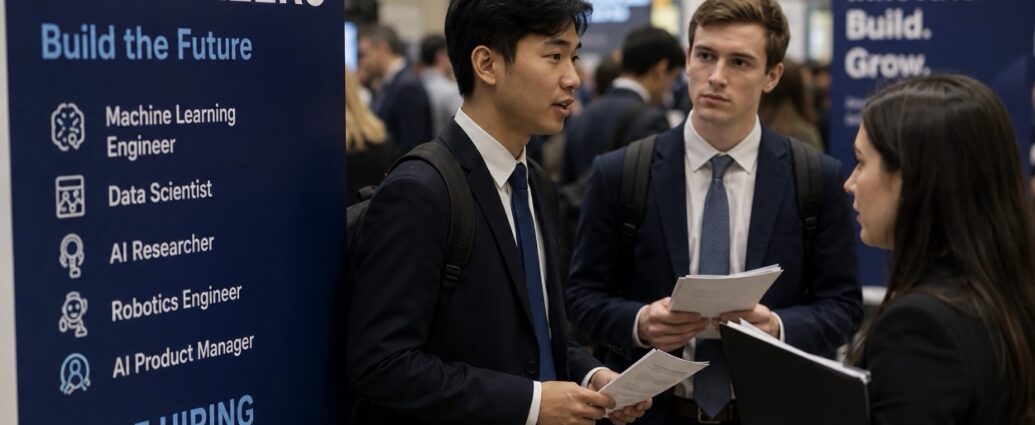
A fierce split has opened among chief executives, economists, and labor researchers over what artificial intelligence is doing to entry-level work. One camp says AI is gutting the bottom rung of the corporate ladder and warns of a generation locked out of white-collar careers. The other says AI is reviving early-career roles by making junior employees productive faster than ever before. Both sides have data, named advocates, and real-world hiring decisions behind them — and the gap between them is now wide enough that new graduates need to understand exactly where each argument comes from to navigate the market.
The elimination camp is led publicly by Dario Amodei, chief executive of Anthropic, who told Fox News that AI capability is advancing faster than workforce planners assumed and is closing in on the tasks that define early-career white-collar work. “Two years ago, it was at the level of a smart high school student; now it’s probably at the level of a smart college student and reaching beyond that,” Amodei said, warning that summarizing documents, brainstorming, drafting reports, and routine research — the daily work that once trained junior employees in finance, consulting, law, and technology — are precisely the functions AI is learning to perform.
The labor data backing that argument has become difficult for executives to ignore. Entry-level job postings in the United States have fallen 35% since 2023, according to labor-research firm Revelio Labs. A study led by Stanford economist Erik Brynjolfsson, using ADP payroll data, found employment for workers ages 22 to 25 in the most AI-exposed occupations declined between 12% and 15% from the third quarter of 2022 through the second quarter of 2025 — roughly 150,000 fewer early-career jobs. The researchers found the decline came overwhelmingly from fewer hires rather than mass layoffs, suggesting companies are simply replacing junior recruitment pipelines with software before workers ever enter the building.
Consulting firms are beginning to map which jobs are most exposed. Boston Consulting Group, in an April analysis, estimated that roughly 12% of current U.S. jobs fall into a category where AI directly substitutes for human labor in core tasks, leading to net job losses and wage pressure on the remaining positions. Financial-analysis support roles, basic coding, document review, and call-center functions ranked among the most vulnerable. A separate global survey highlighted by Fast Company found two-fifths of executives said entry-level roles have already been reduced due to AI-driven efficiency gains, while 43% expect additional cuts over the next year.
Yet the opposite side of the debate has become equally vocal — and it is being driven by some of the world’s largest employers.
Marc Benioff, chief executive of Salesforce, said the company plans to hire 1,000 new graduates and interns to help build its Agentforce and Headless360 AI-agent platforms, framing the move as a direct rebuttal to the idea that AI eliminates junior opportunity. Arvind Krishna, chief executive of IBM, told investors the company expects to hire more college graduates over the next year than it has in several years. Matt Garman, chief executive of Amazon Web Services, said Amazon plans to bring on roughly 11,000 software-engineering interns in 2026, broadly in line with prior hiring levels, because demand for AI-related development work continues to expand.
The hiring momentum is reinforced by corporate survey data. SAP and Wakefield Research, polling chief human resources officers at companies generating more than $500 million in annual revenue, found 88% of CHROs said AI is making early-career employees productive faster than previous generations of workers. Seventy-nine percent said new hires receive enterprise AI tools within their first month on the job, while 87% said companies now expect incoming employees to either arrive AI-fluent or learn the systems almost immediately. More than half reported measurable productivity gains and higher confidence levels among workers using AI-assisted systems.
Even the government data complicates the apocalyptic narrative. Unemployment among Americans ages 20 to 24 has fallen sharply from last year’s peak and currently stands near 5.6%, according to data tracked by the Federal Reserve Bank of St. Louis. Meanwhile, demand for AI-related skills is accelerating across entry-level recruiting pipelines. As of March 2026, more than 10% of internship postings on the early-career platform Handshake referenced AI-related skills or tools, nearly double the share from a year earlier.
In reality, both camps are describing different parts of the same labor-market transformation.
AI is eliminating execution-heavy entry-level work — repetitive coding, data entry, first-draft writing, ticket routing, routine research, and standardized reporting. Those functions historically formed the training ground for junior workers. At the same time, AI is creating an entirely new category of entry-level employment focused on deploying, monitoring, integrating, auditing, and managing AI systems themselves.
Hugo Malan, president of the science, engineering, technology, and telecom division at staffing firm Kelly Services, described the shift as “a tectonic realignment” rather than a one-for-one replacement cycle. Andrew McAfee, principal research scientist at the Massachusetts Institute of Technology and co-leader of its Initiative on the Digital Economy, warned companies that removing junior employees entirely could damage their own future leadership pipelines. “How else are people going to learn to do the job except via on-the-job learning and training apprenticeship?” McAfee told Harvard Business Review.
Inside corporate America, the new hiring focus is becoming increasingly clear. Aaron Levie, chief executive of Box, told The Wall Street Journal that banks, pharmaceutical companies, healthcare systems, and large enterprises are now aggressively hiring engineers and operations staff capable of implementing AI-agent systems across their organizations. The market is shifting away from workers who simply execute tasks and toward workers who supervise, refine, troubleshoot, and operationalize AI itself.
For younger workers, the practical implications are increasingly straightforward.
The first advantage is demonstrating real AI fluency rather than vague familiarity. Employers are no longer impressed by resumes that simply mention “AI experience.” Hiring managers increasingly want evidence of actual implementation — which tools were used, what workflows were automated, what content or systems were built, and what productivity gains resulted.
Second, workers increasingly need to pursue augmentation roles rather than substitution roles. The positions showing the strongest growth are implementation engineering, AI operations, workflow automation, prompt architecture, AI compliance, quality control, and human oversight functions. The positions under the greatest pressure remain repetitive coding, basic research, tier-one customer support, and standardized financial analysis.
Third, graduates are benefiting most from joining firms publicly expanding junior hiring pipelines around AI adoption. Companies scaling AI products still require large cohorts of younger workers to build infrastructure, manage deployment, and support enterprise adoption. By contrast, companies using AI primarily as a headcount-reduction strategy are creating narrower entry points and steeper internal competition.
Fourth, judgment is becoming more valuable than raw production ability. The new entry-level role increasingly centers on verifying AI outputs, identifying mistakes, escalating complex situations, and translating machine-generated insights into decisions senior executives can trust. Knowing when AI is wrong may ultimately become more valuable than producing the first draft yourself.
Finally, the broader AI economy is also reviving demand for non-office labor that many white-collar graduates have ignored. Nvidia chief executive Jensen Huang recently described the AI expansion as “the largest infrastructure buildout in human history,” requiring massive numbers of electricians, plumbers, HVAC technicians, steel workers, installers, network specialists, and equipment operators. AT&T chief executive John Stankey said the company is paying substantial bonuses to recruit and retain field technicians as AI infrastructure construction accelerates nationwide.
The bottom line emerging from the debate is that both camps are correct — but only partially. The traditional execution-based entry-level job is unquestionably shrinking. But a new generation of entry-level work centered on AI deployment, oversight, and operational judgment is expanding rapidly, often at higher wages than the jobs being replaced.
The graduates who treat AI as something to compete against risk being displaced by it. The workers who learn how to direct, supervise, and build alongside it are increasingly positioning themselves on the winning side of the divide.
— JBizNews Desk
© JBizNews.com. All rights reserved. This article is original reporting by JBizNews Desk. Unauthorized reproduction or redistribution is strictly prohibited.