
The Israeli woman who approached Mike Evans in a California restaurant had woken up that morning feeling depressed. Then, he recalled, she turned on the television and heard people from around the world singing. Recognizing the man behind the production, she came over to thank him.
For Evans, an American Christian evangelist who leads Friends of Zion and has supported Israel and the Jewish people for more than 40 years, the encounter captured what “The Whole World Sings Together” was meant to do: reach people who believed they had been abandoned and let them hear something different. “So, … we believed that the vision was more than a song. It was a movement; it was a global movement,” Evans told The Media Line.
Seventeen singers of different nationalities took part in the production, bringing their own languages, musical traditions, and experiences of belonging and loss. Inspired by the spirit of Michael Jackson and Lionel Richie’s “We Are the World,” the song became part of Evans’ effort to demonstrate international support for Israel and the Jewish people.
That effort includes a 24-hour global prayer broadcast and approximately 2,000 Christians now visiting Israel for Oct. 7 commemorations and solidarity events.
Asked where it all began, Evans recalled the painful experiences of his childhood home. “Well, it started for me at 11, when my father strangled me and left me for dead. He was an antisemite, and he was married to a Jew, my mother, and he hated Jews.” He said that when he regained consciousness, he made a fist to God and asked, “Why was I born?”
He said the answer became his life’s purpose.
“I couldn’t defend one Jew against the Jew-hater. My life’s call was to defend all the Jews, and there’s never been a more important time to show solidarity with the Jewish people globally than right now.”
Producer was flattered, excited when Evans pitched idea
Producer Noam Ben Shalom credits Evans with creating “The Whole World Sings Together” and said that when Evans proposed the production, he was flattered and excited. Then came the almost impossible deadline – a finished video clip to be ready in two weeks.
“I said, well, Mike, with God’s help.”
“He said, you have God’s help.”
Ben Shalom, a freelancer who has worked with Friends of Zion for more than a decade, joined a team that included co-producer Zvi Raviv, musical director Ronit Banit, and Friends of Zion staff. They searched social media and personal connections, requested videos, and conducted screen tests.
“Eventually we managed to gather 17 singers,” he said. “We got into the studio for two very intensive days, and we started working on the clip.”
The frantic search soon gave way to a different feeling once the voices began coming together.
“Once we got into the studio, the atmosphere was electrifying,” Ben Shalom told The Media Line.
“They felt their mission. We felt our mission, Ronit and I. And we really thought and felt that we are doing something great here.”
Banit said she looked beyond talent when choosing the ensemble, weighing the singers’ sensitivity to Oct. 7 and how they treated one another. In the studio, those choices became something she could hear and feel.
“We stopped being just a collection of singers from different places and became a single group, with a real human and musical relationship,” she told The Media Line.
Raviv has known Evans for about 30 years, since running the Jerusalem 3000 project. He describes their friendship as one that has helped bring Christians and Jews together through humanitarian work.
Finding voices for Evans’ latest idea meant drawing on Israel’s diverse population. Raviv cited a description by Israel’s fifth president, Yitzhak Navon, of people arriving from 116 countries. But locating singers from countries such as India and Japan proved harder, and embassies helped.
Even with the performers assembled, the words did not simply fall into place. Music written for English had to accommodate languages with different rhythms and line lengths.
“Now, if I take Hebrew, Hebrew is longer than English. Japanese is shorter than English. How do you fit the music, the words into the music?” Raviv asked.
Another challenge was keeping the song clear of the political arguments surrounding it.
“We wanted to bring … the message of unity, the message of togetherness, the message of just being human without getting into strife and into battles, etc.,” Raviv told The Media Line.
For Ronen Lazarov, Banit, a conductor and pianist with whom he had previously performed, extended the invitation.
“The idea … was not only to sing this song in English, but to sing it in different languages, according to the mother tongue of each one of the singers,” he said. “And my ticket was the Italian.”
A tenor from Milan, Lazarov came to Israel after high school with friends from a Zionist youth movement. His early years included kibbutz life and the army. More than 40 years later, his family connections remain in Italy, but he lives in Israel.
He began developing his operatic voice in his mid-20s, studying privately for years with teachers in Tel Aviv and Jerusalem. He now performs in orchestral and choral projects, gives recitals, and sings with bands.
In the studio, he met unfamiliar faces, including a Chinese participant living in the Upper Galilee and an Iranian singer. Yet the feelings the project stirred were familiar. Each anniversary, he said, changes how Oct. 7 sits in people’s memories; recording brought those emotions back to the surface.
“We felt that we were part of something that can be an ambassador in the world to try to explain in an artistic way what the feelings of our people are about this tragic event and what happened after that,” he told The Media Line.
He called it shlichut – a mission. During the chorus, the singers looked into one another’s eyes and moved with the music. After hours of recording, Lazarov left with a feeling he still struggled to describe. “My feeling was … that I was like seven meters above the ground.”

Cherubin Ngemba had long imagined singing alongside people from different international backgrounds. “I was thinking how one day it can be possible for me to sing with other people from other countries, from other cultures, how we can bring something together for one objective, to be united.”
When Ben Shalom invited him to join Evans’ project, he accepted. “I did it with all my heart.”
Ngemba, 37, said he arrived from the Democratic Republic of Congo in 2016 after threats connected to a youth association led by his father. His father sought somewhere safe to send him, and Israel granted him a visa.
Ngemba’s connection to the project was also personal. A close friend, Bar, was murdered after attending the Nova festival on Oct. 7.
That loss gave Evans’ campaign urgency. He said the protests immediately following Oct. 7 intensified his determination to show another picture. He described demonstrations against Jews and in support of Hamas, including American young people chanting “from the river to the sea.”
“So, we’re showing, no, no, no, it’s not true, that the world is not against the Jewish people. Quite the contrary. The world is with them, and we’re showing that and revealing and exposing the lie.”
Evans said 130 nations would unite in solidarity for the 24-hour prayer event, including thousands participating from Pakistan. He described it as the largest solidarity event in Israel’s history and the largest prayer meeting in the world.
For Evans, its growth is part of a continuing effort rather than a single production.
“Well, it’s a wave. You’re building a wave, and one of the things that I’ve always believed is that the key to happiness is committing your life to a cause greater than yourself, and this is such a cause.”
For many participants, the support he wants Israelis to recognize is rooted in faith. Evans estimates that there are 750 million Bible-believing Zionists and argues that Israel underestimates how many of its supporters are not Jewish.
“Now, they don’t agree on the politics of Israel, but they do agree that this is a Jewish state, and it’s a fulfillment of prophecy,” he said.
“They believe that God will bless them if they bless the Jewish people, and God will curse them if they curse them.”
Pressed on whether Christian leaders sufficiently understand the complexities of Israel, Arab nations, and Iran, he returned to the Bible. “It’s not a problem for them, because they’re moral clarity people, and they based it upon their Bible.”
Evans’ own view of present-day conflict is uncompromising. He describes Israel as a firewall against radical Islam, links hostility toward Jews and Christians, and argues that weakening Israel and American accommodation of the Muslim Brotherhood helped create the circumstances that led to the September 11 attacks.
He draws a sharp distinction, though, between standing with Israel and endorsing its politics. “I’ve never agreed with Israel’s policies. It’s mishigas. It’s crazy stuff.”
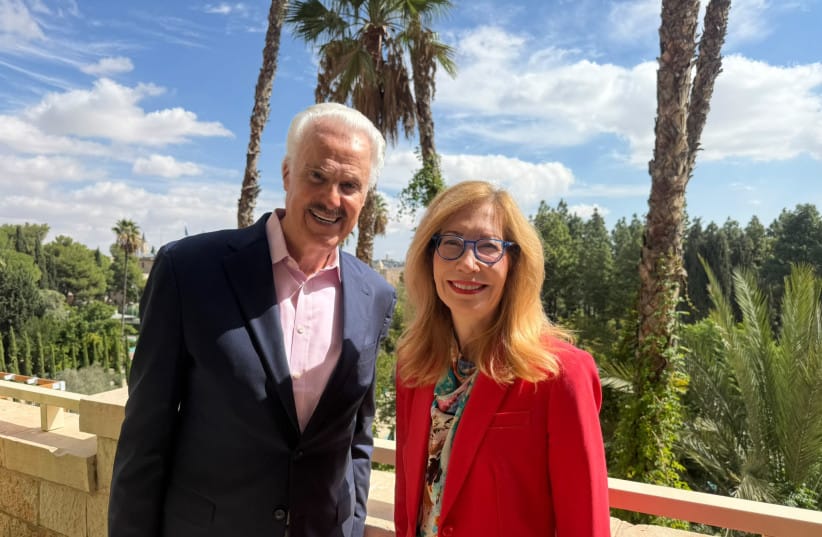
Evans criticized the coalition government, the Supreme Court’s structure, and the attorney general’s role, and rejected both right-wing and left-wing labels.
Raviv wants the song to reach beyond those divisions – and beyond Israel. “If you look today into every single country, every single country has a problem of polarization. We need to depolarize the world,” he said.
“And this song hopes to carry the message of depolarization of the world for people to act together for the improvement and betterment of humanity.”
For Evans, young people are a crucial audience. He believes universities, artificial intelligence, and hostile messaging have distorted their understanding, comparing what he sees as their indoctrination to that of Nazi youth.
His response includes social media influencers whose posts, he said, attracted more than a quarter-billion views last year, as well as challenging figures such as Tucker Carlson. “It’s a war of ideas. It’s a media war, also.”
Evans predicts that the event, music, and related social media efforts will generate more than 1 billion views and reach more than 1 billion people within 12 months.
He said the prayer event would stream online and be carried by broadcasters. Ben Shalom expects the music video’s inclusion in the 24-hour broadcast to reach tens of millions, potentially hundreds of millions, of viewers.
Ben Shalom measures its effect in more personal terms.
“You know, feeling the love and support of different nationalities, the message to the world that we are with you, that Israel, you are not alone, is something that is very heartwarming and very rare in these days,” he said.
Evans hopes that support will also challenge perceptions of Israelis as arrogant, aggressive, militaristic, or heartless. He points instead to hospitals treating Muslim patients and employing Muslim doctors. “And it’s just that perception is reality in many people’s eyes, but perception is not truth,” he said.
Raviv, asked what future generations should remember, wants them to hear more than a beautiful performance. “The music is beautiful, but the question is whether people look into the message.”
For him, Jerusalem gives that message religious and historic significance: a city associated with monotheistic faiths, belief in a God overseeing human conduct, and an obligation to do good. He hopes a message emerging from Jerusalem can urge people to end conflict and live in peace.
Lazarov is cautious about the distance between the song’s ambition and the world outside the studio. “We want the whole world to sing together,” he said. “Unfortunately, it’s not what is really happening in the world now. But this can be one drop in the big sea where we can try to influence somehow.”
Evans: Music won’t remove ‘memories of October 7’
Evans knows the music cannot undo the loss. Asked whether hope might soften or blunt the memories of Oct. 7, he answered directly. “No, hope won’t remove the memories of October 7.”
For Banit, the possibility of something new emerging from grief was there in the studio.
“For me, this song is much more than a musical production. It’s a small proof that even out of great pain, a new encounter can be created. People can come from different countries, speak different languages, and grow up in different cultures, and still find a single, shared voice.”