Since the events of October 7, it has become undeniably clear that Israel is fighting not only on the battlefield, but also in the arena of international public opinion.
While Israeli soldiers operate decisively against brutal terrorist organizations, another war has unfolded in parallel: the war over the narrative. In that arena, unfortunately, Israel has failed time and again, not only because of the strength of opposing propaganda but also because of deep internal weaknesses.
The failure of Israeli public diplomacy is not a new phenomenon. Rather, it is the result of years of neglect, lack of coordination, and above all, the absence of clear and centralized leadership.
The National Public Diplomacy Directorate, which was supposed to serve as Israel’s spearhead in the battle for global public opinion, operated without a permanent director, a unified strategy, and without real authority. Under such conditions, victory is impossible, even when justice is on your side.
The reality following Oct. 7 illustrated this sharply and painfully. On social media, staged or partial videos, images without context, and at times entirely false information spread rapidly and gained millions of views within hours.
Instead of responding quickly and decisively, Israel found itself reacting too late and refuting claims only after the damage had already been done. Serious accusations regarding “deliberate harm to civilians” circulated before the facts had been verified, and even after some of the claims were disproven, the damage to public perception had already occurred.
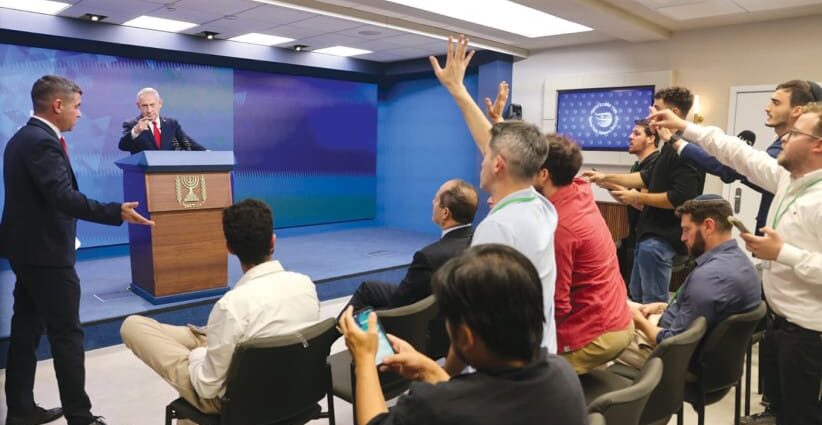
Serious failures were also evident in international television coverage. Interviews with Israeli spokespersons often turned into media traps, with hostile interviewers interrupting guests, steering the conversation, and presenting questions framed around assumptions of guilt.
At the same time, commentators and reporters in various countries at times crossed the line between legitimate criticism and rhetoric that was emotionally charged and at times even antisemitic. Instead of analyzing policy, some coverage relied on sweeping language, demonization of Israel, and, at times, even questioning its right to exist.
As a result, criticism of military actions, which is legitimate in any democracy, sometimes evolved into a broader campaign of delegitimization. The use of historically loaded expressions, inaccurate and at times dangerous comparisons, and the portrayal of Israel as the sole source of violence strengthened hostile narratives and deepened Israel’s international isolation.
The problem lies not only in the content being presented, but in the structure itself. It is no secret that Israel’s public diplomacy system is fragmented among government ministries, security bodies, and outside organizations. Each operates according to its own considerations, lacking sufficient coordination and a unified messaging line.
A fragmented system without leadership
When there is no single guiding authority, the message becomes scattered and at times even contradictory. The result is confusion, lack of credibility, and diminished influence.
This is precisely why the appointment of a professional, experienced leader with a broad strategic vision is so important. This is where the recently appointed head of the National Public Diplomacy Directorate, Tzipi Hotovely, enters the picture. It is a worthy, necessary, and above all, promising appointment.
Hotovely brings with her a rare combination of education, diplomatic experience, and deep understanding of the international arena. She is not only a politician; she is also an experienced diplomat who has proven herself in one of the most difficult and complex arenas: Britain.
During her tenure as Israel’s ambassador in London, she operated before one of the most challenging and hostile audiences, while projecting a clear, sharp, and persuasive voice. She understood how media discourse functions, how narratives are built, and how public agendas can be influenced.
But an appointment, important as it may be, is not enough. Rehabilitating Israeli public diplomacy requires a fundamental change. First and foremost, a single centralized body with clear authority must be established to coordinate all public diplomacy efforts.
Such a body must operate professionally, rapidly, and flexibly, exactly as Israel’s adversaries operate in the battle over public perception.
Investment is also needed in training spokespersons and opinion leaders, not only within government systems but also throughout civil society. In the age of social media, every citizen is a potential ambassador.
Yet without tools, knowledge, and guidance, that potential is wasted and can even become harmful. Clear tools must be provided to address misinformation, improve response times, and enable proactive, rather than merely reactive, communication.
Israel must also shift from defense to offense. The country should not limit itself to refuting allegations, but should actively promote its own narratives by presenting its human stories, democratic values, and the complexity within which it operates. The world does not sufficiently understand Israeli reality, and this is a failure that must be addressed proactively, consistently, and intelligently.
Finally, it must be understood that public diplomacy is not a luxury. It is a strategic component of national security. Just as Israel invests in intelligence, military capabilities, and technology, it must also invest in shaping public consciousness. Whoever prevails in the battle over perception influences the legitimacy to act, and sometimes even the outcome of the conflict itself.
The challenge is immense, but so is the opportunity. Hotovely’s appointment signals a new direction that is more professional, more focused, and above all, more determined.
If she is given the necessary tools and authority, there is little doubt that she will be able to lead real change and restore Israel’s voice in the international arena.
The author is the CEO of Radios 100FM, honorary consul and deputy dean of the consular diplomatic corps, president of the Israel Amateur Radio Club, and a former Israel Army Radio monitor and NBC television correspondent.