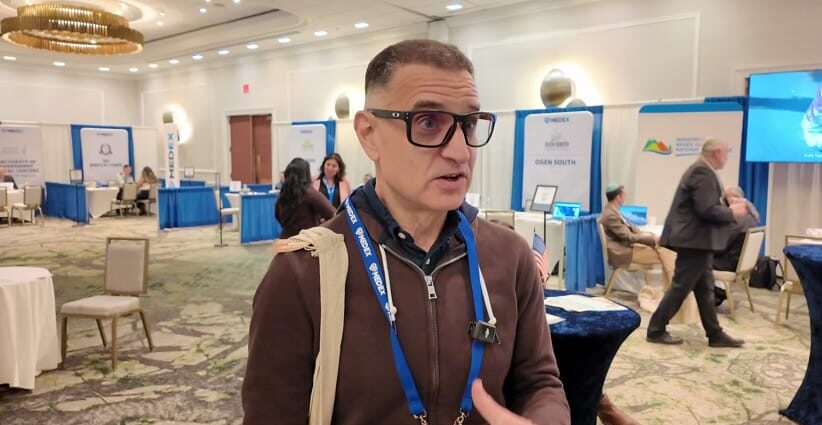
NEW JERSEY – Lance Dunlop was, the day I met him, technically still a soldier in the United States Army. By the time you read this he will not be. He told me it was his last day in uniform almost in passing, the way you might mention you’d skipped lunch, and then he got back to the more pressing business of explaining how he had arranged to move to Haifa.
Dunlop is a psychiatrist. He lives in Alaska, where there is a great deal of snow and a large military presence, and he runs a medical practice there. In August, he will start work as an attending physician at Rambam Health Care Campus in Haifa, where there is very little snow. He already has the job. He already has his Israeli medical license and his board certifications. What he does not quite have is a tidy explanation for why a man with, by his own account, a very good life in Alaska would give it up for a country that spent much of the last two years under rocket fire.
“Part of it’s scary,” he said. “I love my life here. I have a really, really good life. But I know that I’m not going to be happy unless I’m in Israel.”
He is sixty, give or take, and the story doubles back forty years. In 1984 he came to Israel at eighteen on a year program at Tel Aviv University. He was meant to leave after a year. He didn’t. He stayed, made Aliyah, and served four years in the IDF as a paratrooper, including combat in Lebanon. He did not get into medical school in Israel. “You have to be freaking brilliant,” he said, and waved the memory off. So he went to the University of Pennsylvania instead, became a doctor in America, and joined the US Army Reserve. He did not expect to go back to Israel. Then, a year ago, the Army sent him to Israel as part of an American air-defense unit protecting the country from missiles, and somewhere on the tarmac at Ben Gurion the thing he had buried for forty years came back up.
There is a story he tells about that deployment. An Israeli sergeant, the one in charge of discipline, took him aside to ask why he was wearing an American army uniform. “Because I’m an American soldier,” Dunlop told him. He said it was an eye-opening moment for both of them. He was wearing the colors of one country and standing, he felt, in another.
A ballroom that doubles as a departure gate
I met Dunlop at MedEx, an annual event run by Nefesh B’Nefesh, in partnership with Israel’s Ministries of Aliyah and Integration; Health; and the Negev, Galilee and National Resilience; as well as the Jewish Agency for Israel. It has quietly become the single most efficient on-ramp into the Israeli healthcare system that exists anywhere in the Jewish world. This year’s edition, in a hotel in New Jersey with a Starbucks next door, drew some 350 medical professionals from across North America. It was the largest international MedEx to date, according to the organizers, with physicians from roughly 31 specialties alongside dentists, nurses, genetic counselors, psychologists and the rest.
The room was a strange and rather wonderful hybrid. The main ballroom was dim and a little party-ish, with tables of food and a low hum of conversation, and people drifting off to talks happening in other rooms. But it also had the unmistakable energy of a transit hub. Everyone had somewhere to be: a desk, a table, a station in the room next door where you could get your medical documents and certificates scanned. People moved through it with the butterflies-in-the-stomach look of travelers about to board a flight they have wanted to take their whole lives, except that the flight was a country and the boarding pass was a stack of notarized paperwork.
Nefesh B’Nefesh’s pitch is that it removes the stack. A medical professional can walk in and, over a single day, walk out with a license conditioned on making Aliyah, a job lined up with an Israeli hospital or health fund, and (new this year) a Hebrew proficiency test already behind them.
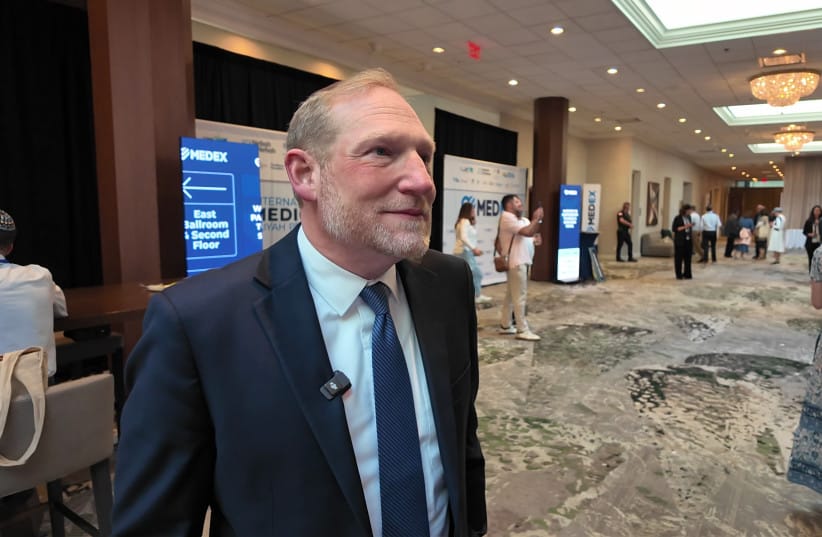
“That means when you hit the ground you have four or five days until you have a license in hand,” Rabbi Yehoshua Fass, the organization’s co-founder and executive director, told me. “And you have a job lined up, because the hospitals and the medical clinics have been fighting for you during the day to offer you a position. It is a dream.”
Fass, who co-founded Nefesh B’Nefesh in 2002 with its chairman, Tony Gelbart, has been doing this for twenty-four years, and he talks about the medical track the way an engineer talks about a system he is proud of. The bureaucracy used to take a new doctor almost a year on arrival: a year of forms and licensing and the supervised clinical period Israelis call the stage, a year in which you could not work or earn while the paperwork ground on. “You would be twiddling your thumbs,” he said. MedEx compresses that year into a day, or close to it.
This year they added two things. The first is a small technological flourish: every registrant wears a QR code that holds their entire CV, so that when a doctor sits down at a hospital’s table the representative scans the badge and the whole resume (specialties, residencies, subspecialties) loads into the system, instead of being scribbled out by hand. The second is more consequential. A new rule requires doctors to pass a Hebrew proficiency test, and rather than make people wait until they reached Israel, Fass had the examiners brought to New Jersey. Upstairs, in a classroom on the second floor, olim-to-be sat the YAEL exam.
I had been on the receiving end of the problem that test is meant to solve. I have sat in an Israeli doctor’s office where the doctor’s English ran out before my Hebrew began, and we sort of met in the middle and hoped. “So in this kind of environment,” I said to Fass, “you’re making sure the Israelis who live in Israel are going to get the same service from the people who’ve just arrived.” He nodded. “That’s the Ministry of Health that added that level this year.”
Why a country needs to import its doctors
Behind the optimism in the room sits a hard arithmetic. Israel’s universities train fewer than a thousand doctors a year, and by the reckoning of the Aliyah and Integration Ministry the country needs closer to two thousand. The gap has a demographic edge to it: the enormous wave of immigration from the former Soviet Union in the 1990s brought with it a generation of doctors who staffed Israeli hospitals for three decades and are now retiring, all at roughly the same time. A steady number of Israeli-trained doctors also leave to work abroad, a long-running feature of the system that no one ministry has quite made its own. The shortfall is felt most acutely in the northern and southern districts the program is trying to staff.
That is the gap. Western Aliyah is one of the ways Israel is trying to close it.
In 2024 the ministry launched the International Medical Aliyah Program, IMAP, with a target of bringing 2,000 doctors to Israel by 2029. It is backed by the Marcus Foundation, the Gottesman Fund, Jewish Federations of North America, the Azrieli Foundation and the Arison Foundation. Since its launch the program has, by the ministry’s own account, brought more than 1,100 doctors in about two years, past the halfway mark. Of those 1,100-plus, 179 came from North America. The bulk came from elsewhere, much of it from the east, and some of that was, as Minister of Aliyah and Integration Ofir Sofer put it to a group of us, a windfall: doctors leaving Eastern Europe because of the war in Ukraine, some of whom were “on the road” anyway and whom Israel simply caught as they passed.
That is what an event like MedEx is partly for: to grow the North American share, in a part of the world the program is still working to reach.
The model leans hard on geography. The grants are bigger if you go where Israel most needs you. A new oleh in the center of the country might get a token housing subsidy that shrinks each year; one who moves to Dimona, or Karmiel, or up into the Galilee, can have the state cover something like 40 percent of the rent. “Today, more than ever, the State of Israel needs quality doctors in Safed, Metula, Kiryat Shmona, Beersheba and Dimona,” the Minister for the Negev, Galilee and National Resilience, Yitzhak Wasserlauf, said in a statement. The ministry pours additional money into hospitals in those regions to make the hires worth their while.
Reena Pankower, who was there representing that ministry, put the sell more plainly. The periphery offers a quieter life, she said, and less competition. “There’s more room for growth, there’s more room to establish themselves.” And there is something else, harder to put on a grant form. “There’s also a certain sense of shlichut,” she said. Mission. The people who choose Safed over Tel Aviv, in her experience, are the ones who wanted to feel needed.
Every stage of the same journey, in one room
What made the day absorbing was that the room held people at every point on the road at once.
Some had only just stepped onto it. Nina Epstein, a pediatrician, and her husband, Yoni, an anesthesiologist, had come because a daughter is making Aliyah and they have decided to follow her. They had been to exactly one lecture. “We just went to one lecture, so we have a lot of questions,” Nina said. They were not at the document stage. They were barely at the deciding stage, except that they had, clearly, already decided. When I asked whether it was the pull of Israel or a push out of America, Yoni thought about it. “I think the pull factor is stronger than the push,” he said, and then, after a beat, “although, has it gotten a little more uncomfortable? Yeah.”
Others were nearly done. David Sloan, an allergy and immunology physician, is moving to Haifa at the end of July with a fourteen-year-old daughter for whom he has already found a school. He has finished his documents. He came to the event to talk to hospital systems about academic medicine and medical education, and he wanted me to understand that none of it would have happened without help. “I’m one of those guys who almost didn’t go to college because I cannot fill out forms,” he said. Without Nefesh B’Nefesh walking him through every step, he reckoned, the move would have been almost impossible. Before their help, the process had been “just a morass of, how am I possibly going to navigate all this bureaucracy.”
And some were essentially at the finish line, signing off on a decision made long ago. Dr. Chava Blybis, a trauma and critical care surgeon, was at her third MedEx, mostly because she had been missing a document last year and wanted it done right. She did not need much convincing about the move; she has been working in Israel since October 7, operating on soldiers and civilians at Barzilai Medical Center and Ziv Medical Center. Trauma, she said, is a language of its own. “No matter where you go in the entire world, we’re all taught the same A, B, C, D, E.” The Hebrew sorts itself out. The work doesn’t change.
Talia Kupferman, a genetic counselor who works in an IVF clinic, was somewhere in the hopeful middle, five years into a five-year plan, documents in hand, waiting in line to open her file. At one point she lifted two diplomas to show me, a bachelor’s from Stern College and a master’s in human genetics from Sarah Lawrence College, and I noticed they were still in their photo frames. She had taken them straight off the wall to bring them, I noted. “Literally,” she replied. There is something about a person carrying their framed degrees through a hotel ballroom that captures the whole enterprise: the proof of a life’s work, held against your chest, on its way to being translated into another country’s language.
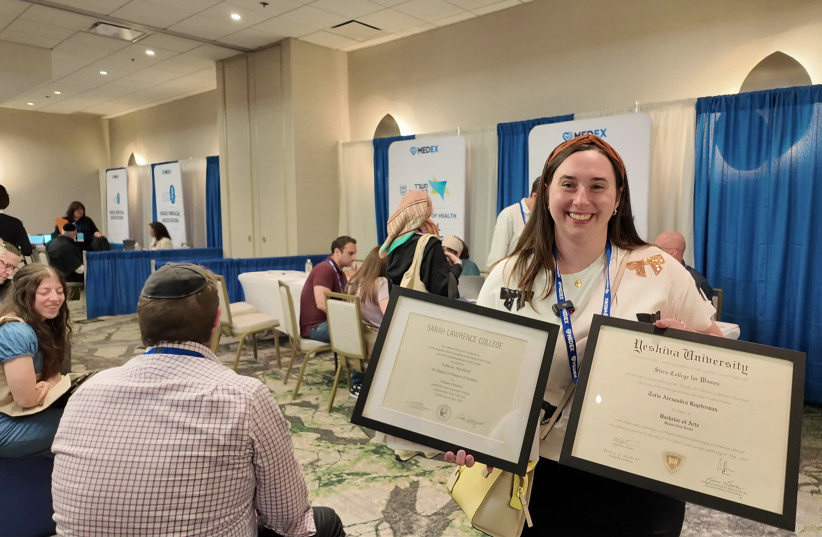
She had been preparing for that translation for years without quite calling it preparation. During COVID she had shadowed the genetics team at Hadassah, and she kept a notebook: every Hebrew word she didn’t know went in it, and after each session she asked a doctor or counselor what it meant. The same medical words kept recurring, and slowly but surely they stopped being foreign.
The ones who aren’t going, and the one who can’t not
Not everyone in the room was leaving, and the honest ones were worth listening to most.
Dr. Brian Smolarz, an endocrinologist from New Jersey, came purely to find facts. He has no Aliyah plans. He is, he said, a planner by temperament, the sort of person who likes to know what he would need to do before he ever needs to do it. But when I asked whether the changing climate for Jews in America was pushing him toward Israel, the question nearly everyone else answered with some version of yes, he gave the opposite answer. “Not really for me,” he said. His job, as he saw it, was “to be a proud American Jew” and to demonstrate his Judaism openly at home, as a kind of pushback. He loves Israel and wants to support it. He just does not, for now, plan to live there.
Talia Kupferman, for all her certainty about her own move, was just as firm that it was hers and no one else’s. People in her community feel the pressure, she said, and she will not judge anyone who feels it differently. “If you want to, that’s great. You go at the time that’s right for you. There’s no point in going if it’s not right.” The time, for her family, is now. That it is not now for someone else is, to her, simply a fact about that someone else.
And then there was Dunlop, who could not have answered Smolarz’s question if he tried, because for him there was never really a question. Late in our conversation he got his phone out to show me photographs from Lebanon in the 1980s, his unit, a submachine gun, a hill above Nabatieh he and his comrades had just retaken, and the phone froze, and we spent a companionable minute trying to force-restart it. He is a child psychiatrist now, and he had his own combat trauma once, untreated for years, which is most of the reason he became one. He was careful to say he was not arriving with all the answers for a traumatized country. “It’s not just this thing where, hey, I’m coming with all the answers, I know everything. No. It’s a relationship. It’s dynamic. We do it together.”
What he would say to someone on the fence, he told me, was simple. Go and look. Reach out. “If it feels right to you, or even if it halfway feels right, or a quarter feels right, then you can’t let that fire go away. You have to explore it.” Maybe it won’t be for you. But you have to find out.
‘The right place on the ship’
One of the first people I spoke to all day was Howard Winter, a dentist from New York who is about to turn 62 and who has been dreaming of this for thirty-six years. He chose dentistry, partly, because it was a good profession to carry to Israel, and then life got in the way, as it does, and the dream waited. His three daughters are all in America. His apartment in Netanya is nearly finished. He is not coming to drill teeth; he has ideas about building businesses, a medical referral service, work that uses his head more than his hands, “because my body hurts me a lot.”
I asked him what made now the time, after a difficult few years for the country. He did not flinch.
“It’s been difficult all the time. I think now it’s just different difficult,” he said. “I do believe we’re living in very unusual times. If you’re going to go down with a ship, you might as well go down in the right place on the ship.”
I said it sounded like an optimistic message, and he agreed. He was not being grim. “I’m pretty optimistic. I think the best years are yet to come.”
By late afternoon, the ballroom was thinning out. The QR codes were still being scanned. Upstairs, somewhere, a few last people were finishing a Hebrew exam they would not have had to take a year ago, in a country that needs them more than it can comfortably admit. The diplomas were going back into their bags. And the doctors were going home to New Jersey, and Alaska, and New York, for now, to pack.
The writer attended MedEx New Jersey as a guest of Nefesh B’Nefesh.