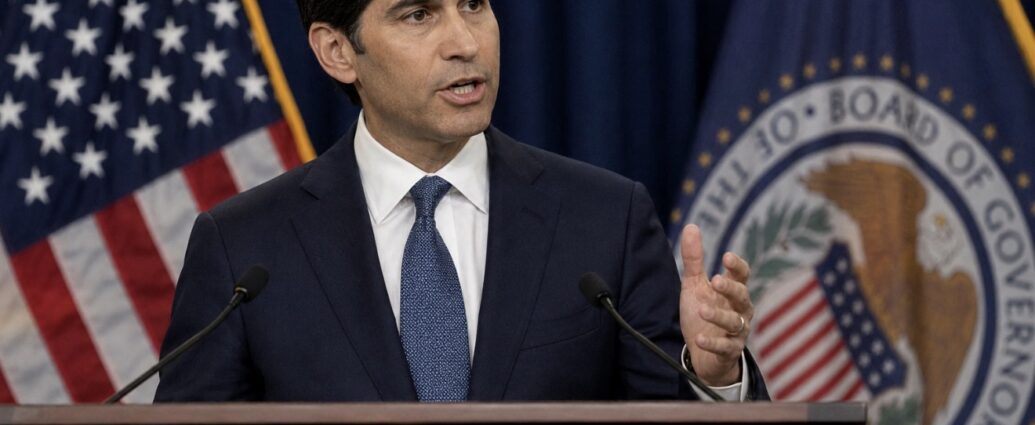
The Federal Reserve opens a two-day policy meeting Tuesday that ends Wednesday, June 17, with a rate decision, and it doubles as the first real test of new Chair Kevin Warsh, who was sworn in as the 17th chair of the central bank in May. Markets widely expect the Fed to leave its benchmark rate parked at 3.50%–3.75%, where it has sat since December. The drama isn’t the rate. It’s everything Warsh says and does around it.
Traders are pricing in better than a 98% chance of no move, according to CME FedWatch data. What’s changed is the direction of the next step. Fed funds futures now lean toward a rate hike, not a cut, as the more likely year-end outcome — a sharp reversal from the easing path investors expected just months ago. Stubborn inflation, fueled by the Iran war’s hit to energy prices, has frozen the Fed in place.
To see how far the mood has shifted, look back a year. In June 2025, the Fed’s own projections pointed to 75 basis points of rate cuts by the end of 2026. Those cuts have effectively been shelved. The March 2026 projections lifted the core inflation forecast to 2.7%, the May reading came in hotter still, and the labor market is holding firm with unemployment near 4.4%.
The bigger question is whether Warsh blows up one of the Fed’s most-watched tools. Warsh has long criticized forward guidance, and reporting indicates he may begin rolling it back as soon as this meeting — potentially dropping the dot plot rate forecast and stripping easing-or-tightening bias language from the statement. The dot plot, released quarterly, shows where each official thinks rates should go. It lands Wednesday alongside a fresh Summary of Economic Projections and Warsh’s first press conference, his first big platform to set the tone of his chairmanship.
Wall Street strategists see continuity on rates and a shift in tone. “The Kevin Warsh era has begun,” said Phil Camporeale, Chief Investment Strategist at J.P. Morgan Wealth Management, who expects the Fed on hold through year-end with a likely move away from an easing bias toward a neutral stance.
Warsh inherits a divided house. Minutes from the prior meeting showed four dissenting votes, the most since 1992, and a committee split over how the Iran war should shape policy. A faction wants to guard against energy-driven inflation; others worry a slowing job market needs relief. Former Chair Jerome Powell has agreed to remain on the board, a move meant to steady the transition.
For everyday Americans, the stakes are concrete. A hold keeps borrowing costs high. The 30-year mortgage has hovered near 6.5%, credit-card and auto-loan rates remain elevated, and savers earning yield on cash will keep it a while longer. With inflation back at a three-year high, the case for cheaper money has weakened sharply.
The timing is loaded. The May Consumer Price Index and Producer Price Index both landed in the committee’s deliberation window last week, and May retail sales hit the wire Wednesday morning, the same day as the decision. So the Fed’s statement will be read against fresh data on how Americans are spending. If shoppers are still opening their wallets while prices climb, that complicates any argument for cuts.
The market reaction may hinge less on the number and more on the messaging. A dot plot that erases the lone remaining 2026 cut would read as hawkish; a missing dot plot entirely would be a structural change in how the Fed talks to markets. Either way, investors will parse Warsh’s words for whether the next move is up, down, or a long pause.
The trickiest part of the backdrop is the combination policymakers fear most: high inflation paired with slowing growth, the mix known as stagflation, which leaves the Fed without a clean option. Cutting risks fueling prices; hiking risks choking a softening economy.
For now, the most likely outcome is the least dramatic one on paper: no change, again. But under a new chair determined to run a leaner, quieter Fed, “no change” may come with the biggest communication shake-up in years — and that’s what will move mortgages, markets, and Main Street in the months ahead.
JBizNews Desk — Economy
© JBizNews.com All Rights Reserved. Reproduction or distribution without written permission is prohibited.