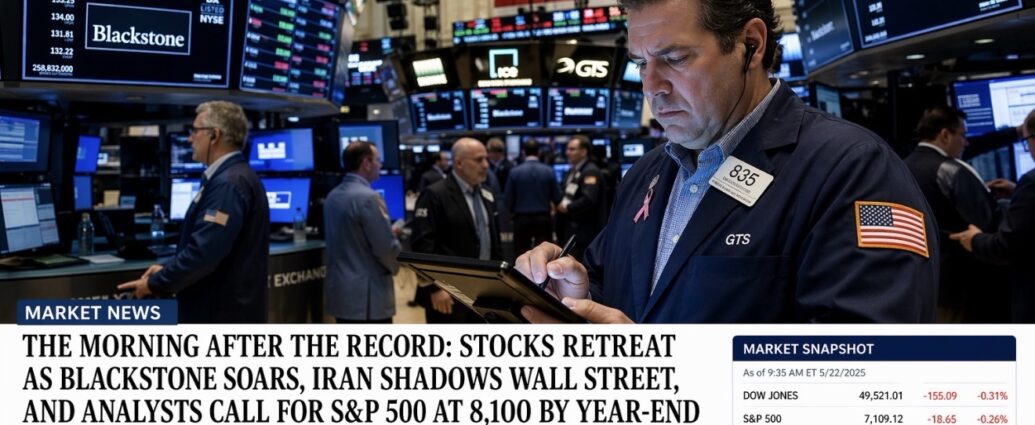
U.S. equities pulled back at Thursday’s open, pausing after a historic run that pushed both the S&P 500 and Nasdaq to fresh record highs a day earlier, as investors weighed a mixed slate of earnings against renewed geopolitical uncertainty tied to escalating tensions in the Middle East.
The Dow Jones Industrial Average fell 0.31% at the open, while the S&P 500 declined 0.26% and the Nasdaq Composite dropped 0.45%, giving back part of Wednesday’s record-setting momentum. In contrast, the Russell 2000 outperformed, rising 0.74%, signaling continued strength in smaller-cap names even as large-cap tech paused. The early retreat comes after a powerful April rally of roughly 9%, driven largely by strong corporate earnings and continued leadership from semiconductor and AI-linked stocks.
As trading began, the S&P 500 hovered near 7,109, the Dow around 49,521, and the Nasdaq near 24,487, each stepping back from Wednesday’s closing peaks of 7,137, 49,490, and 24,657, respectively. The CBOE Volatility Index (VIX) held near 19, reflecting modest but persistent investor caution as markets digest both earnings and geopolitical developments.
A wave of corporate results shaped early sentiment, with clear winners and laggards emerging across sectors. American Express topped quarterly earnings expectations and reaffirmed its full-year outlook, with management signaling resilient consumer spending trends despite macro uncertainty. Shares edged higher in premarket trading following the release.
Blackstone delivered one of the standout reports of the morning, posting a 25% jump in distributable earnings to $1.76 billion. Earnings came in at $1.36 per share, narrowly beating consensus estimates. Jon Gray, President of Blackstone, projected a strong pipeline ahead, stating the firm is positioning for what could be its “best year ever” for public listings as capital markets reopen and AI-related companies prepare to go public.
Comcast also exceeded expectations, reporting an 11% increase in quarterly revenue, supported by major broadcast tailwinds including the Milan-Cortina Winter Olympics and the Super Bowl. The company generated $3.9 billion in free cash flow and returned $2.5 billion to shareholders through dividends and buybacks, underscoring continued capital discipline.
Still, not all earnings impressed. Lockheed Martin missed both revenue and profit forecasts, raising concerns about defense execution. IBM disappointed investors after maintaining unchanged forward guidance, suggesting limited near-term growth acceleration. Tesla shares came under pressure after CEO Elon Musk signaled a significant increase in capital expenditures, sparking concerns about margin compression despite long-term AI and robotics ambitions.
Elsewhere, ServiceNow declined on signs of slowing subscription growth, while American Airlines beat quarterly expectations but sharply reduced its full-year earnings outlook. The airline directly cited rising jet fuel costs tied to the U.S.-Iran conflict as a key driver of the downgrade, highlighting how geopolitics are increasingly filtering into corporate guidance.
Despite these mixed results, the broader earnings season remains solid. According to aggregated market data, roughly 81% of S&P 500 companies reporting so far have beaten earnings estimates, while 76% have exceeded revenue expectations, reinforcing the underlying strength of corporate America even amid uncertainty.
Energy markets remain a central focus for investors. Brent crude climbed to $102.83 per barrel, while West Texas Intermediate rose to $93.80, as tensions in the Strait of Hormuz intensified. Iran’s seizure of two vessels earlier this week has raised concerns about the security of one of the world’s most critical oil shipping routes.
The geopolitical backdrop continues to evolve rapidly. President Donald Trump, who recently extended a ceasefire framework, has yet to define a clear timeline for its duration, leaving markets exposed to sudden shifts in policy or escalation. The uncertainty surrounding U.S.-Iran negotiations has injected a layer of risk into an otherwise strong equity environment.
On Wall Street, strategists remain broadly constructive, even as they acknowledge near-term volatility. JPMorgan analysts recently raised their year-end S&P 500 target to 7,600, aligning with broader consensus expectations after briefly adopting a more cautious stance. The firm warned of a likely period of consolidation, noting that elevated oil prices and unresolved geopolitical tensions could weigh on markets in the short term.
Across major institutions, the average 2026 year-end S&P 500 target stands near 7,555, with projections ranging from 7,000 to as high as 8,100, implying roughly 9% upside from current levels. Jurrien Timmer, Director of Global Macro at Fidelity, cautioned that while long-term equity trends remain intact, future returns are likely to moderate, stating that gains may settle into “single-digit territory” following a decade of outsized performance.
Among the most bullish voices, Oppenheimer strategists are forecasting S&P 500 earnings of $305 per share for 2026 and maintaining a year-end target of 8,100, citing continued innovation in AI, resilient consumer demand, and improving capital markets activity.
For now, markets are searching for direction. The path forward will likely hinge on incoming earnings reports, the trajectory of oil prices, and any developments out of the Middle East—particularly the stability of shipping lanes through the Strait of Hormuz.
As the rally pauses at record levels, investors are being reminded that even in strong markets, the next move is rarely linear.
JBizNews Desk