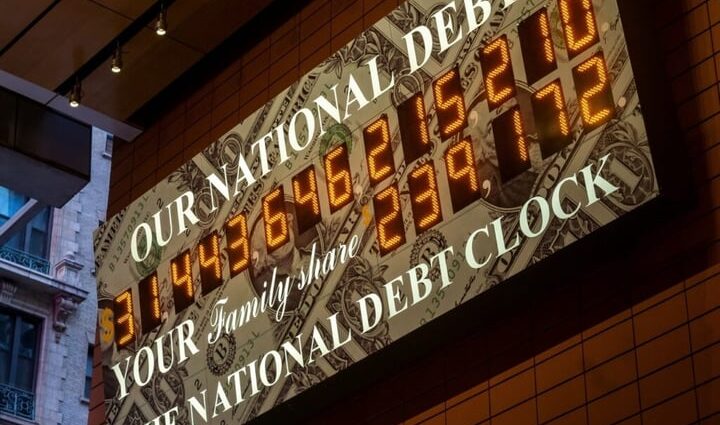
The U.S. has crossed a threshold that is hard to ignore: the national debt is now larger than the entire economy. As of the end of March, debt reached 100.2% of gross domestic product, a level not seen since the aftermath of World War II, with total national debt now surpassing $39 trillion. At the same time, public anxiety is growing, with some Americans openly questioning what options are left.
“I don’t see a way out of the 40 trillion in debt,” one person wrote in a recent Reddit thread as the national debt is on track to hit $40 trillion by the November elections, according to some estimates.
A Big Problem With No Easy Answer
In simple terms, devaluation means your money slowly buys less, usually because of inflation or decisions made by the government and central bank.
Don’t Miss:
- Find out if you qualify to reduce your monthly debt payments — see how much you could save with a quick, free consultation.
- Most Retirement Plans Ignore Taxes — See If Yours Does
Many commenters in the Reddit thread argued that this is already happening. “It’s not that stocks and home prices just keep going up, it’s that the value of the dollar keeps going down,” one person wrote, reflecting a widely shared view that inflation is quietly doing the work of reducing the debt burden.
Others argued that this isn’t new. “We’ve been devaluing our currency the second we got off the gold standard,” one person said, while another added, “Currency devaluation has been happening since fiat money was created.”
The idea that the system is built around a gradual loss of purchasing power came up repeatedly.
“I used to think gold standard people were weird,” the original poster responded. “But a lot of our economic problems started up right after the 70s.”
“This is what happens when you remove safeguards and stability by giving politicians the freedom to start arbitrarily messing with things to suit their own agendas,” the same commenter pushed further. “Fifty years later, here we are.”
See Also: See how a tax-aware retirement strategy could help improve your 2026 outlook — match with a financial adviser today.
There is also a debate about whether currency devaluation would be intentional or just a byproduct of policy. “Inflation is the decrease in the value of currency over time,” one person said. “Devaluation is intentionally causing inflation as an economic tool.”
Still, not everyone agrees that devaluation is the only path. Some argue the U.S. can manage its debt as long as it continues to pay interest and maintain economic growth. “The U.S. doesn’t need a ‘way out’ of 40 trillion debt, it just needs to manage interest payments,” one commenter said, pushing back against the more alarmist views.
Others continue to argue for higher taxes on the wealthy or spending cuts, though those ideas remain politically difficult. “We need a combination of both cutting spending and raising taxes,” another commenter wrote, reflecting a more balanced approach.
For now, the debate isn’t going away. More people are paying attention, and the tone is starting to change. As the debt keeps climbing and the options feel more limited, a growing number of people are asking a simple question: …





This post was originally published here