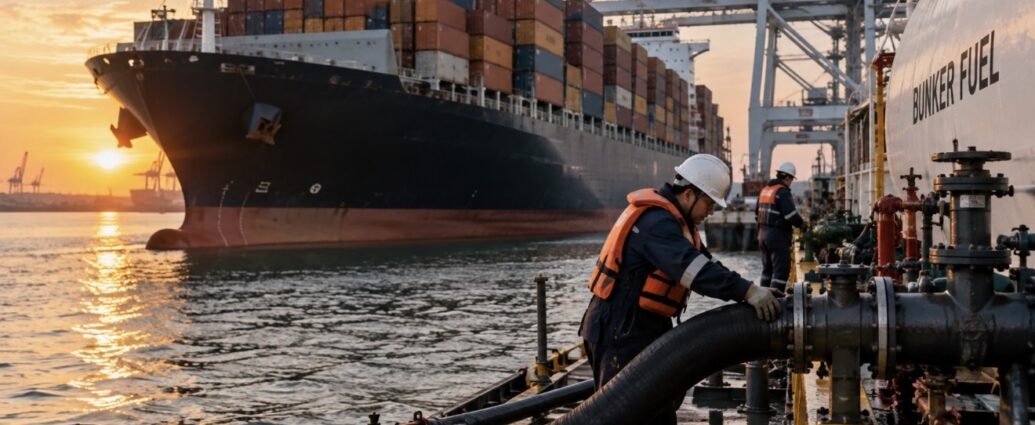
The fuel that carries your groceries across the ocean costs 76 percent more than it did before the Iran war started.
That is a bigger jump than crude oil itself, which is up about 40 percent over the same stretch, and the gap is the whole story. Very low sulphur fuel oil, the heavy fuel most cargo ships burn, was going for just under $825 a metric ton in Singapore as of Sept. 1, roughly $130 a barrel, according to bunker platform ZeroNorth.
Here is why it is running short. A refinery splits a barrel of crude into several fuels, and diesel, gasoline and jet fuel pay far better than the heavy stuff left at the bottom. When refineries get knocked out and crude gets scarce, refiners make the profitable fuels first and let ship fuel come last.
Ukrainian drone strikes have torn into Russia’s refineries, and the Iran war has cut Middle East output. Russia’s fuel oil exports fell to a record low 591,000 barrels a day in August, down from over 860,000 a day in 2025. Middle East exports dropped 45 percent from a year ago.
At the same time ships are burning more of it, because vessels routing around conflict waters sail longer voyages.
Less made, more needed.
Energy Aspects now expects the world to come up 218,000 barrels a day short in the third quarter. A year ago the gap was 6,000 barrels a day.
That is 36 times wider.
Rystad sees the same picture.
The cushion is thin too. Stockpiles at the three big refueling hubs — Singapore, Fujairah in the United Arab Emirates, and the Amsterdam-Rotterdam-Antwerp cluster — are about 30 percent below their three-year seasonal norms.
Where there would normally be 10 barrels sitting in a tank, there are 7.
Singapore, the world’s biggest bunkering port, imports more than half of the nearly 1 million barrels a day it burns, which leaves Asia most exposed.
For American shoppers this is the second fuel bill arriving at once.
Diesel hit a record $5.85 a gallon on Sept. 4, up from $3.71 a year ago, and that lands on every truck and railcar moving goods inside the country.
Ship fuel is the same cost at the ocean end of the trip.
Carriers recover it through bunker surcharges written into container rates, so it reaches importers within weeks and store shelves within months.
The timing is awkward.
Inflation ran 3.4 percent in July, well above the Federal Reserve’s 2 percent target, and Chair Kevin Warsh said at Jackson Hole that prices should be the Fed’s main focus.
Futures markets put the odds of a quarter-point rate increase at the Sept. 16 meeting somewhere near 60 percent.
The fix is not complicated, only slow.
Refiners can swing production back toward fuel oil once crude flows steady and damaged plants come back online.
Until then, importers with freight contracts up for renewal should be locking rates now, before the surcharges reset.
JBizNews Desk | New York
© JBizNews.com All Rights Reserved. Reproduction or distribution without written permission is prohibited.