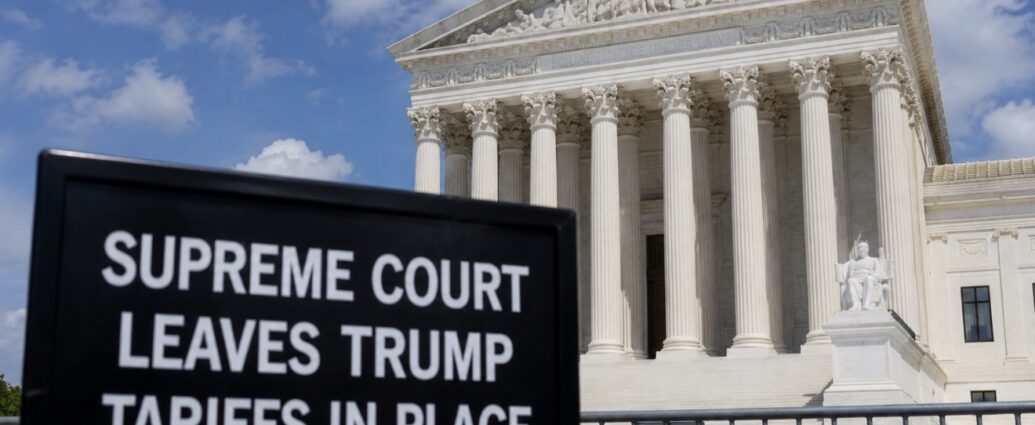
The Supreme Court on Monday declined to hear a challenge to the tariffs President Donald Trump placed on Chinese goods during his first term, leaving the import taxes in place and ending a years-long fight by businesses that had hoped to overturn them and recover what they paid.
The justices denied review, without comment, in a case known as HMTX Industries LLC v. United States, the test case in a long-running effort to undo the duties. The decision closes the door on the lawsuit and on the refunds that importers across the country were seeking.
The tariffs at issue were imposed in 2018 under Section 301 of the Trade Act of 1974, after the U.S. Trade Representative investigated and concluded that China was engaging in unfair trade practices, including the theft of American intellectual property and the forced transfer of technology from U.S. companies.
The original duties covered about $50 billion worth of Chinese goods. The administration later expanded them sharply, to roughly $370 billion in products, a move the plaintiffs argued went beyond what the law allowed.
Lower courts, including the U.S. Court of Appeals for the Federal Circuit, had already sided with the government, and the Supreme Court’s refusal to step in lets those rulings stand.
The timing is what makes this significant.
Just four months ago, in February, the same Supreme Court struck down a far broader set of tariffs Trump imposed in his second term, ruling 6-3 that he had overstepped his authority by using a national-emergency law to tax imports from nearly every country.
That decision wiped out the sweeping “reciprocal” tariffs.
But it left the older Section 301 tariffs on China untouched because those rest on a different and firmer legal foundation.
Monday’s action confirms that distinction: the emergency-powers tariffs fell, while the China tariffs survive.
For the administration, that is a meaningful win.
With the emergency-powers route blocked, Section 301 has become one of the most reliable tools left for taxing imports, and the court has now signaled it will not interfere with how that tool has been used.
The administration has already begun leaning on it, recently opening new Section 301 actions against several seafood-trading partners over forced-labor concerns.
Here is why it matters beyond the courtroom.
The tariffs cover an enormous share of what the United States buys from China, from electronics and machinery to furniture and auto parts.
Those taxes are paid in the first place by American companies that import the goods, and a portion of the cost typically reaches consumers through higher prices.
They have been part of the economic landscape for years, and Monday’s decision means they are not going anywhere.
The businesses that paid them and hoped for relief, or for money back, will get neither.
It also leaves the broader trade picture firmly in place.
Even after the bigger tariffs were struck down in February, Chinese goods remained among the most heavily taxed imports in the country because of these Section 301 duties stacked alongside other measures.
With the legal challenge now exhausted, that structure is locked in for the foreseeable future.
The ruling lands as the United States and China continue a delicate economic relationship, one that has swung between confrontation and negotiation.
For companies that spent years building supply chains around Chinese factories and betting the courts might eventually grant them relief, the message from Washington is now unambiguous:
Plan around the tariffs, because they are here to stay.
Washington — JBizNews Desk
JBizNews Desk / © JBizNews.com All Rights Reserved. Reproduction or distribution without written permission is prohibited.