JBizNews Desk | May 9, 2026
Bentonville, Arkansas was once a quiet small town known mainly as the birthplace of Walmart.
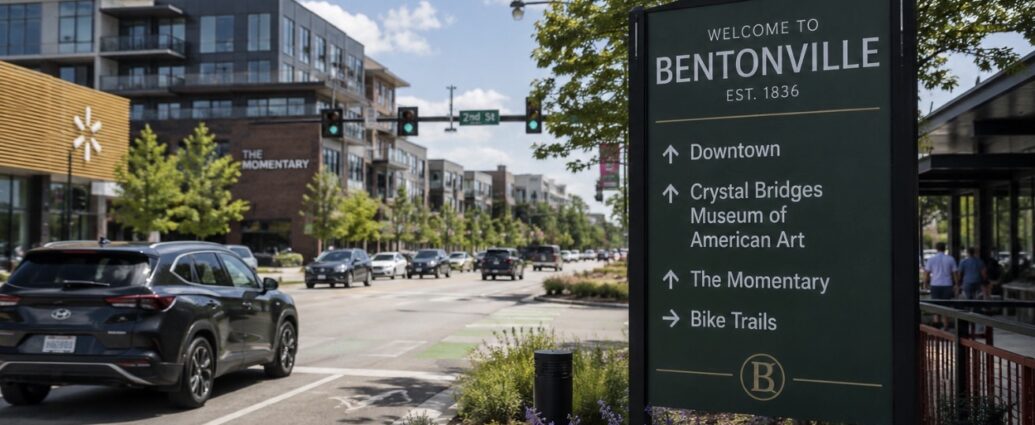
Today it has become something entirely different: a rapidly growing cultural and business hub filled with luxury hotels, high-end restaurants, mountain biking networks, corporate campuses, upscale housing, performing arts venues, and one of the country’s most respected modern art museums.
Much of it was funded, built, or influenced by the Walton family.
And increasingly, some longtime residents are questioning whether the transformation came at too high a cost.
The Walton Family Rebuilt Bentonville
Over the past two decades, the heirs of Walmart founder Sam Walton have invested billions of dollars into reshaping Northwest Arkansas — particularly Bentonville — into a destination designed to attract talent, tourism, and global attention.
The Walton family still controls roughly 44% of Walmart, whose market value has approached approximately $1 trillion, making the family one of the wealthiest dynasties in modern American history.
Through direct investments and the Walton Family Foundation, which distributes more than $500 million annually across education, environmental, and civic projects, the family has transformed Bentonville into one of the fastest-evolving communities in the United States.
The city now features:
- Crystal Bridges Museum of American Art
- Extensive mountain biking trail systems
- Boutique hotels and luxury developments
- New performing arts infrastructure
- High-end restaurants and retail
- Major community redevelopment projects
- Walmart’s new multibillion-dollar headquarters campus
What was once viewed as a rural corporate town increasingly resembles a hybrid of Austin, Boulder, and Silicon Valley culture transplanted into the Ozarks.
But Not Everyone Likes the Transformation
Despite the economic growth and national attention, tensions inside the community are rising.
Unlike the large public protests seen in some major cities, the pushback in Bentonville has been quieter — appearing through local meetings, opinion pieces, social media criticism, and growing frustration among some longtime residents who feel the city is becoming unrecognizable.
Critics argue the Walton-backed redevelopment has:
- Accelerated gentrification
- Increased housing costs
- Shifted the town’s identity toward wealthy outsiders
- Displaced smaller local businesses
- Prioritized attracting elite talent over preserving local culture
For many residents who spent decades living in a modest Arkansas community, Bentonville’s rapid upscale transformation feels less like organic growth and more like a top-down redesign.
The Buffalo River Fight Became a Flashpoint
The tensions became especially visible during a controversy surrounding the nearby Buffalo National River.
Members of the Walton family explored support for redesignating portions of the area as a national park, a proposal intended partly to increase tourism and environmental investment.
But many local residents strongly opposed the idea, fearing it would accelerate overdevelopment and bring further outside control into rural Arkansas communities.
At one town hall meeting in Jasper, Arkansas, more than 1,100 people reportedly attended to voice concerns.
The backlash became intense enough that Walton family members ultimately stepped back from the proposal.
Several members of the family later acknowledged they regretted not engaging more directly with local residents earlier in the process.
A New Version of the Company Town
The deeper issue extends beyond any single project.
Walmart’s leadership increasingly needed to attract engineers, designers, executives, and technology workers capable of competing with major e-commerce and technology companies.
To do that, Bentonville needed to become attractive to highly educated professional workers accustomed to the amenities found in larger cities.
The result was a sweeping civic transformation centered around:
- Arts and culture
- Outdoor recreation
- upscale housing
- private and charter education
- lifestyle-focused development
The Walton Family Foundation became one of the primary engines behind that strategy.
For supporters, the results are extraordinary.
Bentonville has become one of America’s most surprising economic success stories — generating tourism, attracting investment, and creating opportunities that likely never would have existed otherwise.
For critics, however, the city increasingly feels curated for affluent newcomers rather than built around the people who lived there long before the transformation began.
A National Story Playing Out Locally
The Bentonville debate reflects a broader question now emerging across America:
What happens when extreme concentrations of private wealth begin reshaping entire communities?
From AI-driven development battles in Michigan to tech-fueled housing displacement in California, wealthy corporations and billionaire-backed initiatives are increasingly influencing not just economies — but the physical identity and culture of entire towns and regions.
In Bentonville, the Waltons succeeded in building a world-class destination in the middle of Arkansas.
But the debate now unfolding is whether a town can remain itself after being redesigned at billionaire scale.
And that is a question communities across America are increasingly beginning to ask.
© JBizNews.com. All rights reserved. This article is original reporting by JBizNews Desk. Unauthorized reproduction or redistribution is strictly prohibited.