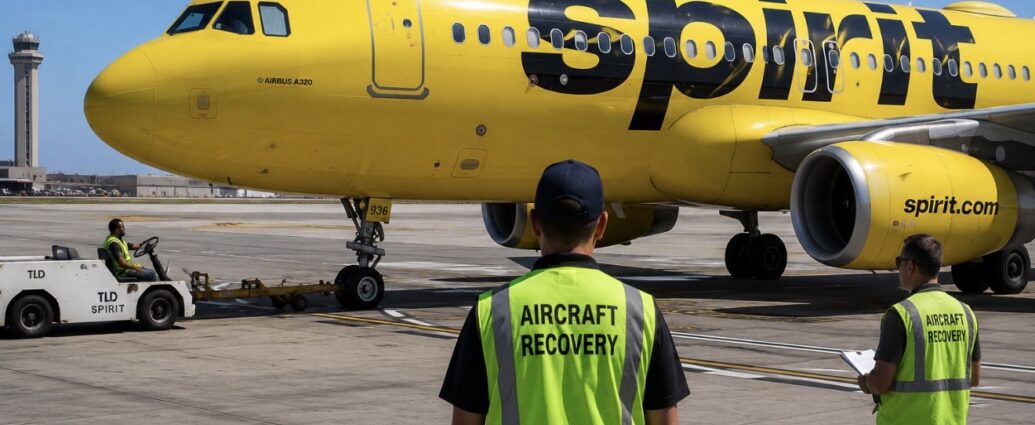
When Spirit Airlines shut down operations at 3 a.m. on May 2, it left behind more than 90 bright yellow Airbus jets scattered across airports nationwide, thousands of stranded employees, and one of the largest commercial aircraft recovery operations the U.S. aviation industry has seen in years.
Within hours, the repossession teams were already mobilizing.
Except these repo men do not drive tow trucks.
They fly Airbus A320s.
The first call came Friday evening to Bob Allen, managing partner of Nomadic Aviation Group, a specialty aviation services company that quietly handles aircraft recoveries, ferry operations, and leasing logistics for major global lessors. The instruction was immediate: prepare pilots and start recovering planes.
Nomadic, founded in 2021 by aviation leasing and ferry-flight veterans, had been retained by six aircraft leasing companies that owned Spirit’s jets. Their mission sounded simple in theory but chaotic in practice — physically gain control of grounded aircraft sitting at major commercial airports, coordinate legal transfer authority with airport personnel and law enforcement, and fly the planes to long-term storage facilities in the Arizona desert.
Within days, at least 20 former Spirit pilots had reportedly joined the operation, trading airline uniforms for jeans and t-shirts as they began ferrying aircraft out of Spirit’s abandoned network one plane at a time.
The scale of the collapse explains the urgency.
At the time of its second bankruptcy filing in August 2025, Spirit operated 214 aircraft with an average fleet age of just 5.5 years, according to aviation data firm Cirium. By the time operations fully ceased this month, roughly 114 Airbus A320-family aircraft remained active in the fleet, including A320neos, A321neos, and older ceo variants spread across airports nationwide.
Industry estimates valued the fleet at roughly $7 billion.
But critically, Spirit did not actually own most of those planes.
Approximately 76% of the fleet was leased, meaning the aircraft legally belonged to a powerful network of global aviation finance firms that immediately moved to reclaim their assets once Spirit stopped flying.
According to court filings and aviation industry data, the lessors involved represent some of the largest aircraft-finance institutions in the world.
AerCap, the Dublin-based giant widely considered the world’s largest aircraft lessor, was Spirit’s single largest supplier with exposure tied to 10 remaining aircraft after earlier restructuring settlements reduced its position.
Other major lessors included:
- Sky Leasing with 10 aircraft,
- SMBC Aviation Capital with 8,
- Air Lease Corporation with 7,
- Carlyle Aviation with 5,
- DAE Capital of Dubai with 4,
- alongside multiple additional leasing and finance groups holding smaller portions of the fleet.
All wanted their aircraft back immediately.
The economics behind the urgency are enormous.
Spirit’s Airbus A320neo-family jets are among the most valuable narrow-body aircraft in the global secondary market today because airlines worldwide remain trapped in severe aircraft shortages. Both Airbus and Boeing continue facing manufacturing delays, while ongoing shortages of Pratt & Whitney GTF engines have sidelined aircraft across multiple carriers globally.
That means every recoverable Spirit aircraft potentially represents:
- an immediately deployable leased aircraft,
- a replacement aircraft for another airline,
- or a valuable source of engines and spare parts.
Some engines are reportedly already being removed from grounded jets before the aircraft even leave for Arizona storage facilities.
AerCap had already moved aggressively months earlier to limit its exposure during Spirit’s previous bankruptcy restructuring. The company paid Spirit approximately $150 million during earlier proceedings in exchange for accelerated lease terminations and the right to repossess dozens of aircraft ahead of the final shutdown.
Even after those arrangements, AerCap still reportedly holds unsecured claims against Spirit’s estate worth up to $572 million.
Physically reclaiming the jets, however, has proved far more complicated than simply presenting ownership documents.
Steve Giordano, managing partner of Nomadic Aviation and one of the operation’s coordinators, described the airport environments as scenes of “mass confusion.”
Ground crews, airport managers, and security personnel often initially refuse access when pilots in plain clothes arrive announcing they are repossessing aircraft parked at commercial gates.
“You go up to a person of authority and say, ‘I need to get on that airplane, I’m repossessing it,’” Giordano told NPR. “And the first thing they’re going to say is ‘no, no, no, no, no.’”
Airport police, sheriffs, and operations managers are frequently called in before control of the aircraft is transferred.
Despite the logistical chaos, the recovery operation is advancing rapidly.
Aircraft have already been ferried from major former Spirit hubs including Fort Lauderdale, Houston, and Miami to Phoenix Goodyear Airport and Pinal Airpark in Arizona — massive desert aircraft-storage facilities commonly known in aviation as “boneyards.”
Several of the jets are already expected to re-enter commercial service elsewhere.
AerCap has reportedly lined up future placements for former Spirit aircraft with carriers including Frontier Airlines and JetBlue, underscoring how valuable relatively young Airbus narrow-body aircraft remain despite the collapse of the airline that operated them.
The deeper irony is that Spirit’s fleet may ultimately prove more valuable dismantled and redistributed than it was as part of the airline itself.
Spirit’s final collapse came after years of financial instability worsened dramatically by the global fuel shock triggered by the U.S.-Iran conflict earlier this year.
According to Marshall Huebner of Davis Polk, representing Spirit during bankruptcy proceedings in White Plains, surging jet-fuel prices following U.S. and Israeli strikes on Iran added roughly $100 million in incremental operating costs during March and April alone — a blow the ultra-low-cost carrier could not absorb.
Industry-wide jet fuel prices have risen approximately 70% since the conflict began.
A proposed federal bailout package reportedly collapsed during the airline’s final days, ending Spirit’s 34-year run as one of America’s most disruptive budget carriers.
Now, the airline’s remaining legacy is unfolding not in terminals filled with passengers, but in quiet repositioning flights across the Southwest — yellow Airbus jets flown silently into the desert by pilots working for the aviation industry’s highest-flying repo operation.
— JBizNews Desk
© JBizNews.com. All rights reserved. This article is original reporting by JBizNews Desk. Unauthorized reproduction or redistribution is strictly prohibited.