Freshpaint Art Fair 2026, Israel’s largest contemporary art and design fair, returns to Tel Aviv for the 17th time, and to the Kremenetski Technical Center for the second time in a row.
From June 24 to 29, the former operations center of the Israel Electric Company changes into a lively art festival meeting point, where visitors can see over 60 exhibitions presented in a spacious hangar and surrounding outdoor areas, showcasing the work of emerging artists, leading local galleries, and independent designers.
As every year, the heart of Freshpaint is “The Greenhouse” section, an incubator supporting independent Israeli artists at the beginning of their careers. The fair’s “Galleries and Projects” features exhibitions from leading galleries, as well as projects created for the event by artists, curators, and various art institutions. “The Fresh Design” gives the floor to independent product designers, design studios, commercial enterprises, and design brands.
Freshpaint Art Fair, organized in cooperation with the Tel Aviv Municipality, also serves as a social gathering spot. Live performances, installations, and special events also take place daily during the fair, providing an enjoyable place to be.
Focusing solely on art, however, for the third time, specifically for this column, I selected three artists from among all the Freshpaint exhibitors whose work particularly caught my attention. In an era of growing use of AI, including in art, I sought out artists who still work with their hands, paint, and sculpt, but manage to keep their art fresh.
We spoke shortly before the opening of the fair. They agreed to answer my three questions:
What inspires you?
What do you call art?
What, in your opinion, makes your artwork different from that of other artists?
Shlomit Gopher
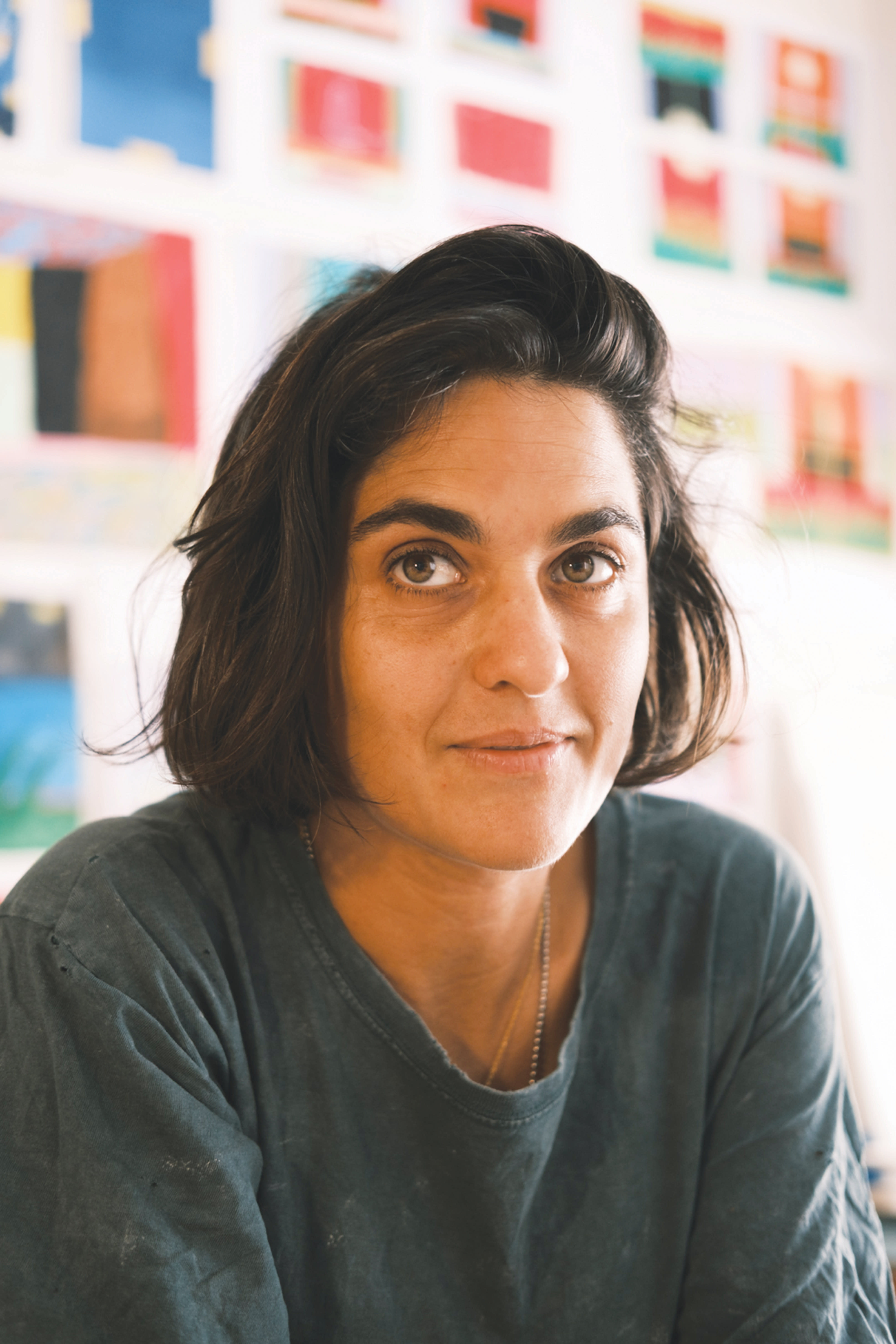
Shlomit Gopher was born in Jerusalem in 1987, grew up in the moshav of Tal Shahar, and has been based in southern Tel Aviv for many years. In 2025, Gopher was awarded the Makov Prize for a Promising Artist for the body of work she presented at the Freshpaint Art Fair Greenhouse. As part of the prize, at this year’s fair, she presents her solo exhibition, This moment’s planet.
Gopher is a self-taught artist, with a wide educational background in variety of disciplines, starting with pattern making at Shankar College, (2008-2009), puppets design, performance, and animation at the School of the Art of Puppetry, Holon (2009-2010); three years of studies in the Set and Costume Design Program at The National Theatre School of Canada, Montreal, Canada (2010-2013); Design Thinking, Technion Israel Institute of Technology (2019); and currently, after receiving her BA in behavioral sciences, from Open University Israel in 2024, she continues her MA in Conflict Resolution and Mediation, at Tel Aviv University.
As in her life, also in her art, she likes to find her own ways. Her highly textured prints and oil pastel paintings frequently examine the human body and architectural forms. Gopher uses a unique technique, researched and implemented by her, involving paper fibers she processes herself from banana fibers through a cycle of grinding, soaking, dyeing, positioning, compressing, and drying.
“The resulting paper is highly dynamic, with a rich, tactile surface that invites close looking and even touch,” she noted.
The artist creates motifs and a dialogue between line, form, and color. She explores geometric figures, breaking images down into colors and basic shapes.
In her current exhibition, unlike the presentation that won her the Promising Artist award last year, the human body is absent in her works. Instead, there are elements of sun, water, earth, and sky. Her works, in vivid colors, at first seem cheerful, but a prolonged observation reveals their depth to viewers.
Crucial to her is perception; she shared with me: “The works engage with the way reality is perceived through mental processes and personal perspectives, and seek to draw attention to this condition.”
Inspiration: The materials themselves are often my greatest source of inspiration. They are the way I come to understand the image I want to convey. In many ways, the material helps me find a language for something that cannot yet be expressed in words. I sketch with oil pastels I make by hand in my studio; the pigments, textures, and depth of each color form the ground from which new ideas can grow.
The paper fibers I work with are equally inspiring. They are a powerful material with a strong autonomous presence and a deep responsiveness to their environment. Working with them constantly pushes me forward and helps me bring the images that interest me to a deeper level of expression.
Meaning of art: Art is a way of looking at the world while simultaneously observing yourself as you perceive it. All these impressions sink into an inner space, where experiences are allowed to settle, mix, and be reborn. Because of that, Art can be almost anything, and it can take a different form for every person, regardless of what they do. It can be a breath, a step, a color, a garment, a conversation, a glance, a state of mind, or a single word.
Gopher’s art: There is something in my work that demands a certain level of intensity. If the color and texture do not reach a point of almost ecstatic presence, the work does not fully move me. This has led me toward increasingly reduced compositions and greater abstraction, while also opening up a richer, more expansive world of color and materiality.
The scale of the work, the intensity of color, and the tactile quality of paper create an experience that is deeply physical and direct. I do not think my work is fundamentally different from that of other artists. My work is simply the form that search has taken for me.
www.instagram.com/shlomitgopher/
Liran Verdiel
Liran Verdiel was born in Gedera in 1990 and still lives in central Israel. Verdiel earned his BA in Interior Design from The College of Management Academic Studies (2016), and an MA in Education from Seminar Hakibbutzim College, Tel Aviv (2025). He also studied Realist Oil Painting under Orit Akta (2023-2024). Since 2022, he has been a high school Visual Arts teacher.
His oil paintings on canvas are vibrant and figurative works, however, on the edge of abstraction. Personally, I found a certain and interesting duality in his art, daring in color and format, yet very modest at the same time. As he emphasized in an interview with The Magazine, his goal is to ask questions, not provide answers.
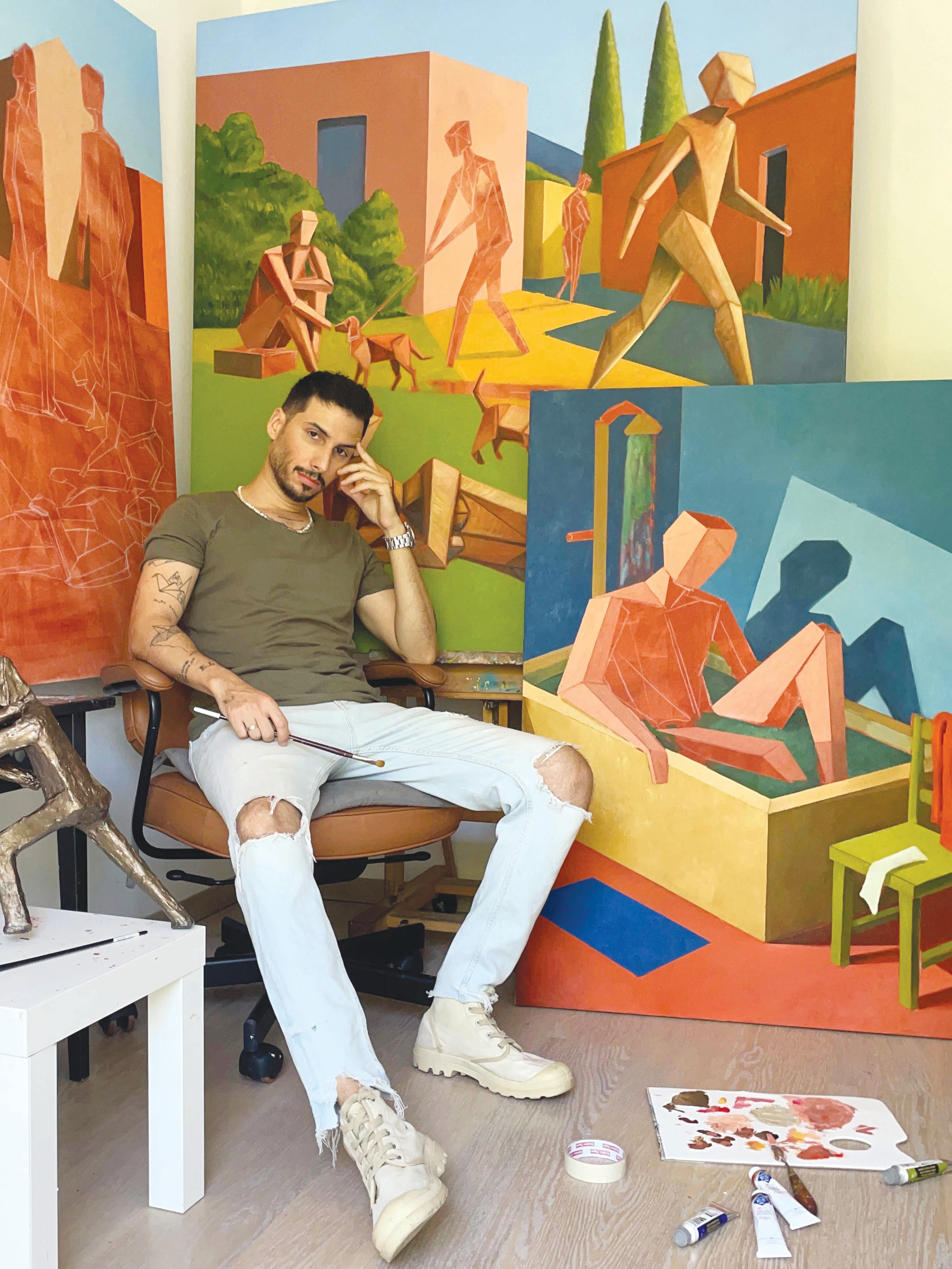
In the 2026 Freshpaint, Vardiel’s work is featured by “Two Curators” in the “Galleries and Projects” section. He presents paintings of geometric, folded paper, nameless people placed within expressive images, creating a surreal perspective on human existence. His paintings tell stories, some steeped in pain and longing; others, in my eyes, with humor. In his hands, paper becomes a medium that transforms hidden emotions into a vivid visual reality. For some, even in a therapeutic way.
Inspiration: I am inspired by human experiences, the ongoing search for connection, meaning, and belonging, and also by my personal experiences and emotions.
My studies in interior design developed my sensitivity to form, proportion, and spatial relationships. I am fascinated by the way subtle changes in position, scale, or perspective can completely transform meaning. In many ways, I see a parallel between architecture and human relationships.
The Japanese architect Tadao Ando has been a particularly important influence on me through his use of light, space, and formal simplicity to create powerful emotional experiences. Artistically, I have been influenced by Giorgio de Chirico, Edward Hopper, David Hockney, and Pablo Picasso. Each of them has shaped my understanding of the relationship between figure, space, and emotion in a different way – from the psychological and dreamlike qualities of de Chirico, to Hopper’s sense of solitude and stillness, Hockney’s use of color and space, and Picasso’s approach to abstraction and form.
Meaning of art: Art is a way of understanding and communicating the human experience. I do not see art as a source of answers, but as an invitation to ask questions. Meaningful artworks leave room for interpretation, evoke emotion, and continue to resonate long after the first encounter.
Art is also a powerful form of connection. Although it often emerges from a personal perspective, it has the ability to speak to universal experiences and create dialogue between people from different cultures, places, and backgrounds.
Verdiel’s art: I believe the distinctive quality of my work lies in the relationship between formal simplicity and emotional complexity.
As a child, my father taught me origami. Looking back, I see it as a lasting influence on the way I think about art. A simple sheet of paper can become something entirely new through a series of folds. For me, this process serves as a metaphor for life: every experience leaves a mark and shapes who we become.
The faceless figures in my paintings are rooted in personal experiences, yet they undergo a process of abstraction. They are not portraits of specific individuals but reflections of broader human emotions and situations.
Using geometric forms, simplified compositions, and carefully structured spaces, I explore themes of loneliness, intimacy, belonging, and emotional distance. I aim to create paintings that feel both personal and universal, allowing viewers to find something of themselves within the folds of the image.
Carolina Lehan
Interdisciplinary artist Carolina Lehan was born in 1992 in Switzerland. From the age of two, she was raised in Rishpon, central Israel, and she considers herself an Israeli artist. She currently lives and works between Israel and Hamburg, Germany.
Lehan holds a BFA from the Bezalel Academy of Arts and Design, Jerusalem (2019), and an MFA from the Hochschule für Bildende Künste Hamburg, Germany (2025). She has exhibited in Israel and abroad, and is also a recipient of several awards, including the Independent Creators Fund Award from the Israeli Ministry of Culture and Sport (2026), the City Art Prize Hamburg (2025), and the HFBK Deutschlandstipendium (2025).
Her practice spans drawing, sculpture, and site-responsive installations, emerging from an exploration of the unconscious through material experimentation and the creation of hybrid figures and mythological forms.
“I am influenced by feminist theory and embodied approaches to form,” Lehan noted, talking to The Magazine.
Her work is featured in the “Greenhouse” section of this year’s Freshpaint art fair. Grassroots, a unique mixed-media piece (oil on woodcut), highlights her recurring practice of combining traditional woodcut relief with oil painting. She also presents reliefs made of epoxy-coated insulating material – a series of carved and painted wooden panels with androgynous images and symbols. I perceived her wooden sculpture Fish Tail as dreamlike, seemingly moving like a wave, transporting viewers to an ancient, mythical era.
Inspiration: I’m inspired by mythological and archaeological history, as well as contemporary aesthetics. Ancient objects reveal human relationships as psychological and repetitive structures, demonstrating that desire, attachment, and conflict have always followed similar patterns throughout history.
[But] I grew up in the early 21st century and am drawn to a mix of kitsch, clichés, and iconic symbols. I’m drawn to the shiny, cheap plastic objects I craved as a child. I’m interested in the intersection of different worlds, the overlap of high and low cultures, and from these connections, new kinds of archaeology emerge.
While in Hamburg, where I completed my master’s degree, I continued to explore the place as an active element of my practice in experimenting with materials and the relationship between landscape and memory.
I often start with a story or image, then deconstruct it and transform it into themes that are meaningful to me. For example, in Fish Tail [presented at Freshpaint], I approach mythological narratives from a queer and lesbian perspective, focusing on femininity, desire, and seduction.
Meaning of art: The art that draws me in usually includes narrative, materiality, and play. I am interested in material complexity and in reading the layers and decisions that form a work. I am also drawn to works that are not fully explicit and leave space for interpretation, while still clearly expressing the artist’s focus. More than anything, I am interested in how art allows us to communicate in different frequencies than everyday life.
Lehan’s art: My practice is strongly influenced by technique, which for me is not only a tool but also a conceptual engine. It drives the transformation from idea into material and from image into physical presence.
My work engages with questions of gender, female solidarity, and the tension between beauty and violence.
I seek to challenge heteronormative systems’ structures. I am influenced by writers such as Paul B. Preciado and Silvia Federici, who understand the body as political, historical, and constructed.
I grew up in Israel in a family that is half Israeli and half Italian-Swiss, between contrasting worlds of Middle Eastern landscape and a more European sense of calm and nostalgia. This duality shaped my approach – different emotional, cultural, and physical geographies coexist within one visual language.
My closeness to ruins, whether preserved or erased, has shaped my fascination with what lies beneath the surface, where excavation becomes an act of care as much as of inquiry.
www.instagram.com/carolinalehan/■