JBizNews Desk | Friday, May 8, 2026
The U.S.-Iran war has already pushed oil prices sharply higher, rattled global supply chains, and raised fuel and transportation costs worldwide. Now it is reshaping something far more unexpected: office dress codes in Japan.
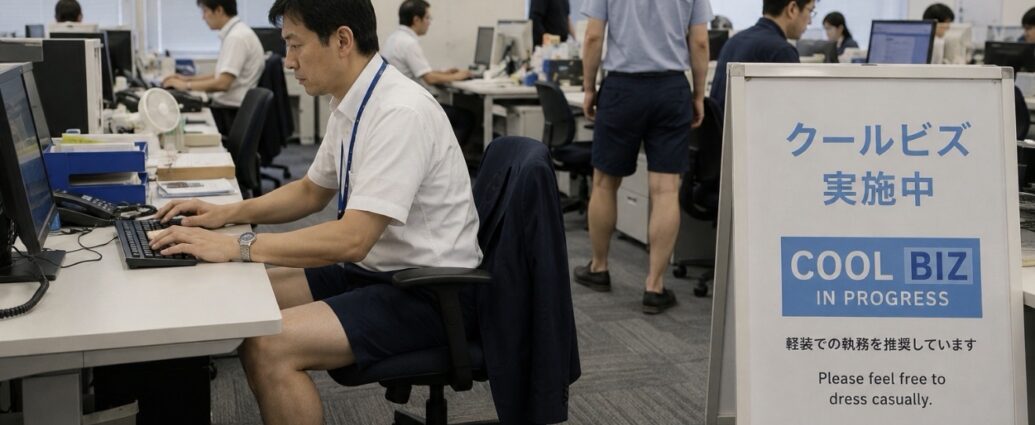
The Tokyo metropolitan government has begun encouraging workplaces to allow employees to wear shorts during the summer as rising energy costs tied to Middle East tensions place growing strain on Japan’s electricity consumption and cooling systems.
Tokyo Governor Yuriko Koike, who originally launched Japan’s famous “Cool Biz” campaign nearly two decades ago while serving as Environment Minister, announced the updated initiative as temperatures begin rising across the capital.
Local media have already published images of government employees working in bermuda shorts and polo shirts inside official Tokyo government offices following the rollout of the revised policy, which officially took effect on April 24, 2026.
A Tokyo Metropolitan Government official said the energy crisis linked to Middle East instability was “one of the factors” behind the decision.
Japan’s ‘Cool Biz’ Campaign Gets a Wartime Update
Japan first introduced the Cool Biz campaign in 2005 to reduce electricity usage by encouraging workers to remove jackets and neckties during the summer months.
At the time, the initiative was viewed as culturally significant in one of the world’s most formal business environments, where suits and strict workplace dress standards have long been considered central parts of professional identity.
But even then, shorts remained largely unacceptable in traditional office culture.
That has now changed.
Under the revised guidance, workers are being encouraged not only to dress more casually but also to:
- Begin work earlier in the morning
- Reduce air-conditioning usage
- Work remotely when possible
- Shift energy consumption away from peak demand periods
The broader goal is to lower electricity usage across Tokyo’s massive office sector during what officials expect could become an unusually expensive summer energy season.
Why the Iran War Matters So Much to Japan
Japan remains one of the world’s most energy-import-dependent economies.
The country imports virtually all of its oil and liquefied natural gas, much of which historically traveled through the Strait of Hormuz before the outbreak of the Iran conflict.
That makes Japan especially vulnerable to disruptions in Gulf shipping routes and prolonged spikes in oil prices.
Unlike China, which has larger strategic reserves and extensive overland pipeline alternatives from Russia and Central Asia, Japan has fewer fallback options when energy costs surge.
As oil prices rise, the economic impact spreads quickly through Japanese industry.
Manufacturers, retailers, logistics firms, airlines, and office operators are all facing higher operating costs tied directly to fuel and electricity expenses.
And in Tokyo — one of the world’s densest office markets — commercial air conditioning systems represent a major source of summertime power demand.
An Economic Problem Turning Into a Cultural Shift
The new office dress guidance may sound symbolic, but it reflects a deeper economic reality.
Rather than imposing mandatory energy rationing or rolling blackouts, Tokyo officials are trying to reduce electricity demand voluntarily through behavioral changes that are less politically disruptive.
The shift also highlights how deeply the Iran conflict is now influencing daily life far beyond the Middle East.
Higher oil prices are not only affecting gasoline costs or shipping rates. They are increasingly altering workplace operations, consumer habits, utility usage, and corporate policies across major economies.
For Japan, the willingness to relax long-standing workplace formality standards underscores how seriously officials view the current energy pressures.
A Warning Sign for Global Businesses
For American businesses and investors, Tokyo’s new shorts policy offers an unusually visible example of how geopolitical instability can ripple through the global economy in unexpected ways.
The Strait of Hormuz sits nearly 6,000 miles from Tokyo.
Yet the conflict affecting oil shipments through that narrow waterway is already influencing:
- Office operations
- Corporate energy policy
- Commercial electricity consumption
- Workplace culture
- Consumer behavior
What begins as a military conflict in a strategic energy corridor increasingly finds its way into everyday economic life around the world.
And now, in one of the world’s most formal business capitals, it is changing what people wear to work.
© JBizNews.com. All rights reserved. This article is original reporting by JBizNews Desk. Unauthorized reproduction or redistribution is strictly prohibited.