By JBizNews Desk
NEW YORK — June 1, 2026
One of Wall Street’s most closely followed economists is issuing a stark warning: the U.S. economy is no longer merely slowing—it is beginning to struggle.
On May 28, Mark Zandi, Chief Economist at Moody’s Analytics, said the combination of weakening economic growth, persistent inflation, and elevated oil prices tied to the conflict involving Iran is pushing the United States closer to recession.
“The economy isn’t just soft, it’s struggling,” Zandi wrote on X, adding that unless the conflict eases and shipping through the Strait of Hormuz returns to normal, the odds of a recession could soon become greater than 50%.
The warning comes as a growing number of economic indicators point in the wrong direction simultaneously, creating a difficult environment for consumers, businesses, and policymakers.
Growth Is Slowing
The first warning sign is economic growth itself.
Recent revisions showed U.S. gross domestic product expanded at an annualized rate of 1.6% during the first quarter, weaker than earlier estimates and well below the pace seen during much of the post-pandemic expansion.
Housing activity has softened under the weight of elevated mortgage rates. Business investment has slowed. Corporate executives have become increasingly cautious about hiring and expansion plans as uncertainty rises.
While the economy continues to grow, the pace has clearly weakened.
For many economists, the concern is not a collapse in activity but a gradual erosion occurring across multiple sectors at the same time.
Consumers Are Feeling the Pressure
The second challenge is the American consumer.
According to recent economic data, real disposable income—the money households have available after taxes and inflation—is under pressure. Savings rates have also fallen as families spend more of their income to cover higher everyday expenses.
Consumer spending has been one of the biggest reasons the U.S. economy avoided recession over the past several years. If that spending begins to slow meaningfully, the broader economy could lose one of its most important sources of support.
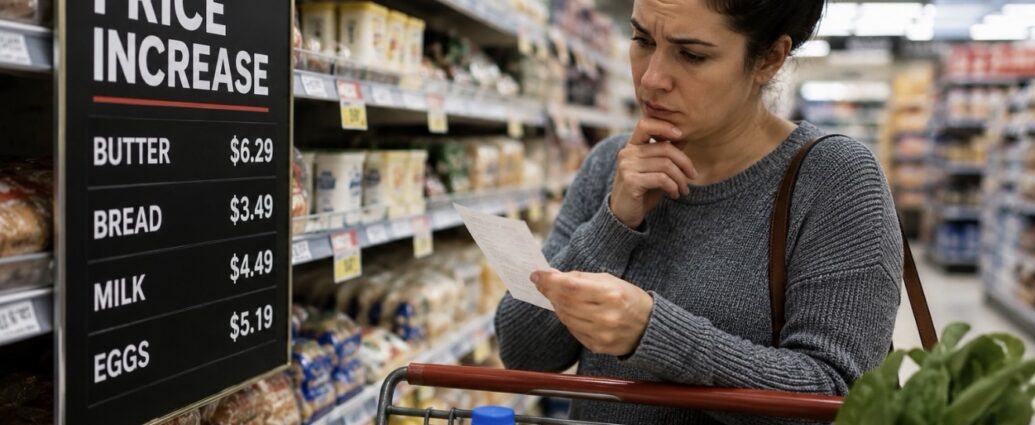
The pressure is becoming increasingly visible at gas stations, grocery stores, and household budgets.
Inflation Is Heating Up Again
At the same time growth is slowing, inflation has moved higher.
Consumer prices increased 3.8% over the past year, according to recent data, marking one of the strongest inflation readings since 2023 and remaining well above the Federal Reserve’s 2% target.
For households, inflation remains more than a statistic.
Higher prices for food, transportation, utilities, and consumer goods continue to reduce purchasing power, forcing families to stretch paychecks further each month.
That reality is especially concerning because inflation was expected to continue cooling in 2026. Instead, recent energy and commodity shocks have complicated that outlook.
The Oil Problem
Much of the renewed inflation pressure traces back to energy markets.
The conflict involving Iran and the disruption of shipping through the Strait of Hormuz have helped push oil prices sharply higher in recent months. The strategic waterway handles roughly one-quarter of the world’s seaborne oil trade, making it one of the most important energy chokepoints on the planet.
U.S. crude prices have recently traded near $94 per barrel, levels that ripple throughout the economy.
Higher oil prices affect far more than gasoline.
Transportation costs rise. Manufacturing costs increase. Airlines pay more for fuel. Farmers face higher operating expenses. Retailers absorb higher shipping bills.
Eventually those costs find their way into the prices consumers pay.
According to Moody’s Analytics, the average American household has incurred roughly $447 in additional fuel-related costs since the conflict began.
That figure represents a meaningful hit to household budgets at a time when many consumers already feel financially stretched.
The Fed’s Dilemma
The situation creates a difficult challenge for the Federal Reserve.
Normally, slowing economic growth would encourage policymakers to lower interest rates to stimulate borrowing and investment.
But inflation moving higher points in the opposite direction.
Fed officials have repeatedly stressed that defeating inflation remains their top priority. Speaking recently, Minneapolis Federal Reserve President Neel Kashkari warned that allowing inflation expectations to become entrenched could make the problem significantly harder to solve later.
That suggests the central bank may be reluctant to cut rates aggressively even if economic growth continues weakening.
Economists have a name for this uncomfortable combination of slowing growth and persistent inflation: stagflation.
It is one of the most challenging economic environments for policymakers because the tools used to fight one problem often make the other worse.
A Growing Recession Debate
Not every economist agrees a recession is imminent.
Goldman Sachs continues to project lower recession odds than Moody’s, while other forecasters remain cautiously optimistic that the economy can achieve a soft landing.
Still, the debate is shifting.
Just months ago, most economists were discussing recession risk as a possibility. Increasingly, the discussion has turned toward probabilities, timing, and severity.
For Zandi, the key variable remains energy.
The longer oil prices remain elevated and the longer disruptions continue in the Strait of Hormuz, the more pressure households, businesses, and financial markets will face.
The U.S. economy has proven remarkably resilient over the past several years.
The question now is whether that resilience can withstand another prolonged energy shock at a moment when growth is already slowing and inflation is once again moving in the wrong direction.
New York — JBizNews Desk
© JBizNews.com All Rights Reserved. Reproduction or distribution without written permission is prohibited.