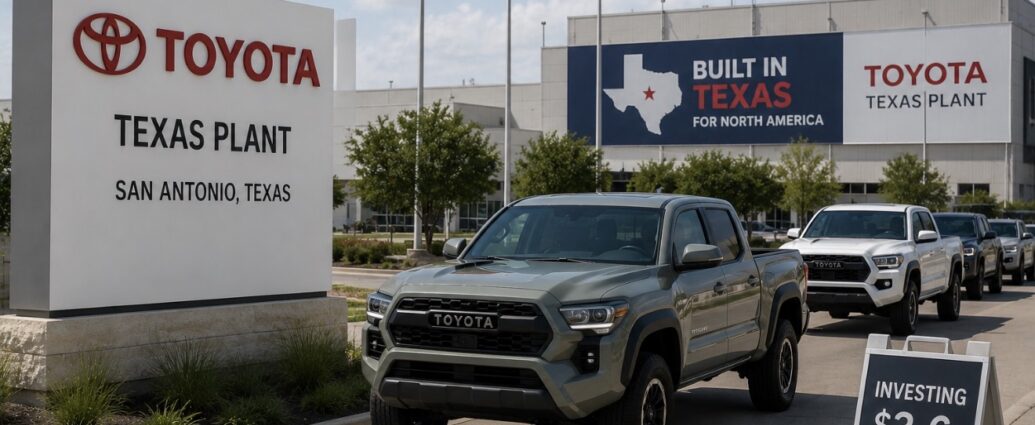
Toyota is pulling a chunk of its popular Tacoma pickup production out of Mexico and into Texas, committing $3.6 billion to expand its San Antonio complex in one of the clearest signs yet that tariff pressure and stalled trade talks are reshaping where automakers choose to build.
The company said earlier this month that it will add a second vehicle assembly line at its San Antonio campus, allowing the plant to build the midsize Tacoma alongside the full-size Tundra and the Sequoia SUV it already produces there. Production will transition from Toyota’s Baja California plant in Tijuana over roughly four years, though the automaker stressed it is not abandoning Mexico—it will keep building some Tacomas at its newer Guanajuato facility and continue operating south of the border.
The expansion carries real weight for the region. Toyota said the project will create about 2,000 jobs by 2030, add roughly 2.5 million square feet to the campus—effectively doubling its footprint—and lift annual capacity at the site by about 150,000 units. The investment brings Toyota’s total commitment to the San Antonio operation to $8.3 billion since ground broke in 2003, and folds in a separate rear-axle plant on the campus slated to begin production this fall. Texas Governor Greg Abbott called the commitment a reflection of the state’s workforce and business advantages.
The timing is pointed. The announcement landed just days after Washington declined to renew the trilateral trade pact with Mexico and Canada, letting a July 1 deadline pass without an extension and opting instead for annual reviews—an outcome that has injected fresh uncertainty into a North American auto supply chain built around duty-free cross-border production. President Trump, who has pressed Toyota to expand its U.S. footprint, has raised tariffs on automobiles, steel and aluminum, giving global manufacturers a direct financial incentive to move assembly stateside. Toyota, for its part, said it remains committed to its operations across the U.S., Canada and Mexico and urged a quick resolution to keep the region competitive.
The move also fits a larger strategic pledge. Toyota said last year it planned to invest as much as $10 billion in its U.S. manufacturing operations over the coming years, and the Tacoma shift is among the most concrete pieces of that plan. There is history here, too: Toyota had moved Tacoma production from San Antonio to Guanajuato back in 2020, so this represents a partial reversal that brings the truck’s assembly full circle.
Underpinning the bet is a truck that keeps selling. Tacoma volumes climbed sharply in 2025 and have continued rising in 2026, with sales tracking toward what could be the model’s best year ever, potentially topping 300,000 units. That strength matters as Toyota closes in on the possibility of overtaking General Motors as the top-selling automaker in the U.S. market—a race in which securing flexible, tariff-insulated truck capacity is a meaningful edge.
For buyers, little changes in the near term; the transition unfolds over several years and Toyota has not signaled changes to the truck itself. The bigger message is strategic. By anchoring more of its most important truck line in Texas, Toyota gains tighter control over capacity, more insulation from trade-policy swings, and a stronger claim to the “built in America” positioning that carries growing commercial value in a volatile new-car market.
JBizNews Desk | San Antonio
© JBizNews.com All Rights Reserved. Reproduction or distribution without written permission is prohibited.