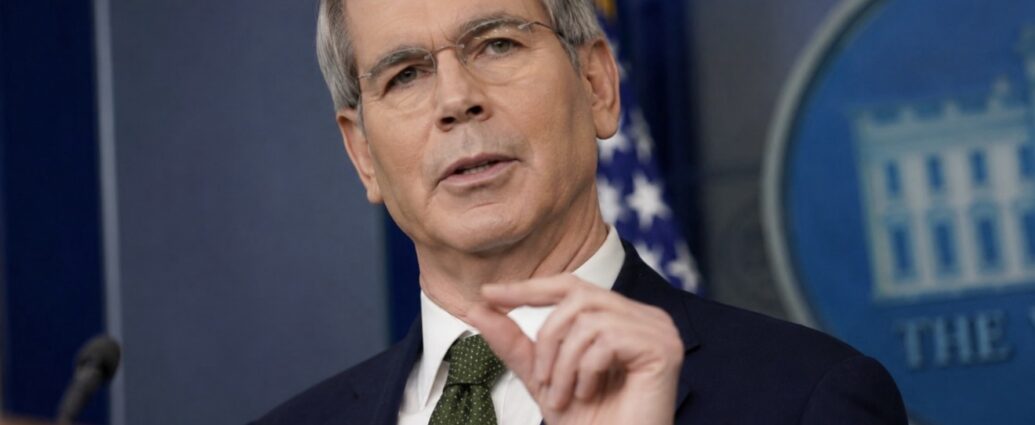
Treasury Secretary Scott Bessent said Tuesday that the United States is prepared to impose sanctions on foreign artificial-intelligence developers if it determines they built their models by lifting capabilities from American systems, sharpening a months-long dispute over how China’s fast-rising AI sector has closed the gap with Silicon Valley.
Bessent framed the issue as a matter of intellectual property rather than open-source competition, drawing a line the administration says it intends to enforce. “This administration supports open-source models, but what we do not support is IP theft,” he said in a televised interview, adding that Washington retains “the ability to sanction them because of this theft” if overseas developers are found to be extracting from U.S. companies.
The most striking claim was technical. Bessent said federal officials have detected “watermarks” of American large language models embedded in numerous Chinese systems, a pattern he called unacceptable and said Treasury would examine “in the coming days or weeks.” He did not define what he meant by watermarks, name any Chinese company or model under review, or specify which sanctions authority the administration would invoke. Treasury has not publicly identified a target for any formal action.
At the center of the concern is a training method known as distillation, in which the outputs of a more advanced “teacher” model are used to train a smaller “student” model at a fraction of the cost. The practice is widespread and legal in much of the AI industry, but American frontier labs and administration officials have increasingly described the large-scale, unauthorized version of it as a national competitiveness threat. A White House science and technology memo earlier this year characterized the China-led form of the practice as adversarial and pledged to help U.S. labs detect and block it.
The timing is not incidental. The warning follows the recent release of Kimi K3, a new model from Chinese startup Moonshot AI that has drawn attention for matching or beating leading American systems on several benchmarks while undercutting them dramatically on price. That combination has rattled both Silicon Valley and Washington, where officials worry about the durability of the U.S. lead in a technology now viewed as strategically decisive. Moonshot has said demand for the model is straining its computing capacity.
American AI companies have been building this case publicly for months. OpenAI has accused Chinese developer DeepSeek of attempting to free-ride on capabilities developed by U.S. labs, and Anthropic last month leveled similar allegations against Alibaba. The accusations remain contested, and no company has been formally charged with wrongdoing.
For businesses, the more consequential signal may be a second lever Bessent floated: potential disclosure requirements. He raised the question of whether American firms that rely on Chinese AI models should be obligated to tell their customers they are doing so. Such a rule, if pursued, would reach well beyond the developers themselves and into the growing number of U.S. companies that have begun integrating lower-cost Chinese open-weight models into their products and internal operations. Open-weight models—those whose trained parameters are released publicly while the underlying code and data stay private—have spread quickly precisely because they are cheap and adaptable, and any disclosure mandate would introduce new compliance and reputational calculations for firms across the economy.
The sanctions threat also lands at a delicate diplomatic moment. The two governments are preparing for their first formal AI dialogue under President Trump, with talks expected in September ahead of a planned visit by Chinese President Xi Jinping on September 24. Bessent is set to lead the American delegation in those discussions. An agreement reached at the Trump-Xi summit in the spring established the framework for intergovernmental AI talks; Beijing has signaled it wants those conversations to stay technical rather than political. A move toward sanctions in the interim would inject fresh friction into a channel both sides have described as fragile but necessary.
For now, Bessent’s remarks amount to a warning shot rather than a policy. No sanctions have been announced, no disclosure rule has been drafted, and the underlying “watermark” evidence has not been made public. But the message to both Chinese developers and their American customers is unambiguous: the administration considers the current trajectory of Chinese AI advancement a matter of enforcement, not merely competition, and it is signaling that regulatory tools—financial and otherwise—are on the table.
How aggressively Washington follows through will depend heavily on what Treasury says it finds in the weeks ahead, and on whether the coming diplomatic talks give either side a reason to hold fire.
JBizNews Desk | Washington, D.C.
© JBizNews.com All Rights Reserved. Reproduction or distribution without written permission is prohibited.