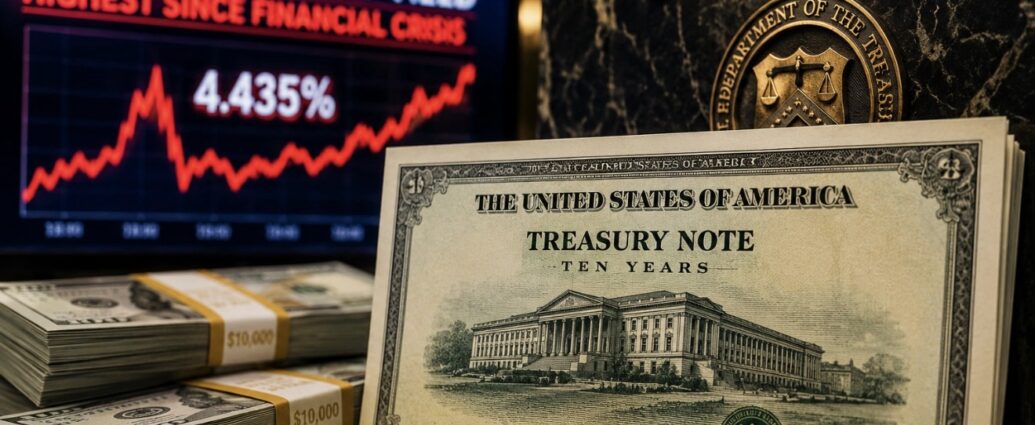
The federal government borrowed $42 billion for ten years on Wednesday, and to get investors to hand over the money it had to promise them 4.683% a year — the steepest rate the United States has paid at a 10-year note auction since 2007, before the financial crisis. That rate is locked in for the life of the debt, and taxpayers carry it.
The auction closed at 1 p.m. Eastern. The high yield of 4.683% came in a fraction above the 4.682% level the notes had been trading at just before the sale — a gap of one-tenth of a basis point. When an auction prices above where the market was already trading, it is called a tail, and it means buyers demanded slightly more compensation than expected. The average tail on recent 10-year sales has been three-tenths of a basis point, so Wednesday’s was smaller than usual.
Everything underneath that headline number pointed to solid demand rather than a buyers’ strike. Bids totaled 2.53 times the amount on offer, above the 2.47 six-month average. The critical measure was foreign appetite. Indirect bidders, the category that captures overseas central banks and foreign institutions, took 76.7% of the sale against an average of 71.3%. Domestic direct bidders were lighter than normal at 14.7%, and primary dealers — the banks obligated to buy whatever nobody else wants — were left with just 8.6%, well below their 11.0% average. A small dealer take is the clearest sign that real investors absorbed the paper.
Wednesday’s sale was the middle leg of the Treasury’s quarterly refunding. The full package totals $125 billion: $58 billion of three-year notes on Tuesday, Wednesday’s $42 billion of 10-year notes, and $25 billion of 30-year bonds on Thursday, Aug. 13. The sales refinance roughly $96.3 billion of privately held debt coming due Aug. 15 and raise about $28.7 billion in fresh cash, with all three settling Monday, Aug. 17.
The reason the government is paying more is not that anyone doubts it will pay. It is the sheer volume of borrowing colliding with inflation that has refused to come all the way down. Treasury raised its estimate for July-through-September borrowing by $68 billion to $739 billion, and expects to borrow another $628 billion in the final quarter of the year — more than $1.3 trillion across the second half of 2026. Every additional dollar of supply has to find a buyer, and buyers set the price.
Inflation is the other half. The July consumer price report released Wednesday morning showed prices up 0.1% on the month and 3.4% from a year earlier — cooler than feared, but still comfortably above the Federal Reserve’s 2% target. An investor lending money for a decade at 4.683% is clearing that inflation rate by a little over a point, which is roughly what it takes to bring lenders to the table now. The 10-year yield had already finished July at 4.75%, so Wednesday’s result was in line with where the market has settled rather than a break to new territory.
What the Treasury is doing about it shows up in the shape of the offering. The three-year piece at $58 billion is larger than the 10-year and 30-year legs combined, a deliberate tilt toward shorter maturities that holds down the interest bill while the extra yield investors demand for long-dated debt stays elevated. Treasury also left its longer-term issuance sizes unchanged in the refunding announcement, avoiding fresh supply pressure at the long end after yields climbed in recent months. It has additionally penciled in up to $38 billion of buybacks next quarter to support liquidity, plus $25 billion for cash management, and is targeting a $950 billion cash balance at the end of September.
For anyone outside the bond market, the 10-year yield is the number that matters most. Thirty-year mortgage rates track it, corporate borrowing costs move with it, and the government’s own interest expense compounds off it. A 4.683% cost of capital for the world’s benchmark borrower sets the floor under every other loan priced in dollars.
The last leg of the refunding comes Thursday at 1 p.m. Eastern with $25 billion of 30-year bonds. Following Wednesday’s result, the expectation on trading desks is that the long bond finds buyers without difficulty — but the 30-year is where doubts about the trajectory of federal debt show up first, and it will be the more honest test of the two.
JBizNews Desk | Wall Street
© JBizNews.com All Rights Reserved. Reproduction or distribution without written permission is prohibited.