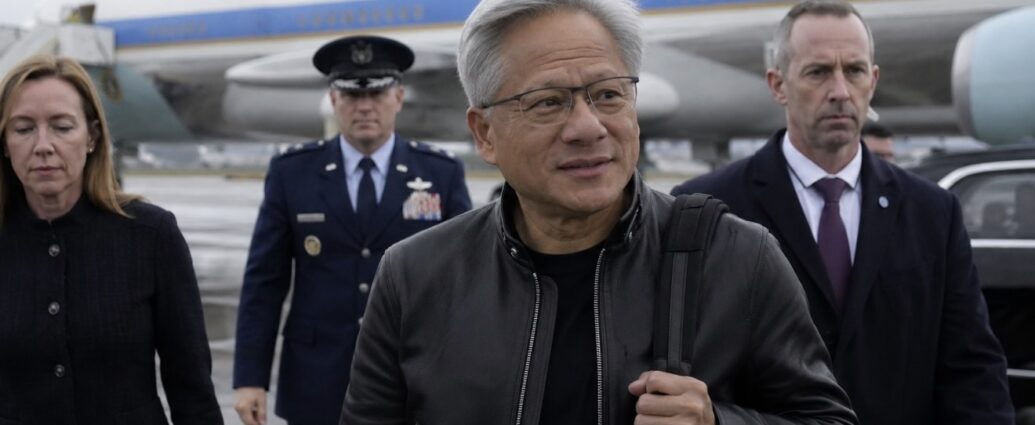
Nvidia Corp. Chief Executive Jensen Huang boarded Air Force One during a refueling stop in Alaska on Tuesday after a personal phone call from President Donald Trump, joining the U.S. delegation traveling to Beijing for meetings with Chinese President Xi Jinping this week — a last-minute reversal by the White House after widespread attention focused on the conspicuous absence of the world’s most important artificial-intelligence executive from the trip.
The decision came after media coverage Monday and Tuesday highlighted that Huang had been left off the administration’s original 17-member CEO delegation despite Nvidia’s central role in the global AI race and the escalating semiconductor battle between Washington and Beijing. After seeing the coverage, President Trump personally called the Nvidia founder and invited him to join the trip, according to a source familiar with the matter cited by CNBC. Huang then traveled to Alaska to board the presidential aircraft before the delegation continued to China.
Nvidia confirmed the executive’s participation in a statement, saying: “Jensen is attending the summit at the invitation of President Trump to support America and the administration’s goals.”
Photos posted on social media by New York Post White House correspondent Emily Goodin showed Huang on the tarmac in Alaska carrying a backpack and waiting to board Air Force One alongside some of the country’s most influential corporate leaders. Also traveling with the president were Tesla and SpaceX Chief Executive Elon Musk, Apple Chief Executive Tim Cook, Boeing Chief Executive Kelly Ortberg, and Goldman Sachs Chief Executive David Solomon. The final delegation includes 17 CEOs, smaller than the 27 executives who accompanied President Trump on his 2017 China visit.
The late addition underscored just how central Nvidia has become not only to Wall Street and Silicon Valley, but also to U.S. economic strategy and geopolitical positioning. Nvidia’s advanced AI chips now power much of the world’s artificial-intelligence infrastructure, including hyperscale data centers, cloud computing networks, sovereign AI projects, and advanced machine-learning systems that governments increasingly view as strategically sensitive technologies.
Asked during a CNBC interview last week whether he would join the trip if invited, Huang replied: “If invited, it would be a privilege — it would be a great honor to represent the United States and to go to China with President Trump.”
Behind the symbolism sits a far more consequential business and geopolitical reality. Nvidia has spent years navigating increasingly aggressive U.S. export controls aimed at limiting China’s access to advanced semiconductors and AI computing systems. Those restrictions have dramatically reshaped one of Nvidia’s most important international markets.
The Trump administration’s April 2025 restrictions on Nvidia’s H20 chip — a version specifically engineered for the Chinese market under prior export-control rules — resulted in what analysts estimated was roughly an $8 billion revenue impact in a single quarter and forced the company to record significant inventory write-downs. China had previously accounted for at least one-fifth of Nvidia’s data-center revenue before the tightening restrictions effectively shut the company out of large portions of the market.
Over the past 18 months, Huang has repeatedly traveled between Washington and Beijing attempting to preserve at least some commercial pathway into China while publicly warning that overly restrictive U.S. policies could accelerate China’s push toward domestic semiconductor independence. His appearances included a high-profile visit to the China International Supply Chain Expo last summer, where he emphasized the importance of maintaining global technology cooperation despite mounting political tensions.
Still, analysts remain skeptical that this week’s summit will produce any major breakthrough for Nvidia or materially loosen semiconductor restrictions.
Hao Hong, chief investment officer at Lotus Asset Management, told CNBC there is “very little” Nvidia is likely to gain in terms of immediate policy concessions because the White House remains deeply reluctant to allow exports of more advanced AI chips into China.
“I think China realized that the tech rivalry between the two countries will be one of the key determinant factors going forward to determine the relative competitive position in the global geopolitics between the two countries,” Hong said. He added that technological “decoupling” between the world’s two largest economies is likely to deepen rather than ease.
For the White House, however, bringing Huang into the delegation carries substantial symbolic and political value. Nvidia’s market capitalization, which crossed $4 trillion last summer, has transformed the company into perhaps the clearest symbol of American AI dominance and technological leadership. Leaving its founder off a presidential trip designed to showcase American corporate power would have raised difficult questions for the administration at a moment when AI leadership has become tightly linked to national competitiveness.
President Trump has repeatedly pointed to Nvidia’s stock performance and America’s broader AI boom as evidence that the U.S. technology sector continues to thrive under his economic agenda despite tariffs, export controls, and rising geopolitical tensions. In a social media post confirming Huang’s participation, the president described it as an honor to have the Nvidia founder and the broader business delegation accompanying him to China.
The meetings between Presidents Trump and Xi on Thursday and Friday are expected to focus heavily on trade, tariffs, semiconductor restrictions, artificial intelligence, Taiwan tensions, and supply-chain security. Officials on both sides have attempted to lower expectations for any sweeping agreement, though negotiators have signaled the talks could still produce narrower commitments involving agricultural purchases, fentanyl-precursor enforcement, and rare-earth mineral supply arrangements.
Those rare-earth discussions are particularly important for companies including Apple, Tesla, and Boeing, all of which remain deeply dependent on Chinese processing capabilities for critical industrial materials and supply-chain components.
For Nvidia investors, the immediate question is whether Huang’s presence inside the room creates any limited opening for future Chinese access to some of the company’s products. The broader question — whether Washington ultimately intends to permanently wall off China from America’s most advanced AI infrastructure — is unlikely to be resolved this week.
But Huang’s presence aboard Air Force One signals something larger already underway: Nvidia is no longer merely a semiconductor company. It has become a central pillar of American economic strategy, diplomacy, and the rapidly intensifying global contest for AI supremacy.
JBizNews Desk
© JBizNews.com. All rights reserved. This article is original reporting by JBizNews Desk. Unauthorized reproduction or redistribution is strictly prohibited.