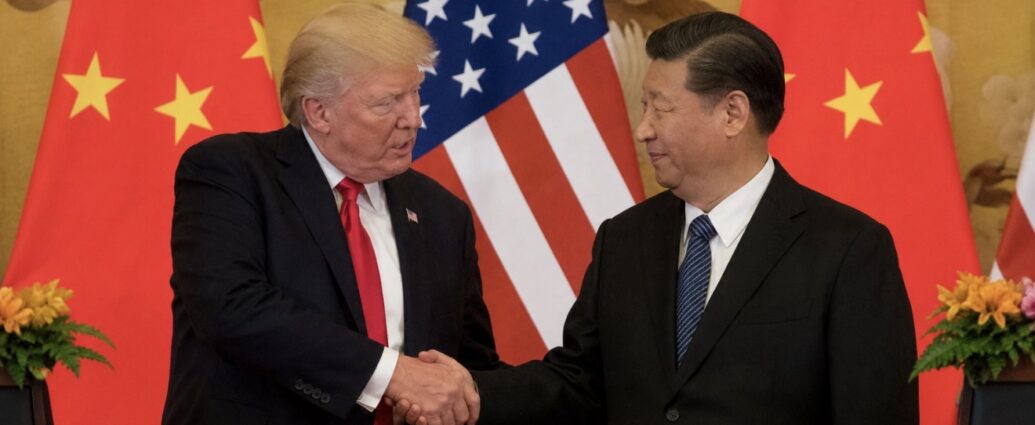
WASHINGTON — President Donald Trump departs Wednesday for Beijing for the first trip to China by a sitting American president in nearly nine years — a high-stakes summit expected to shape the future of global trade, financial markets, technology supply chains, and geopolitical stability far beyond the two countries themselves.
The state visit, scheduled for May 13 through May 15, comes at one of the most fragile moments in U.S.-China relations in years, with tensions surrounding trade, Taiwan, artificial intelligence, rare earth minerals, and the ongoing Iran conflict all converging simultaneously.
China’s foreign ministry formally confirmed the visit Monday, while the White House described the trip as carrying “tremendous symbolic significance.”
Trump is expected to arrive in Beijing on Wednesday evening before attending a formal state welcome ceremony and bilateral meetings with Chinese President Xi Jinping on Thursday, followed by ceremonial events including a visit to the Temple of Heaven and a state banquet.
The trip had originally been planned for March but was postponed after the United States launched military operations tied to the escalating conflict involving Iran and the Strait of Hormuz.
Now, with oil markets under pressure and global supply chains increasingly strained, the summit has taken on even greater economic urgency.
At the center of the discussions will be the future of trade relations between the world’s two largest economies.
Since November 2025, Washington and Beijing have operated under a temporary tariff framework that reduced U.S. tariffs on many Chinese imports to 30%, while China lowered duties on American goods to 10%. That arrangement expires later this year, and markets are closely watching for signals about whether the two governments will extend, revise, or abandon the agreement.
The outcome could directly impact inflation, manufacturing costs, technology pricing, agricultural exports, and corporate investment planning across multiple industries.
American officials are also expected to push aggressively for expanded access to China’s rare earth mineral supply chain — an area where Beijing retains enormous strategic leverage.
Rare earth elements are critical for semiconductor manufacturing, electric vehicles, defense systems, batteries, advanced electronics, and artificial intelligence infrastructure. As demand for those materials accelerates globally, Washington increasingly views dependence on Chinese supply as both an economic and national security vulnerability.
The administration is also reportedly exploring proposals for new bilateral trade management structures, including potential Board of Trade and Board of Investment frameworks designed to oversee non-sensitive commercial activity and reduce friction surrounding cross-border investment.
Officials caution, however, that such mechanisms remain preliminary and may require extended negotiations before becoming operational.
Several major commercial issues are also expected to surface during the summit.
The White House is likely to raise expanded purchases of Boeing aircraft by Chinese carriers alongside increased exports of American agricultural products. Discussions are also expected regarding whether Chinese electric vehicle giant BYD could eventually gain broader access to the U.S. market — an issue carrying major implications for American automakers and the domestic EV sector.
Beyond economics, however, the summit unfolds against an increasingly volatile geopolitical backdrop.
One of the most sensitive issues surrounding the trip has been China’s relationship with Iran.
According to U.S. officials, Beijing has privately assured the Trump administration that it will not supply weapons or military support to Tehran during the ongoing regional conflict. Defense Secretary Pete Hegseth said those assurances were facilitated directly through the relationship between Trump and Xi and helped clear the path for this week’s summit.
The continued disruption of shipping routes tied to the Strait of Hormuz blockade has already driven energy prices sharply higher, increasing pressure on both governments to prevent further instability.
Taiwan will remain the summit’s most politically delicate issue.
Officials in Taipei are closely monitoring whether Trump offers any concessions related to arms sales, diplomatic language, or broader U.S. policy toward the island as part of negotiations with Beijing.
While neither side is expected to announce any dramatic breakthrough, analysts believe even subtle shifts in rhetoric could carry major geopolitical consequences throughout Asia.
The Council on Foreign Relations characterized the summit in advance as an effort primarily aimed at stabilizing relations rather than resolving core disputes — a reflection of how deeply entrenched tensions remain between the two powers.
The trip also carries unusual personal and political optics.
Eric Trump and his wife Lara Trump are expected to accompany the president in a personal capacity, a detail already drawing scrutiny because members of the Trump family continue overseeing broader Trump business interests.
For global markets and corporate leaders, however, the Beijing summit represents something far larger than symbolism.
Virtually every major multinational industry — from semiconductors and technology to agriculture, energy, manufacturing, shipping, automotive production, and consumer goods — has direct exposure to the outcome of U.S.-China relations.
Any signals regarding tariffs, technology restrictions, investment frameworks, rare earth access, or geopolitical cooperation could immediately ripple through financial markets and boardrooms worldwide.
And with the global economy already navigating war-driven energy volatility, AI disruption, and rising trade fragmentation, this week’s meeting between Trump and Xi may become one of the defining economic and geopolitical moments of 2026.
JBizNews Desk
© JBizNews.com. All rights reserved. This article is original reporting by JBizNews Desk. Unauthorized reproduction or redistribution is strictly prohibited.