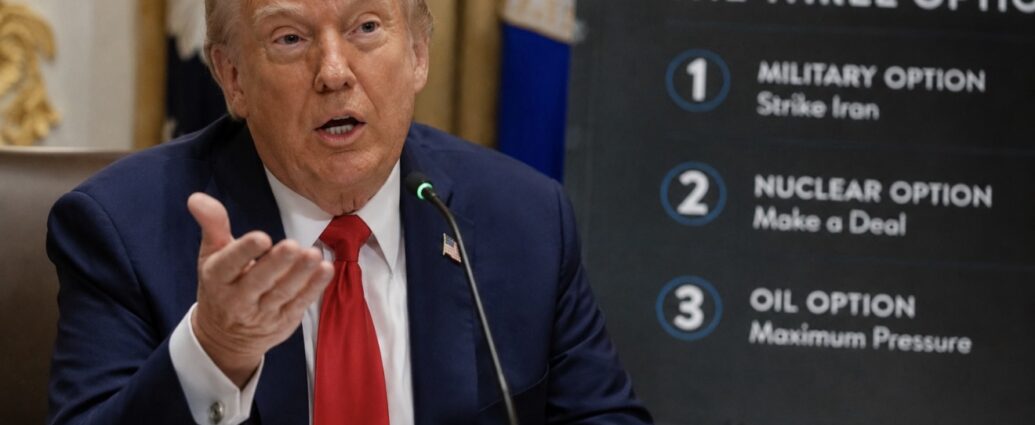
President Donald Trump said the United States has three ways to force an end to the Iran war, and that the one he likes best requires no new military action at all: let Iran run out of money.
Trump laid out the options in a pre-taped interview with Real America’s Voice that aired early Tuesday. The first is to do nothing and wait, on the argument that Iran’s economy fails on its own. The second is to strike Iran hard. The third, in his framing, is to beat Tehran economically — and he described that as something Washington is already doing.
The line that carried the interview was his description of the American position over Iran’s blocked assets. Trump said the United States controls the regime’s money, that there is a lot of it, and that he is Iran’s banker. He also said Iran cannot borrow.
In plain terms, that refers to Iranian government funds and reserves frozen in overseas accounts under U.S. sanctions, plus the banking restrictions that keep Iran from moving oil revenue through the international financial system. Tehran can still sell oil to buyers willing to take the risk, but converting those sales into usable hard currency is the choke point. Releasing blocked assets is one of the conditions Iran has attached to reopening the Strait of Hormuz.
Trump’s claims about how bad things are inside Iran should be read with care. He said the country is running 300 percent inflation, that its currency has almost no value, and that soldiers are not being paid and are leaving. Iranian inflation is severe, but his figures run higher than what his own administration officials have been giving reporters. That gap matters for anyone trying to judge how close the pressure campaign is to producing a result.
The timing of the interview also matters. It follows Trump’s Truth Social post on Monday saying he would demand Iran pay compensation for people the regime killed, as part of any future talks. That demand came after Tehran refused to reopen Hormuz unless Washington agreed to a list of conditions: lifting the naval blockade of Iranian ports, lifting sanctions, releasing blocked assets, withdrawing U.S. troops, and paying war damages. Trump’s compensation demand answers that with a mirror-image claim of his own.
Wire coverage read the week as a shift rather than a new plan. The pivot back to financial pressure comes as U.S. stockpiles of key weapons have thinned and as stop-start talks appear to have stalled again — and sanctions are a slow instrument, built to grind over years rather than end a shooting war on a schedule.
The enforcement side of the economic strategy is running in the meantime. Central Command said on Aug. 9 that U.S. forces had redirected 55 commercial vessels, disabled two ships and boarded two others under the naval blockade of Iranian ports, which was reinstated on July 14 after the ceasefire collapsed in early July. Those numbers are the practical expression of what Trump described in the interview: not strikes, but a cordon around Iran’s ability to move cargo and get paid for it.
The military option he named second is not hypothetical either. Central Command struck Iranian military targets for 13 straight days beginning July 11 and ending July 23, and Trump said on July 24 the military was ready for a far larger attack.
For businesses, the significance is what all this says about how long the disruption lasts. A negotiated reopening of Hormuz would restore the shipping route that normally carries about a fifth of the world’s traded oil. An economic-attrition strategy, by design, does not have an end date — it works by outlasting the other side. Companies with exposure to Gulf shipping, energy costs or Asia-Europe freight are pricing the difference between those two paths every day.
Trump gave no timetable for choosing among the three, and his description of Iranian negotiators as dishonest — he said they agree to terms and then deny it publicly — suggests he does not expect a fast diplomatic close. The two sides signed a memorandum of understanding on June 17, nearly four months after U.S. strikes began on Feb. 28, and it broke down in July.
What Trump is betting is that Iran’s finances give out before the world’s patience with closed shipping lanes does. Nothing in Tuesday’s interview indicated which way that race is running.
JBizNews Desk | Washington
© JBizNews.com All Rights Reserved. Reproduction or distribution without written permission is prohibited.