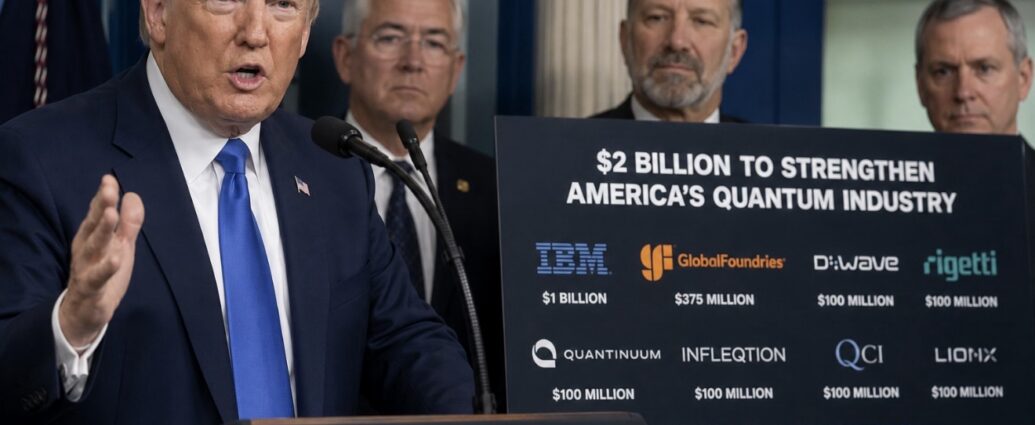
President Donald Trump’s administration is giving roughly $2 billion in federal funding to nine American quantum computing companies while taking ownership stakes in each business, marking one of the most aggressive industrial-policy moves yet in the emerging quantum technology race.
The funding package, announced by Commerce Secretary Howard Lutnick on May 21, 2026, represents a major shift in how Washington supports strategic industries.
Instead of simply issuing grants, the federal government is now becoming a shareholder.
The largest recipient is IBM, which will receive approximately $1 billion tied to quantum computing manufacturing and infrastructure expansion in the United States.
GlobalFoundries will receive roughly $375 million, while companies including D-Wave Quantum, Rigetti Computing, Quantinuum, and Infleqtion are each expected to receive around $100 million.
Additional funding is being distributed among smaller quantum startups and infrastructure firms.
Quantum computing is widely viewed as one of the next major technology frontiers after artificial intelligence.
Unlike traditional computers, which process information using binary bits, quantum computers use quantum bits known as qubits that can process enormous combinations of calculations simultaneously.
The technology remains early and highly experimental, but researchers believe it could eventually transform:
- Drug discovery
- National security
- Materials science
- Logistics
- Financial modeling
- Encryption systems
The administration’s move reflects growing concern in Washington over technological competition with China, which has invested billions into national quantum research programs.
The White House now classifies quantum computing alongside semiconductors, artificial intelligence, and rare earth minerals as core national-security technologies.
The structure of the funding package is what makes the announcement especially significant.
The federal government is not just subsidizing development.
It is taking equity ownership in the companies receiving taxpayer support.
That model mirrors the administration’s earlier investment strategy involving companies including:
- Intel
- MP Materials
- Lithium Americas
- Critical Metals
Supporters argue taxpayers should benefit financially if government-backed technologies become highly valuable.
The administration frequently points to its earlier investment in Intel, where government-owned shares appreciated substantially after the company’s recovery.
Critics argue government ownership creates conflicts of interest when regulators also become shareholders in the same companies they oversee.
IBM confirmed it will match federal support with an additional $1 billion private investment focused on building advanced quantum chip manufacturing infrastructure in the United States.
The company clarified the federal government’s ownership stake applies to a dedicated quantum subsidiary rather than the broader IBM corporation.
Markets reacted immediately after the announcement.
Shares of publicly traded quantum firms including D-Wave Quantum and Rigetti Computing surged sharply following the news as investors interpreted the funding as major federal validation of the sector.
The technology itself still faces enormous challenges.
Quantum computers today remain highly unstable and error-prone.
Most quantum systems require complex error-correction layers simply to maintain calculations long enough to complete useful tasks.
Researchers still debate how quickly commercially viable quantum systems can emerge at scale.
But Washington increasingly views the race itself as strategically important regardless of the exact commercialization timeline.
The funding originates from the CHIPS and Science Act, originally signed into law in 2022.
Under the original framework, most of the money would have been distributed as traditional grants.
The Trump administration restructured the program to require ownership participation in return for federal capital.
Industry leaders largely welcomed the move.
Rebecca Krauthamer, founder of Quantum Thought and CEO of QuSecure, said the announcement reflects a major shift in Washington’s approach to quantum technology.
“The administration’s $2 billion equity stake across nine quantum companies marks the moment Washington stopped treating quantum as a speculative bet and started treating it as critical national infrastructure,” Krauthamer said.
The announcement also signals how aggressively governments globally are now intervening in advanced technology markets.
The United States, China, Europe, and parts of the Middle East are increasingly treating strategic technologies not simply as commercial sectors but as geopolitical assets.
For investors, the move gives the quantum industry significantly stronger financial backing at a time when many companies in the sector remain years away from profitability.
But it also introduces new political considerations into future mergers, acquisitions, and strategic partnerships involving government-backed firms.
The broader message from Washington is becoming increasingly clear.
Quantum computing is no longer viewed as a speculative science experiment.
It is now officially part of American industrial policy.
JBizNews Desk — Washington
© JBizNews.com All Rights Reserved. Reproduction or distribution without written permission is prohibited.