
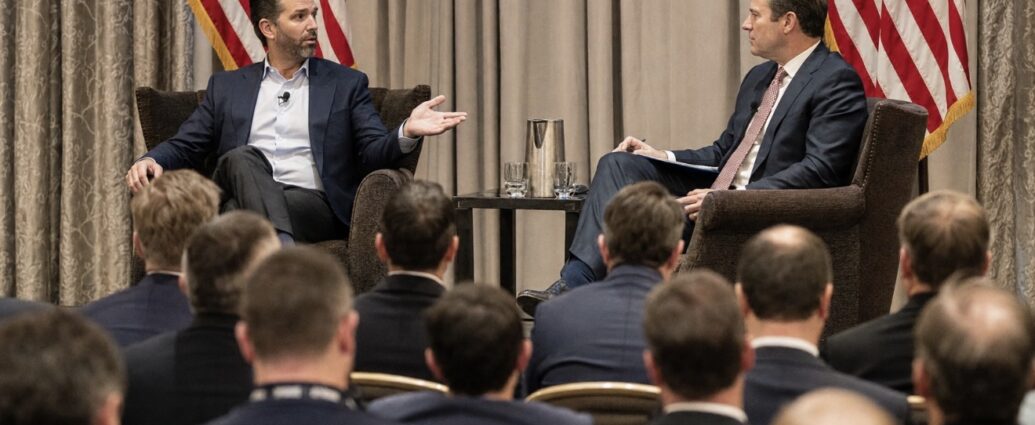
Donald Trump Jr. privately urged Republican state attorneys general to leave prediction markets to federal regulators as states intensify efforts to treat the fast-growing platforms as gambling operations, according to a New York Times report.
The president’s eldest son reportedly made the argument during a closed-door gathering of Republican attorneys general in New Orleans in March. Four people familiar with his remarks told the Times that Trump Jr. accused established gambling companies of attacking prediction markets to protect their own monopolies.
His intervention is attracting scrutiny because he has financial and advisory relationships with the industry’s two most prominent companies, Kalshi and Polymarket.
Kalshi hired Trump Jr. as an adviser in January 2025, with compensation reportedly including more than $300,000 in company shares. He also joined Polymarket’s advisory board after his investment firm, 1789 Capital, acquired a stake in the business.
Prediction markets allow customers to buy contracts tied to the outcome of real-world events, including elections, sporting contests, economic reports and geopolitical developments. Prices fluctuate according to what traders believe is likely to happen, and winning contracts generally settle at $1.
Kalshi and similar platforms argue that these products are federally regulated financial contracts under the Commodity Exchange Act. Kalshi operates as a designated contract market overseen by the Commodity Futures Trading Commission.
State officials and casino regulators see the industry differently. They contend that many contracts—particularly those tied to individual games and player performances—function like ordinary sports bets while avoiding state licensing requirements, consumer safeguards and gambling taxes.
That dispute has produced litigation involving approximately 20 states. Republican and Democratic officials have both challenged prediction-market operators, making the regulatory fight broader than a purely partisan confrontation.
The central legal question is whether federal oversight by the CFTC overrides state gambling laws. Prediction-market companies say allowing each state to impose its own rules would fragment a federally regulated national marketplace. States counter that federal registration cannot be used to convert unauthorized sports betting into a financial product.
Trump Jr. reportedly told the attorneys general that prediction markets already face robust federal oversight and should not be policed as state gambling businesses.
A spokesman for Trump Jr. said he does not communicate with the federal government on behalf of companies in which he invests or serves as an adviser. Kalshi said his role concerns marketing and that he does not advise the company on regulatory policy.
The distinction may not end questions surrounding the appearance of a conflict. State attorneys general are among the officials deciding whether to investigate, prosecute or sue prediction-market companies, and Trump Jr.’s remarks were delivered directly to Republican members of that group while his holdings stood to benefit from reduced state enforcement.
The industry has grown from an election-focused niche into a major competitor to regulated sportsbooks. The outcome of the legal battle will determine not only who oversees prediction markets, but also whether states can collect taxes and enforce age, advertising and consumer-protection rules on billions of dollars in contracts increasingly indistinguishable from conventional betting.
The dispute is likely to move through multiple federal courts and could ultimately require the Supreme Court to decide where federal commodities regulation ends and state gambling authority begins.
JBizNews Desk | New Orleans
© JBizNews.com All Rights Reserved. Reproduction or distribution without written permission is prohibited.




