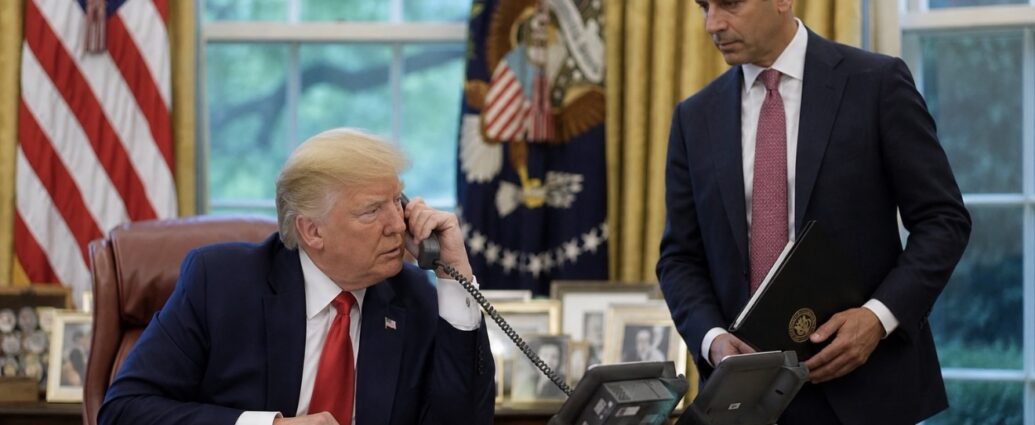
President Donald Trump has been picking up the phone to Federal Reserve Chairman Kevin Warsh, speaking with him by telephone a number of times since Warsh was sworn in this spring, according to people familiar with the conversations. The two have talked multiple times since Warsh was confirmed in May, with the president asking about Warsh’s forecasts and views rather than pressing him toward any particular decision, one person said, speaking anonymously to describe private discussions. Two others described the contact as irregular and infrequent, and it is not clear whether monetary policy itself has come up.
The calls were first reported Thursday by the Wall Street Journal and picked up by Bloomberg. People familiar with the pattern said the president calls in bursts — several times in a single week, then nothing for stretches — and has sought Warsh’s read on how the war with Iran and the buildout of artificial intelligence are hitting the economy. Interest rates themselves have not been part of those discussions since Warsh’s Senate confirmation, according to people cited in the reporting.
The White House said the president has been deliberate about leaving the new chairman room to work. Spokesman Kush Desai said Trump has repeatedly stressed that he is giving Warsh the space he needs to restore confidence in Fed decision-making, and has reaffirmed both the chairman and the central bank’s independence, while retaining the right to voice his own views. The Fed declined to comment.
Here is why business owners and borrowers care about something as ordinary as a phone call. The Federal Reserve sets the short-term interest rate that ripples through nearly every price of credit in the country — business loans, mortgages, car notes, credit card balances. The institution was built so that the officials setting that rate do not answer to whoever occupies the White House, on the theory that borrowing costs decided for political convenience eventually show up as higher inflation. Presidents appoint the chairman and the Senate confirms him, but day-to-day contact between the two offices has traditionally been kept sparse and formal. Calls and meetings between presidents and Fed chairs have happened before, though historically they have been rare.
What makes the current arrangement worth watching is that the two men are publicly on opposite sides of the rate question.
Warsh took over from Jerome Powell in May when Powell’s term expired. Trump nominated him after a year of hammering Powell for not cutting rates fast enough. Warsh, 55, served as a Fed governor from 2006 to 2011, becoming the youngest governor in the institution’s history at 35, and came to the job from the Hoover Institution and Stanford’s business school after calling openly for a shakeup of how the central bank runs.
That shakeup has not yet produced the cheaper money the president wants. At its July 29 meeting the Fed left its benchmark rate in a range of 3.5% to 3.75%, the fifth straight meeting without a change. The vote was 9-3, with the presidents of the Cleveland, Minneapolis and Dallas regional banks dissenting in favor of raising rates a quarter point. That was the most dissents pointing in a single direction since September 2016. Inflation has stayed high largely because of the Iran war and the spike in energy prices that came with it.
Trump’s public reaction to that decision was measured. Asked at the White House whether he was disappointed, he said Warsh is “fantastic, but he’s got a board,” describing the committee as political and inclined to keep rates where they are.
Warsh has been rewriting how the Fed talks to the outside world, shortening its post-meeting statements and stepping back from the practice of telegraphing where rates are headed. He told reporters the Fed has no quick fix for inflation and said he welcomed the internal argument at the July meeting. He also acknowledged that the reduced signaling has moved the bond market, where the 10-year Treasury yield climbed from about 4.50% in mid-June to 4.64% just before the rate decision.
For companies waiting on financing, the practical picture is unchanged by the reporting. Rates are sitting near 3.6%, and about three-quarters of traders expect a rate increase in September — a move up, not down. The next Fed decision comes in September, and the calls, however frequent, have not altered the direction the committee is leaning.
JBizNews Desk | Washington
© JBizNews.com All Rights Reserved. Reproduction or distribution without written permission is prohibited.