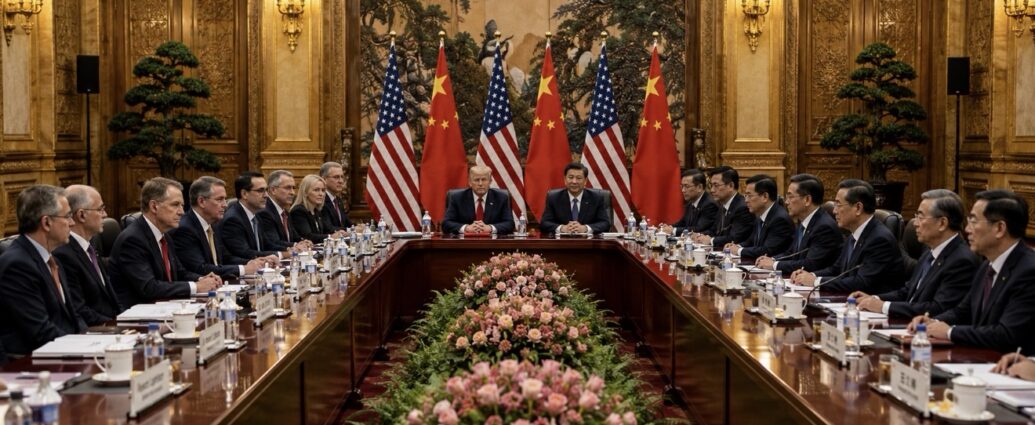
President Donald Trump arrived in Beijing Wednesday for a two-day summit with Chinese President Xi Jinping that could become one of the most consequential U.S.-China meetings in decades, unfolding against the backdrop of war in the Middle East, rising inflation, global supply-chain disruption and growing competition between the world’s two largest economies.
The visit marks Trump’s first trip to China since 2017 and the first visit by a sitting American president to Beijing in nearly nine years.
The summit carries unusually high geopolitical and economic stakes.
The ongoing Iran war has transformed what might otherwise have been a traditional trade and diplomatic meeting into a broader negotiation over energy security, inflation, supply chains and global stability.
The Strait of Hormuz, one of the world’s most critical shipping chokepoints, has remained heavily disrupted since late February, sending oil prices sharply higher and contributing directly to rising inflation pressures now visible across the global economy.
In the United States, April inflation data showed consumer and producer prices accelerating to their fastest pace in years, driven heavily by energy and transportation costs tied to the conflict.
China sits at the center of that equation.
Beijing remains the largest buyer of Iranian crude oil and one of Tehran’s most important economic lifelines, giving Xi significant potential leverage over Iran at a moment when Washington is seeking broader international pressure to reopen shipping lanes and stabilize energy markets.
Whether China is willing to use that leverage — and under what conditions — has emerged as one of the summit’s most important questions.
The optics surrounding the visit are carefully choreographed.
Xi is hosting Trump with full state-level ceremony, including events at the Temple of Heaven, meetings inside the Great Hall of the People and an official state dinner involving senior business leaders and cabinet officials from both countries.
The symbolism echoes Trump’s 2017 Beijing visit, when Xi hosted the American president inside the Forbidden City in what was widely viewed as one of the most elaborate diplomatic welcomes China had extended to a foreign leader in decades.
Behind the ceremony, however, the negotiations are expected to be intensely transactional.
Trump arrived with a delegation heavily focused on trade, manufacturing, energy and technology.
Executives traveling with the president include Apple CEO Tim Cook, Tesla CEO Elon Musk, Nvidia CEO Jensen Huang, BlackRock CEO Larry Fink, Blackstone Chairman Stephen Schwarzman, Citigroup CEO Jane Fraser, Cargill CEO Brian Sikes and Boeing CEO Kelly Ortberg.
Several major commercial agreements are reportedly already nearing completion.
Among the largest is a possible Boeing aircraft package involving hundreds of jets for Chinese airlines, potentially valued at more than $100 billion depending on final structure and delivery schedules.
Agricultural negotiations are also central to the summit.
Cargill and other U.S. agriculture groups are reportedly seeking multiyear Chinese purchase commitments covering soybeans, beef, poultry and energy exports — agreements designed both to stabilize trade flows and provide political wins for the White House ahead of the 2026 midterm cycle.
Technology and tariffs remain another major focus.
Apple’s previously announced $600 billion American Manufacturing Program has already secured the company substantial tariff protections under the Trump administration’s industrial policy framework, and other CEOs in the delegation are closely studying that model as they navigate future trade exposure.
Artificial intelligence, semiconductors and export controls are also expected to dominate portions of the negotiations.
The broader strategic relationship remains deeply complicated.
China continues pursuing long-term technological independence in semiconductors, AI and advanced manufacturing while simultaneously attempting to preserve access to U.S. consumer markets and global capital flows.
At the same time, tensions surrounding Taiwan remain unresolved, with Beijing continuing military and political pressure aimed at reducing American influence in the region.
Inside Washington, the business community itself is increasingly divided over China.
The U.S. Chamber of Commerce released a sharply worded assessment just before the summit warning that Beijing’s state-driven industrial strategy is rapidly reshaping global competition and arguing that American policymakers may have only a narrow remaining window to respond effectively.
That message reflects a growing shift inside portions of corporate America away from the deep economic integration model that dominated earlier decades.
Even so, both governments appear motivated — at least temporarily — to stabilize relations.
The late-2025 Busan APEC truce, which paused portions of the escalating tariff conflict between Washington and Beijing, is set to expire later this year.
Extending that framework while producing visible economic deliverables has become a priority for both sides.
For Xi, the summit arrives during a difficult domestic economic environment marked by property-sector weakness, soft consumer demand and rising pressure on employment and capital flows.
For Trump, the trip offers an opportunity to project global economic leadership while seeking relief from inflationary pressures now affecting American consumers and financial markets.
Analysts remain cautious about expecting major political breakthroughs.
Most observers anticipate incremental agreements rather than sweeping structural changes.
The larger question is whether any commercial commitments announced during the summit ultimately translate into durable implementation after the headlines fade.
For markets, however, the significance of the meeting is already clear.
The trajectory of global trade, inflation, energy flows, semiconductor policy and supply-chain stability increasingly depends on the ability of Washington and Beijing to manage competition without allowing it to spiral into deeper economic confrontation.
And for now, that future is being negotiated inside the Great Hall of the People.
JBizNews Desk
© JBizNews.com. All rights reserved. This article is original reporting by JBizNews Desk. Unauthorized reproduction or redistribution is strictly prohibited.