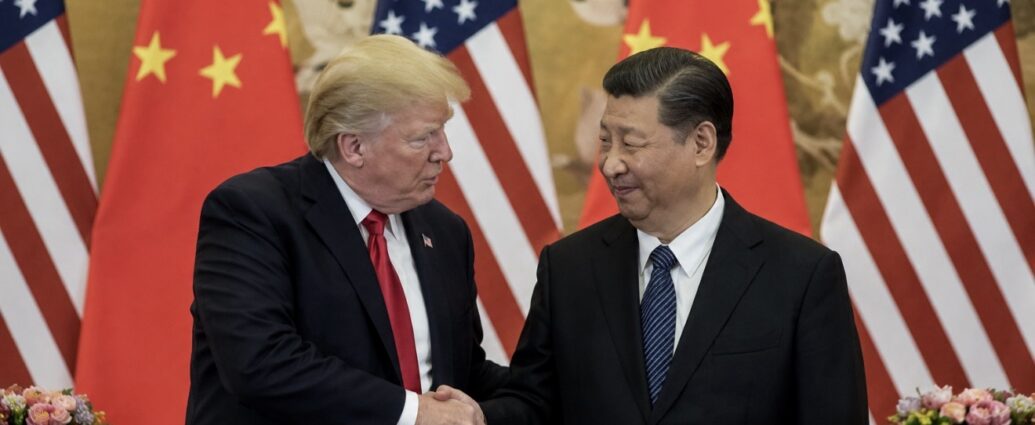
President Donald Trump opened his high-stakes summit with Chinese President Xi Jinping at the Great Hall of the People in Beijing on Thursday with an unusually warm declaration that the world’s most consequential bilateral relationship is about to enter a new phase.
“It’s an honor to be with you. It’s an honor to be your friend, and the relationship between China and the USA is going to be better than ever before,” Trump told Xi at the start of formal talks, according to live coverage by CNN and CBS News before reporters were escorted from the room.
The comments, delivered after an elaborate state welcome ceremony featuring a People’s Liberation Army military band, flag-waving schoolchildren, a red-carpet honor guard review, and ceremonial cannon fire in Tiananmen Square, set a notably conciliatory tone for a summit unfolding at one of the most sensitive moments in U.S.-China economic relations in years.
Trump also described Xi as a “great leader,” acknowledging that critics dislike the phrase but insisting, “I say it anyway, because it’s true.” The visit marks Trump’s first trip to China since 2017 and the first state visit to Beijing by a sitting U.S. president in nearly a decade.
The size and composition of the U.S. delegation underscored the summit’s economic significance. According to CBS News coverage of the welcoming ceremony, Trump arrived alongside U.S. Trade Representative Jamieson Greer, Defense Secretary Pete Hegseth, Treasury Secretary Scott Bessent, Secretary of State Marco Rubio, and U.S. Ambassador to China David Perdue.
The delegation also included several of America’s most prominent technology and industrial executives, among them Tesla and SpaceX Chief Executive Elon Musk, Nvidia Chief Executive Jensen Huang, and outgoing Apple Chief Executive Tim Cook. Huang joined the delegation at the last minute after concerns surfaced publicly over his initial absence from the trip.
Thursday’s schedule includes a bilateral working session, a cultural visit to the Temple of Heaven, and a formal state banquet before negotiations continue Friday. The agenda spans some of the most consequential issues in the global economy, including rare-earth exports, AI semiconductor restrictions, Taiwan, the Iran conflict, and potential expansion of Chinese purchases of U.S. energy and agricultural products.
According to a summit preview by Council on Foreign Relations senior fellow Rush Doshi, expectations remain more restrained than during Trump’s 2017 visit, when Xi staged what observers called a “state visit-plus,” complete with a private Forbidden City dinner, major ceremonial displays, and announcements of more than $250 billion in business agreements.
This year’s summit instead arrives amid escalating geopolitical strain and fragile trade ties. The most immediate issue is likely the future of the rare-earth export framework negotiated during last year’s APEC summit in Busan, South Korea.
Under that temporary arrangement, Beijing agreed to ease restrictions on rare-earth materials critical to American manufacturing in exchange for the United States softening several threatened tariffs. According to Foreign Policy and the Center for Strategic and International Studies, both governments appear motivated to preserve the arrangement after Chinese restrictions last year caused U.S.-bound rare-earth magnet exports to collapse roughly 93% year over year.
Those materials remain essential for electric vehicles, advanced weapons systems, semiconductors, data centers, and industrial manufacturing.
Trump is also expected to unveil a new bilateral “Board of Trade” composed of senior officials from both governments to oversee implementation of future agreements, according to analysis from CSIS senior adviser Scott Kennedy and China Power Project director Bonny Lin. The proposal is intended to address longstanding U.S. complaints that Beijing failed to fully implement commitments made under the Phase One trade agreement signed during Trump’s first term.
China has reportedly pushed for a parallel “Board of Investment” focused on easing barriers to Chinese investment in the United States.
Hovering over the summit is the unresolved war with Iran and the ongoing disruption of oil shipments through the Strait of Hormuz. The U.S. Navy continues intercepting vessels connected to Iranian exports, many of them ultimately destined for China, which remains Tehran’s largest oil customer.
Secretary of State Marco Rubio said earlier this week that Iran would feature prominently in discussions. “We’ve made clear to them that any support for Iran would obviously be detrimental for our relationship,” Rubio told Fox News.
Analysts have interpreted recent diplomatic outreach between Beijing and Tehran as an effort by Xi to position China as a potential intermediary in efforts to reopen the Strait of Hormuz — an outcome that would stabilize energy markets and benefit both economies.
Taiwan remains perhaps the summit’s most politically sensitive issue. Officials in Taipei are closely monitoring whether the Trump administration signals any shift in language surrounding cross-strait relations or future U.S. arms support.
Trump disclosed last week that Taiwan came up during a February call with Xi, fueling speculation that Beijing may seek concessions tied to trade or investment negotiations.
For now, however, the public optics from Beijing have been carefully calibrated toward stability: smiling exchanges, ceremonial pageantry, and a public pledge from Trump that ties between the two countries will become “better than ever.”
Whether the atmosphere translates into substantive agreements — particularly on trade, rare earths, semiconductors, and energy — will become clearer Friday when the summit’s concrete outcomes are expected to emerge.
JBizNews Desk
© JBizNews.com. All rights reserved. This article is original reporting by JBizNews Desk. Unauthorized reproduction or redistribution is strictly prohibited.