President Donald Trump privately complained to acting Attorney General Todd Blanche about media leaks stemming from the U.S.-Iran war, according to administration officials familiar with the matter, setting in motion an aggressive campaign at the Department of Justice to investigate journalists, subpoena news organizations, and root out government officials who spoke to the press — a crackdown that press freedom advocates have called one of the most sweeping assaults on the First Amendment in modern presidential history.
The private complaints to Blanche, delivered last month as a stream of damaging stories emerged about the administration’s handling of the Iran conflict, prompted a sharp escalation in leak investigation activity at the DOJ that has now become one of the defining institutional features of the second Trump administration.
The president’s dissatisfaction was driven in significant part by a series of media reports that exposed deep fissures within his own inner circle over the decision to go to war. Senior White House officials were reportedly having “buyer’s remorse” over the Iran war, with a source close to the administration telling Axios that key officials had not been fully on board with Trump’s plans before the president overruled them all.
“He ended up saying, ‘I just want to do it,’” the source said. “He grossly overestimated his ability to topple the regime short of sending in ground troops.”
That disclosure — along with a cascade of classified operational details that appeared in Axios, The Washington Post, Reuters, and other outlets — infuriated the president, according to officials familiar with his private conversations.
The most explosive incident came in early April, when an F-15E Strike Eagle was shot down over Iran during combat operations and one of the two-person crew, a Weapons Systems Officer, was left stranded deep inside Iranian territory. Before the U.S. government had mounted a rescue, the story of the missing second airman appeared publicly in the press.
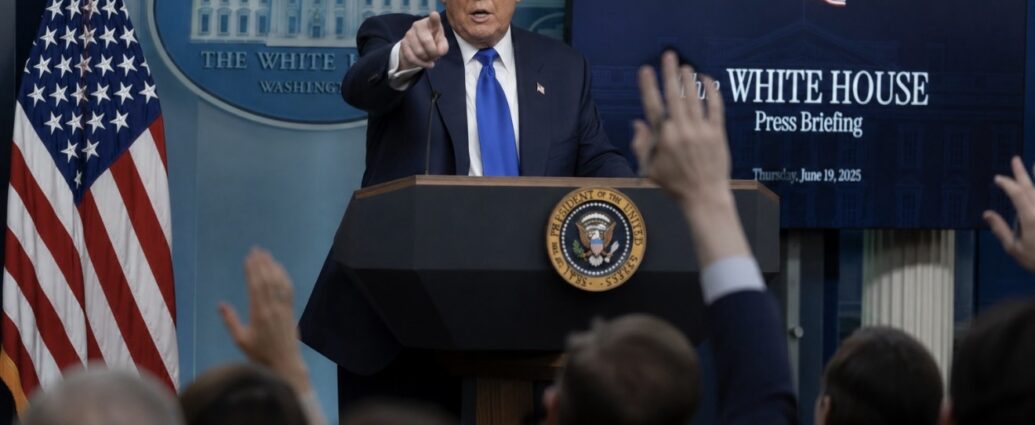
Trump later told reporters in the White House Briefing Room that “all of a sudden the entire country of Iran knew that there was a pilot that was somewhere on their land, fighting for his life,” and threatened that his administration would go to the media company responsible and say, “national security — give it up or go to jail.”
The comments immediately sparked backlash from press freedom organizations and constitutional law scholars.
Jameel Jaffer, Executive Director of the Knight First Amendment Institute at Columbia University, responded: “News organizations have a First Amendment right to publish stories about matters of public importance — including stories the government would prefer to suppress. President Trump’s threat to force journalists to disclose their sources raises serious press freedom concerns because journalists’ ability to do their work turns in part on their ability to protect their sources’ identities.”
Blanche, who became acting attorney general in April after Trump dismissed former Attorney General Pam Bondi amid controversy surrounding the handling of the Epstein files, publicly confirmed the administration’s hardening approach toward leak investigations the following day.
Asked whether the DOJ was investigating the F-15E disclosures, Blanche said: “I will never comment on ongoing investigations. I think that, to the extent that we have seen a series of leaks that necessarily involve classified information and put the lives of our soldiers or agents at risk, that is something we will always investigate.”
“And we will investigate, even if it means sending a subpoena to the reporter,” Blanche added. “That’s exactly what we should do, and that’s exactly what we will be doing.”
The legal groundwork for that strategy had already been established earlier under Bondi.
As attorney general, Bondi rescinded Biden administration protections that had limited prosecutors from secretly seizing journalists’ phone records or aggressively compelling reporters to reveal confidential sources during leak investigations.
The revised DOJ guidance authorized prosecutors to issue subpoenas to journalists, execute search warrants involving media organizations, and compel testimony tied to national security leaks.
“The Justice Department will not tolerate unauthorized disclosures that undermine President Trump’s policies, victimize government agencies, and cause harm to the American people,” Bondi wrote in the policy memorandum.
The administration has already moved aggressively under the expanded rules.
Washington Post reporter Hannah Natanson reportedly had her Virginia home searched by FBI agents earlier this year as part of a leak-related investigation. Separately, federal prosecutors in Maryland charged a former government contractor accused of sharing national security information with a journalist, with Bondi publicly stating the case had been pursued “at the request” of the Pentagon.
The Iran war has also fundamentally altered relations between the Pentagon and the press corps.
The Department of Defense implemented new credentialing requirements obligating reporters to commit to publishing only officially sanctioned operational information. Multiple journalists and media organizations refused, with dozens surrendering Pentagon credentials rather than accept the restrictions.
After legal challenges led by The New York Times, a federal judge ordered certain press credentials reinstated. In response, the Pentagon announced plans to remove permanent media offices from inside its headquarters altogether, relocating journalists to a separate annex outside the main building.
Blanche’s tenure has simultaneously been marked by an expansion of politically sensitive investigations beyond the leak cases.
He has approved probes involving former CIA Director John Brennan, former White House aide Cassidy Hutchinson, Democratic fundraising platform ActBlue, and the Southern Poverty Law Center, while appointing longtime Trump ally Joseph diGenova to oversee the Brennan investigation.
According to individuals familiar with the matter, more than 150 subpoenas have already been issued in the Brennan inquiry alone, including subpoenas involving former FBI Director James Comey, with additional rounds expected.
For businesses, multinational corporations, financial institutions and investors that rely heavily on independent reporting about national security, trade policy, military conflicts and geopolitical decision-making, the escalating confrontation between the administration and the press carries significant economic implications.
Market analysts note that reduced transparency surrounding government actions can increase uncertainty around energy markets, sanctions policy, tariffs, military operations and international supply chains — particularly during periods of geopolitical instability.
Critics warn that an environment in which reporters face subpoenas and sources risk criminal prosecution may discourage whistleblowers and reduce the flow of independent information into financial markets and public discourse.
The White House, however, has shown no indication of softening its position.
Trump has repeatedly argued that national security leaks tied to the Iran war endangered American lives and undermined military operations, while Blanche has signaled the DOJ intends to continue pursuing aggressive leak investigations regardless of media backlash.
As the administration deepens its confrontation with major news organizations, the battle over press freedom, classified information, and the limits of executive power is rapidly becoming one of the defining constitutional and institutional conflicts of Trump’s second term.
JBizNews Desk
© JBizNews.com. All rights reserved. This article is original reporting by JBizNews Desk. Unauthorized reproduction or redistribution is strictly prohibited.