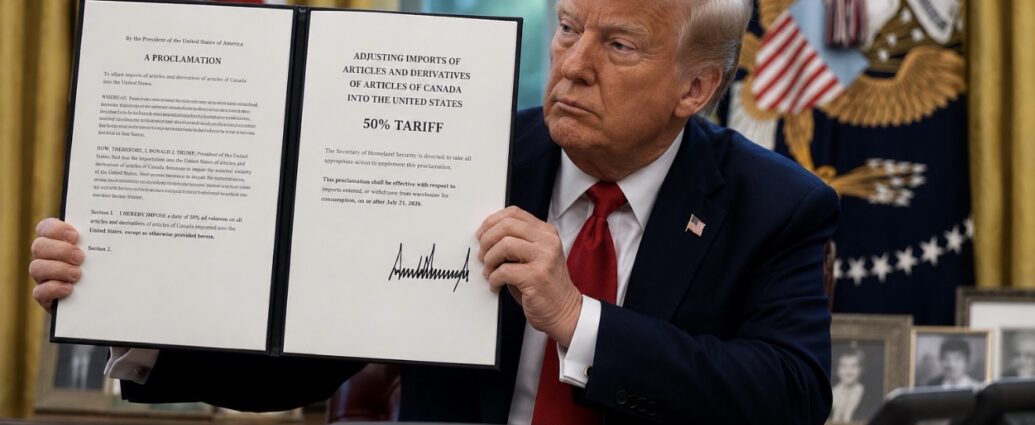
President Donald Trump has invoked Section 338 of the Tariff Act of 1930 — a provision on the books for nearly a century but never once used to actually impose tariffs — to place an additional 50% duty on roughly $20 billion in Canadian imports, opening a new front in his trade agenda and a fresh legal question over how far presidential tariff power reaches.
The proclamations, signed Monday, target a broad slice of Canadian goods running from wine, cement and furniture to autos, dairy products and alcohol. A White House fact sheet described the coverage as spanning everything “from wine to hockey sticks to cement,” with the dairy list reaching various milks, creams, whey, lactose and cheeses. The duties are set to take effect in roughly 30 days, putting them on track to land in August, ahead of the holiday shopping season.
Section 338 lets the president impose tariffs of up to 50% on goods from countries found to discriminate against U.S. commerce. Trump chose the maximum penalty the statute allows. The administration frames the action as a response to Canada’s decision to retaliate against earlier U.S. tariffs — a step officials note only China had otherwise taken. U.S. Trade Representative Jamieson Greer described the new duties as a direct consequence of that retaliation in a Tuesday morning interview, casting them as the natural result of Ottawa’s countermeasures rather than an opening salvo.
What makes the move unusual is the tool itself. Section 338 sits inside the 1930 law commonly known as Smoot-Hawley, the tariff act frequently blamed for deepening the Great Depression. This particular provision, though, was threatened over the decades but never triggered. A 2016 legal analysis found no public record of the section being invoked since 1949, and senior administration officials acknowledged to reporters that using it this way has no precedent. One official, speaking on background, conceded the novel use could draw a court challenge but argued the situation “fits squarely with what the statute allows.”
The timing is not accidental. The administration turned to Section 338 after courts earlier this year narrowed the emergency tariff powers Trump had leaned on, and after the Supreme Court ruled against the use of those emergency authorities for the so-called “Liberation Day” tariffs. That decision sent the White House hunting for alternative legal footing. Section 338 offers a faster path than other trade tools — the Section 232 national security route and the Section 301 unfair-trade statute both require investigations and public comment periods that can stretch for months. The stopgap 10% global levy the White House imposed under Section 122 to replace many invalidated tariffs happens to expire this Friday, adding urgency to the search for durable authority.
For American consumers, the duties carry a direct cost. Landing on autos, alcohol and dairy just as holiday spending ramps up, the tariffs raise the prospect of higher shelf prices and add to inflation pressure at a moment when energy costs are already elevated by conflict in the Middle East. One market strategist estimated the measure would lift the average tariff rate on Canadian goods by about 2.3 percentage points. The political exposure is real too, with the added costs arriving before November’s midterm elections — a vulnerability some lawmakers have flagged in past efforts to repeal Section 338 over worries about its potential for misuse.
The larger significance lies in what the maneuver signals to the rest of the world. The discrimination rationale at the heart of Section 338 is built for reciprocal disputes, and Trump has long complained that trading partners charge higher import rates than the United States. The European Union’s 10% tariff on passenger cars — four times the 2.5% U.S. rate — has been a recurring irritant, and trade attorneys point to the bloc as a logical next target for the same argument now being tested on Canada. In that sense, Ottawa is less the endpoint than the proving ground.
Canadian Prime Minister Mark Carney criticized the tariffs as the latest in a series of U.S. actions straining an already tense relationship. Whether Canada answers with a legal challenge, further retaliation, or both will shape the next month before the duties bite. The broader renegotiation of the USMCA framework, now potentially extending for years, remains the central venue for resolving the underlying fights over dairy, autos and alcohol that prompted Monday’s move.
For now, businesses and foreign governments are left to absorb a familiar lesson from this White House: even when a specific tariff is delayed or struck down, the willingness to reach for untested authority keeps the threat alive — and keeps companies planning for higher costs.
JBizNews Desk | Washington, D.C.
© JBizNews.com All Rights Reserved. Reproduction or distribution without written permission is prohibited.