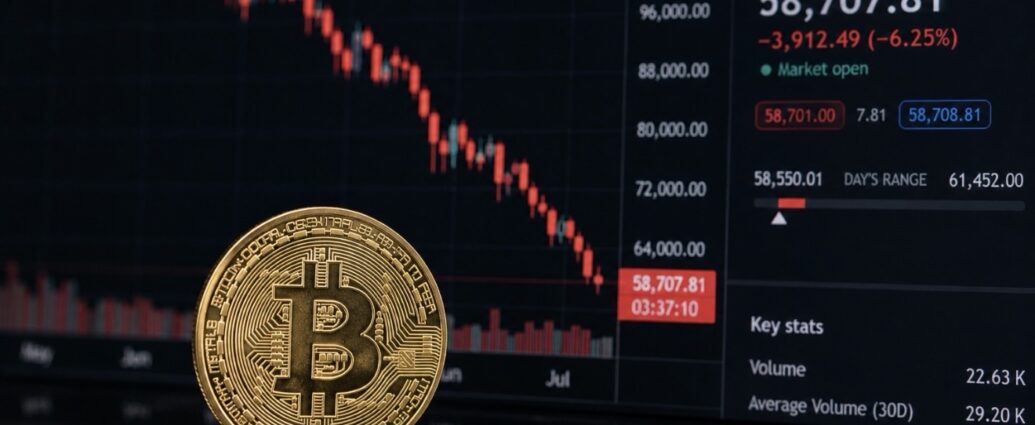
Bitcoin sank below $59,000 this week, its weakest level since September 2024, capping a brutal stretch that has cut the price in half despite a Washington that has never been friendlier to digital assets. On Wednesday, Citigroup slashed its 12-month Bitcoin target to $82,000 from $112,000 and its Ethereum target to $2,240 from $3,175, blaming vanishing demand, a wall of fund outflows and stalled crypto legislation.
The drop is striking because it comes under a president who campaigned as crypto’s champion. President Donald Trump promised to make the United States the crypto capital of the world, installed regulators friendly to the industry, and backed efforts to write digital assets into federal law. Yet Bitcoin has fallen roughly 50% from its record high of about $126,000, reached in October 2025, and the coins that rode Trump’s endorsement into the mainstream are now leading the market lower.
The clearest culprit is money leaving the exchange-traded funds that were supposed to make crypto safer and more mainstream. U.S. spot Bitcoin ETFs lost about $4.5 billion in June, according to industry fund-flow data, marking their worst month since launching in early 2024 and pushing total 2026 flows into negative territory for the first time. Those funds were major buyers on the way up. Now the same mechanism is working in reverse, amplifying each new wave of selling.
Citigroup analysts outlined the shift in their research note. The bank cut its assumption for net ETF inflows over the coming year to zero, down from an earlier forecast of $10 billion, warning that the pipeline of new institutional money has largely dried up. One reason, the bank said, is that the CLARITY Act—legislation designed to provide regulatory certainty for institutional crypto investors—remains stalled in the Senate. In a more pessimistic scenario involving continued fund outflows and a weakening economy, Citi sees Bitcoin falling to approximately $53,000.
Investor confidence also took a hit from an unexpected source.
Strategy, formerly known as MicroStrategy, which built its reputation on continuously accumulating Bitcoin, sold a portion of its holdings for the first time since 2022. Executive Chairman Michael Saylor previously indicated the company might sell assets to cover dividend obligations and demonstrate financial flexibility if necessary. Even so, the move unsettled investors who had viewed Strategy as Bitcoin’s most unwavering corporate supporter. The company remains the world’s largest corporate Bitcoin holder, owning approximately 843,700 coins.
The broader economic backdrop has done little to help.
The Federal Reserve, under Chair Kevin Warsh, has maintained benchmark interest rates in the 3.50% to 3.75% range, keeping financial conditions relatively tight and making speculative assets such as cryptocurrencies less attractive. At the same time, investor enthusiasm has shifted toward artificial intelligence, with much of Wall Street’s risk capital flowing into semiconductor companies, AI infrastructure and data centers instead of digital assets.
The weakness extends beyond Bitcoin.
Ethereum has fallen to around $1,600, its lowest level since April 2025, while many smaller cryptocurrencies have suffered even steeper losses. The Crypto Fear & Greed Index, a closely watched measure of investor sentiment, has dropped to 11, deep inside “extreme fear” territory. Blockchain data also indicates that more than half of all Bitcoin currently in circulation is being held at a loss, a condition that has historically appeared only during periods of severe market stress.
For everyday investors, the lesson remains familiar.
Political support and favorable headlines do not override the basic forces that ultimately drive financial markets: interest rates, investor demand and capital flows. A supportive White House may have provided the cryptocurrency industry with greater legitimacy and regulatory access, but it cannot create buyers or eliminate the effects of higher borrowing costs.
Some analysts believe Bitcoin is approaching a market bottom and argue that much of the recent selling has already been priced in. Others warn that if the $58,000 support level fails, the next leg lower could come quickly.
What appears increasingly clear is that cryptocurrency’s direction over the remainder of 2026 will depend less on politics than on market fundamentals—whether ETF inflows return, whether the Federal Reserve begins easing monetary policy, and whether investors regain confidence in digital assets.
JBizNews Desk | New York
© JBizNews.com All Rights Reserved. Reproduction or distribution without written permission is prohibited.