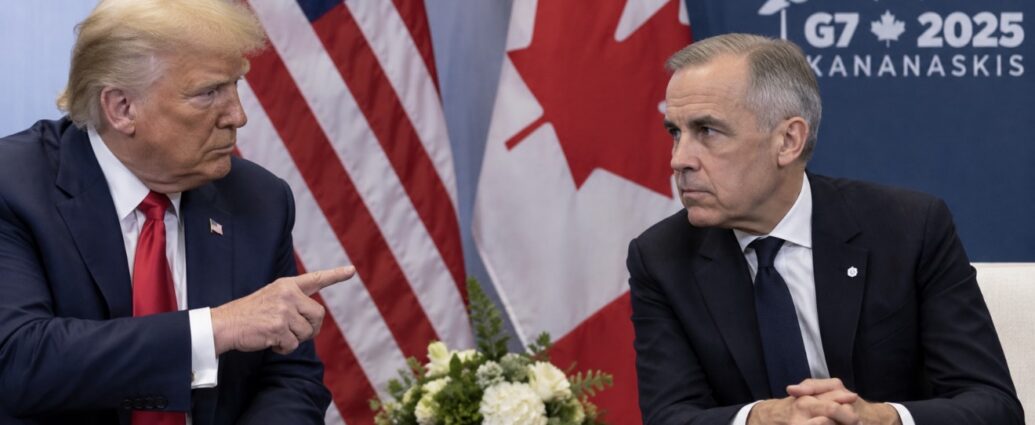
President Donald Trump is taking aim at the Canadian dollar, declaring the long-standing difference between the two countries’ currencies unacceptable as Washington and Ottawa move deeper into an escalating trade confrontation.
President Donald Trump opened a new front in the U.S.-Canada economic dispute Sunday, criticizing the value of Canada’s currency relative to the U.S. dollar and signaling that exchange rates could become another issue in already-fractured trade negotiations.
“Canada’s Dollar imbalance with the U.S. is unacceptable,” Trump wrote Sunday, adding that the situation had existed for years but would no longer be tolerated.
Trump did not announce a specific currency action or explain what exchange rate he believes would be appropriate.
But the statement immediately raises the possibility that Washington could begin pressing Ottawa over the Canadian dollar as part of broader trade negotiations.
The Canadian dollar recently traded around C$1.38 for one U.S. dollar, meaning one Canadian dollar buys roughly 72 U.S. cents.
That difference itself is not unusual.
Currencies trade at different nominal values for many reasons, including interest rates, inflation expectations, economic growth, commodity prices and investor demand.
What matters economically is whether a government is deliberately keeping its currency artificially weak to make exports cheaper.
Trump’s remarks suggest the administration may increasingly view Canada’s exchange rate through the same lens it has used when criticizing trade imbalances with other countries.
The comments arrive at an especially sensitive moment.
U.S.-Canada trade negotiations recently broke down after Ottawa rejected American demands it considered unacceptable.
The United States has already imposed 50% tariffs on tens of billions of dollars of Canadian goods, while Canada is preparing to retaliate with its own tariffs beginning September 8.
Ottawa says its countermeasures will cover C$27.6 billion of U.S. imports, with tariffs ranging from 15% to 50%.
Products affected include steel, dairy goods, appliances, agricultural equipment, pulp and paper, plastics and electronics.
The currency dispute could make finding a compromise even harder.
Canada sends roughly two-thirds of its exports to the United States, making the U.S. market enormously important to Canadian manufacturers, energy companies and agricultural producers.
A weaker Canadian dollar can help exporters because their goods become cheaper for American buyers.
But it also makes U.S. products more expensive for Canadians and raises the cost of imported equipment and materials.
The latest Canadian trade numbers already show the pressure building.
Canada’s merchandise trade surplus fell sharply to C$769 million in July from C$4.2 billion in June, while exports to the United States dropped 6.6%.
The Canadian dollar has also been under pressure because of the escalating trade dispute.
Foreign-exchange strategists surveyed recently expect the currency to remain relatively weak in the near term, although many believe it could strengthen if tensions with Washington eventually ease.
What It Means for You
This could become much bigger than a disagreement over whether one dollar is worth more than another.
If the White House formally makes the Canadian dollar part of trade negotiations, Washington could begin demanding policies intended to strengthen Canada’s currency or compensate American companies for what it considers an exchange-rate disadvantage.
That could affect autos, steel, lumber, agriculture, energy and manufacturing — industries where U.S. and Canadian supply chains are deeply interconnected.
For American consumers, the risk is straightforward.
More tariffs or currency-related trade restrictions can increase the cost of Canadian products entering the United States.
For Canadian companies, a stronger currency could make exports less competitive just as they are already dealing with sharply higher U.S. tariffs.
And for investors, Trump’s statement introduces another variable into one of the world’s largest trading relationships.
The U.S.-Canada dispute began with tariffs.
It expanded into autos, banking and government procurement.
Now the Canadian dollar itself is on the table.
That means the economic fight between America and its largest northern trading partner may be entering a new — and potentially more complicated — phase.
JBizNews Desk | New York
© JBizNews.com All Rights Reserved. Reproduction or distribution without written permission is prohibited.