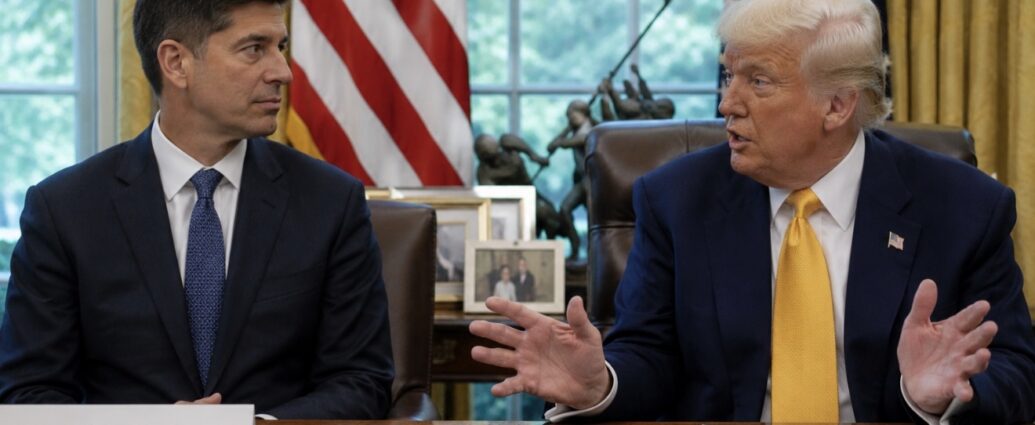
President Donald Trump said Thursday that Federal Reserve Chairman Kevin Warsh should have the freedom to lower interest rates but faces resistance from other policymakers at the central bank, adding new political pressure as signs emerge that the U.S. job market is slowing.
Speaking during an Oval Office interview with CNBC’s Joe Kernen, Trump said Warsh “has to do what he has to do,” while suggesting the Fed chairman privately favors lower rates but is dealing with a board that is resistant to changing policy.
The comments came just hours after the Bureau of Labor Statistics reported that employers added only 57,000 jobs in June, a much weaker hiring pace that immediately reignited debate over whether the Federal Reserve could begin cutting interest rates later this year.
Trump nominated Warsh to lead the Federal Reserve earlier this year. The U.S. Senate confirmed him on May 13, and he was sworn into office on May 22.
Since taking over, Warsh has led a central bank that has kept its benchmark interest rate in a range of 3.50% to 3.75%, where it has remained since late 2025.
During the interview, Kernen asked whether the weaker jobs report gives the Fed more room to reduce rates after investors had recently worried the next move could instead be another increase.
Trump responded that he believes Warsh is a capable chairman who would like to ease policy but suggested other members of the Federal Reserve Board are pushing in a different direction.
The president again made clear that he wants borrowing costs to come down.
The remarks contrast with the Federal Reserve’s most recent policy meeting on June 17, when officials left interest rates unchanged for a fourth consecutive meeting.
Updated economic projections released after that meeting showed policymakers becoming more cautious about inflation, with nine of the eighteen officials submitting forecasts expecting at least one interest-rate increase before the end of the year.
Inflation remains well above the Fed’s long-term 2% target.
Consumer prices increased at an annual rate of 4.2% in May, driven in part by higher energy costs following the conflict involving Iran, reinforcing the central bank’s concern that inflation pressures have not fully subsided.
Warsh has consistently emphasized that future policy decisions will depend on incoming economic data rather than political pressure.
Since becoming chairman, he has said restoring price stability remains the Federal Reserve’s primary objective and declined to provide detailed forward guidance about future interest-rate decisions.
Thursday’s weaker employment report nevertheless shifted expectations across financial markets.
Investors who had recently priced in the possibility of another rate increase scaled back those expectations, with some now anticipating the Federal Reserve could lower rates before the end of the year.
The next meeting of the Federal Open Market Committee is scheduled for July 28–29.
Lower interest rates generally reduce borrowing costs for consumers and businesses, making mortgages, auto loans, credit cards, and business financing less expensive while often supporting stock prices.
During the same interview, Trump argued that Wall Street’s reaction to economic data has fundamentally changed.
He said strong economic reports now sometimes push stocks lower because investors believe solid data reduces the likelihood of Federal Reserve rate cuts—a reversal from the traditional relationship between economic strength and market performance.
Trump also renewed his criticism of Federal Reserve Governor Lisa Cook, saying he intends to pursue her removal after the U.S. Supreme Court returned a related case on procedural grounds earlier this week rather than ruling on its merits.
Meanwhile, former Fed Chair Jerome Powell continues serving as a member of the Federal Reserve Board, underscoring the continuing evolution of the central bank’s leadership.
For businesses and consumers, the Federal Reserve’s next move carries enormous financial consequences.
Interest-rate decisions directly affect borrowing costs, corporate investment, housing affordability, consumer spending, and stock market valuations. As the economy shows signs of slowing while inflation remains elevated, investors will closely watch the July meeting to see whether Chairman Kevin Warsh begins moving toward the lower rates President Trump continues to advocate.
JBizNews Desk | Washington
© JBizNews.com All Rights Reserved. Reproduction or distribution without written permission is prohibited.