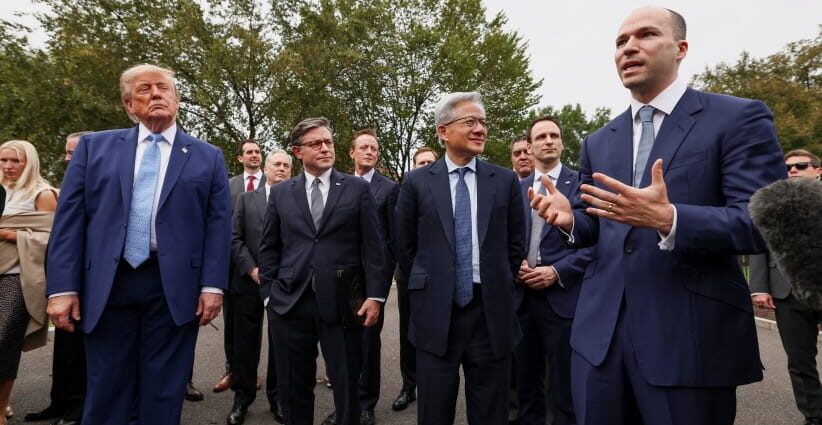
US President Donald Trump said Tuesday that Iran would eventually give up, although he stopped short of predicting when, during remarks at a White House event attended by leading technology executives.
Asked whether Iran was about to concede, Trump replied: “Well, they’re doing very poorly. I don’t know if they’re going to give up yet, but they’ll give up, but they’re doing very poorly.”
He also claimed that more oil had moved through the Strait of Hormuz over the preceding two days than at any previous point in history, including before the war.
Trump made the remarks following a luncheon for tech leaders and artificial intelligence (AI) moguls held in the White House’s East Room.
The US president did not provide figures to substantiate the claim. He reiterated that preventing Iran from acquiring a nuclear weapon remained the central objective of the military campaign.
“Iran will not have a nuclear,” he said, ending the sentence without completing the phrase.
The remarks came during an event largely devoted to artificial intelligence, which Trump wants to rename “superintelligence,” or SI.
Trump: Kim Jong Un ‘happens to be a friend of mine’
Trump returned to the nuclear issue when a reporter asked why North Korea had been allowed to develop nuclear weapons while the United States was determined to prevent Iran from obtaining them.
“Ah, that’s interesting. You know why? Because you had a different president, and they could have stopped him,” Trump replied, blaming his predecessors for failing to halt Pyongyang’s nuclear program.
He then spoke about his personal relationship with North Korean leader Kim Jong Un.
“He happens to be a friend of mine, Kim Jong Un. He’s a friend of mine. He likes Trump. Doesn’t like a lot of other people,” Trump said.
“I’m about the only person in the entire world that he likes, and I like him. I get in a lot of heat when I say that.”
Trump acknowledged that North Korea possesses a substantial nuclear capability.
“He does have a nuclear capacity, a large nuclear, pretty large nuclear. Not like us, but he has a nuclear capacity,” he said.
He again contrasted the situation with his approach to Iran, saying previous presidents “didn’t do what I did.”
Trump criticizes UK over RAF Fairford suspects
The president also addressed an investigation near RAF Fairford, a British airbase used by US forces, including for operations involving Iran.
Trump said American authorities had been involved in the investigation and criticized the decision to release five arrested men on bail.
“How do you give bail to a terrorist?” he asked, referring to the suspects.
“They put them out on bail. I assume they have them watched closely. But these were serious people, seriously bad people, and they should not have done that.”
British counterterrorism police said Tuesday that no improvised explosive devices had been found during the investigation, although petrol had been recovered from vehicles. The five men remain under investigation following their release on bail. Police have said the decision was made as part of their investigative strategy.
Authorities are examining several possible explanations for the incident, including whether individuals may have been acting on behalf of a foreign state. An Iranian connection has not been established, and Iran has denied involvement.
Xi meeting and the race for AI
Trump said his recent meeting with Chinese President Xi Jinping had been discussed with the technology executives gathered at the White House.
“We had a great meeting with President Xi. A lot of respect for President Xi,” he said.
The discussion then turned to competition between the United States and China over AI infrastructure.
Trump argued that American companies must be able to build data centers domestically rather than move projects overseas.
“If we’re not smart, they’ll end up building data centers in other countries, and those other countries will make a fortune, and we won’t,” he said.
He suggested that China would welcome American investment that failed to materialize in the United States.
“Elon and I sat with President Xi the other day, and he will take every data center that we don’t want,” Trump said, referring to Elon Musk.
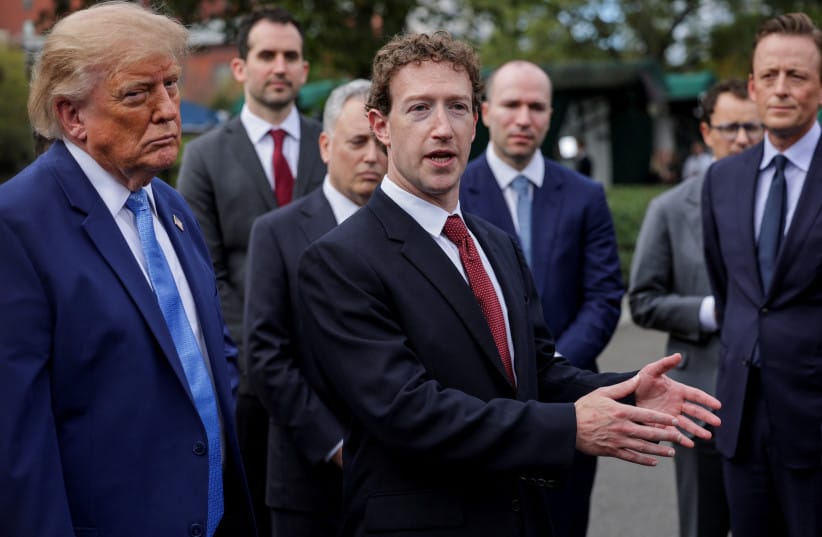
Trump also praised the American technology industry’s position in the global AI race.
“Our companies are dominating the world,” he said. “They’re dominating China. They’re dominating everyone. We want to keep it that way.”
The White House said following Xi’s recent visit that the two countries had agreed to use the term “superintelligence” and establish a dialogue on the technology’s risks and benefits.
Musk predicts ‘an age of abundance’
Musk was asked what superintelligence could mean for workers concerned that their jobs may disappear.
“I think by far the most likely outcome is an age of abundance, where we don’t have just universal basic income. We have universal high income,” he said.
Musk argued that advances in robotics and superintelligence could eventually make medical care far more widely available.
Pressed on what people would do without jobs, he said: “Well, jobs are going to change. Jobs have always changed.”
He compared the potential transition to the disappearance of jobs once devoted to performing calculations by hand, work that is now done by computers.
Not every executive offered an unqualifiedly optimistic view.
Anthropic CEO Dario Amodei emphasized that AI presents significant risks alongside its benefits.
“I think the technology has very real risks, and you know, the mechanism by which we address those risks is still under discussion,” he said.
Meta CEO Mark Zuckerberg described an agreement among industry leaders on internal controls, outside audits and independent reviews by company boards. He characterized the commitments as an initial step rather than a complete solution.
Trump, meanwhile, expressed confidence that the companies had strong incentives to ensure their products were safe.
“If something goes wrong, their companies are at stake,” he said. “They’re not going to let that happen.”
The exchanges illustrated how an event intended to promote America’s technological ambitions became a forum for questions extending from AI safety and competition with China to the Iran war and security concerns in Britain.