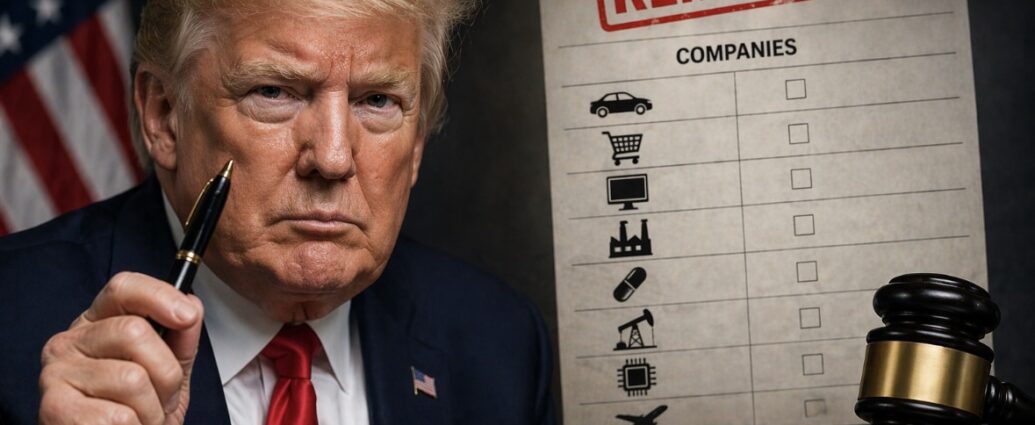
President Donald Trump said he will be paying attention to whether major companies seek refunds tied to tariffs that the U.S. Supreme Court ruled unlawful, injecting a new political calculation into a decision that could affect some of the country’s largest importers. In an interview with CNBC on April 21, Trump said, “It’s brilliant if they don’t do that,” adding, “If they don’t do that, I will remember them,” in remarks that immediately raised questions about how corporate America will balance fiduciary duties against White House pressure, as reported by CNBC.
The legal backdrop traces to the long-running fight over Trump-era tariffs imposed under emergency and trade authorities, with importers arguing the government collected duties it had no lawful basis to impose. In prior coverage of tariff litigation, Reuters reported that companies challenging the measures sought to recover billions of dollars in duties, and court records in trade cases before the U.S. Court of International Trade and subsequent appeals have shown how high the stakes remain for retailers, manufacturers and technology groups with global supply chains. While the latest Supreme Court ruling framed the immediate refund question, the broader issue for business centers on whether companies now act on a legal right that could invite political scrutiny.
Neither Amazon nor Apple has publicly said whether it plans to pursue refunds, leaving investors and trade lawyers to parse the significance of Trump’s comments. Amazon declined to comment, and Apple did not immediately respond to requests from multiple media outlets, according to reports carried by CNBC and other U.S. news organizations. That silence matters because both companies sit at the center of U.S.-China trade flows, and any move to reclaim tariff payments could become a test of how large multinationals manage relations with a president who has repeatedly used tariffs as both economic policy and political leverage.
Trade lawyers have long said refund claims in customs disputes are not optional in the ordinary course of business but part of a company’s duty to protect shareholder interests when a court invalidates a levy. In public commentary on tariff litigation, attorneys cited by Reuters and Bloomberg have said importers typically face strict deadlines and procedural requirements to preserve claims, meaning hesitation can carry a real financial cost. That practical reality could put in-house legal teams and boards in a difficult position if they conclude that seeking reimbursement makes economic sense even as the White House signals displeasure.
The episode also underscores how tariff policy continues to blur the line between trade enforcement and corporate diplomacy. Trump has repeatedly defended tariffs as a tool to rebuild domestic industry and pressure trading partners, telling CNBC in the same interview that tariffs remain central to his economic approach. Economists at institutions including the Peterson Institute for International Economics and the Tax Foundation have said in prior analyses that tariffs often function as a tax on importers and consumers, even when policymakers present them as a cost borne by foreign producers. Those findings help explain why refund claims could matter not just to company earnings but also to pricing, margins and supply-chain decisions across sectors from electronics to consumer goods.
For Apple, the politics carry particular weight because the company’s manufacturing footprint in China and broader Asia has made it a frequent target in Washington’s trade debates. Apple Chief Executive Tim Cook has previously said on earnings calls that the company evaluates tariff impacts carefully and works to manage supply-chain exposure, according to transcripts carried by financial data providers and reported by outlets including Reuters. For Amazon, whose marketplace and retail operations touch a vast range of imported products, any tariff reimbursement could ripple through cost structures that affect third-party sellers as well as the company’s own retail economics, analysts cited by CNBC and MarketWatch have noted in past trade coverage.
The market significance extends beyond two companies. Public filings and customs litigation over the past several years show that a wide range of importers, from industrial manufacturers to apparel groups, challenged tariff collections and preserved their rights to refunds. In prior reporting on customs disputes, Bloomberg said successful claims could unlock substantial repayments for companies that kept protests and cases alive through the courts. If some businesses now decide not to pursue those claims, investors may ask whether management put politics ahead of recoverable cash, especially at a time when many companies continue to cite trade uncertainty, input costs and consumer sensitivity in quarterly guidance.
What happens next will depend on the fine print of the court ruling, refund procedures at U.S. Customs and Border Protection, and whether companies judge the legal and financial upside to outweigh the political risk. Customs and Border Protection has said in prior guidance that importers seeking duty corrections or refunds must follow established protest and liquidation processes, and trade attorneys say those windows can be narrow. With Trump making clear on CNBC that he is watching, the next moves by Amazon, Apple and other major importers could become an early measure of how corporate America plans to navigate a second Trump-era tariff regime in which legal rights, boardroom obligations and presidential pressure increasingly collide.
JBizNews Desk