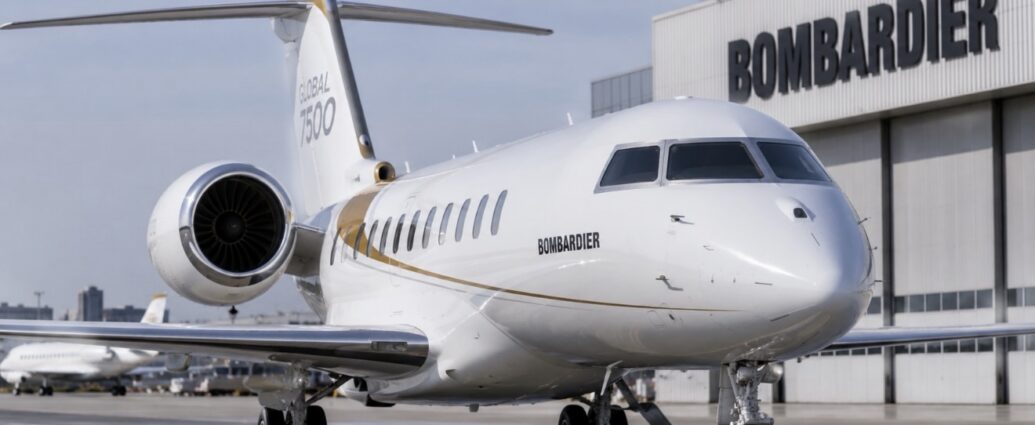
President Donald Trump is escalating his pressure campaign against Canada, warning Bombardier that it will not be allowed to keep selling aircraft into the U.S. market unless it manufactures them in America.
Trump said Monday that Canadian aircraft maker Bombardier should no longer be allowed to sell in the United States unless it begins building planes in the country, opening another front in the widening U.S.-Canada trade dispute.
“NO MORE SELLING BOMBARDIER IN THE UNITED STATES!” Trump wrote, adding that if the company wants access to the American market, “they must build here.”
The White House has not yet explained how such a restriction would be implemented or whether it would take the form of tariffs, certification changes, procurement limits or another trade measure.
That distinction matters.
For now, Trump’s statement is a political and trade warning — not yet a fully detailed regulatory action.
Bombardier is particularly exposed because the United States is one of its most important markets.
Roughly half of the company’s approximately 5,100-aircraft global fleet is operated by U.S. customers, making American access central to its business.
Bombardier does already have an American footprint.
The company operates facilities in the United States, including a defense operation in Wichita, Kansas, but its primary aircraft manufacturing remains centered in Canada.
Trump’s demand therefore goes beyond simply asking the company to invest more in the United States.
He is effectively saying that access to American customers should be tied to where the aircraft themselves are built.
The confrontation did not begin Monday.
Earlier this year, Trump threatened to impose 50% tariffs on Canadian-made aircraft and said the United States would move to decertify Bombardier Global Express business jets unless Canadian regulators approved several aircraft manufactured by U.S. rival Gulfstream.
Those threats were never fully carried out.
Canada later certified several Gulfstream aircraft.
But the latest statement shows that Bombardier remains directly in the administration’s crosshairs.
The timing is important.
Canada and the United States are already locked in a broader tariff fight involving steel, autos, agriculture and other manufactured goods.
Ottawa is preparing new retaliatory tariffs on American imports, while Washington continues pressing Canadian companies to shift more production south of the border.
Bombardier has also been expanding strategically.
The company recently announced plans to acquire a Canadian wing-manufacturing facility, strengthening its control over a key part of its aerospace supply chain.
Its latest quarterly revenue rose approximately 6%, helped by strong aftermarket-services demand.
What It Means for You
This is the clearest example yet of how Trump wants to use access to the U.S. market as leverage to force foreign manufacturers to move production into America.
The message is simple:
If you want American customers, build in America.
For Bombardier, the stakes are enormous because the U.S. market is too large to simply walk away from.
For aerospace suppliers, however, the pressure could create opportunities.
If Bombardier ultimately shifts more manufacturing into the United States, that could mean new factories, jobs and contracts for American suppliers.
But there is also risk.
Aircraft manufacturing depends on deeply integrated international supply chains, and abrupt trade restrictions can raise costs, delay deliveries and create uncertainty for customers who have already ordered planes.
The bigger issue is that Washington is increasingly applying the same strategy across multiple industries:
Autos. Steel. Pharmaceuticals. Semiconductors. Aerospace.
Trump is making market access conditional on domestic investment.
Bombardier may now become one of the highest-profile tests yet of whether that strategy actually forces companies to move production — or simply pushes the U.S. and Canada deeper into a costly trade fight.
JBizNews Desk | New York
© JBizNews.com All Rights Reserved. Reproduction or distribution without written permission is prohibited.